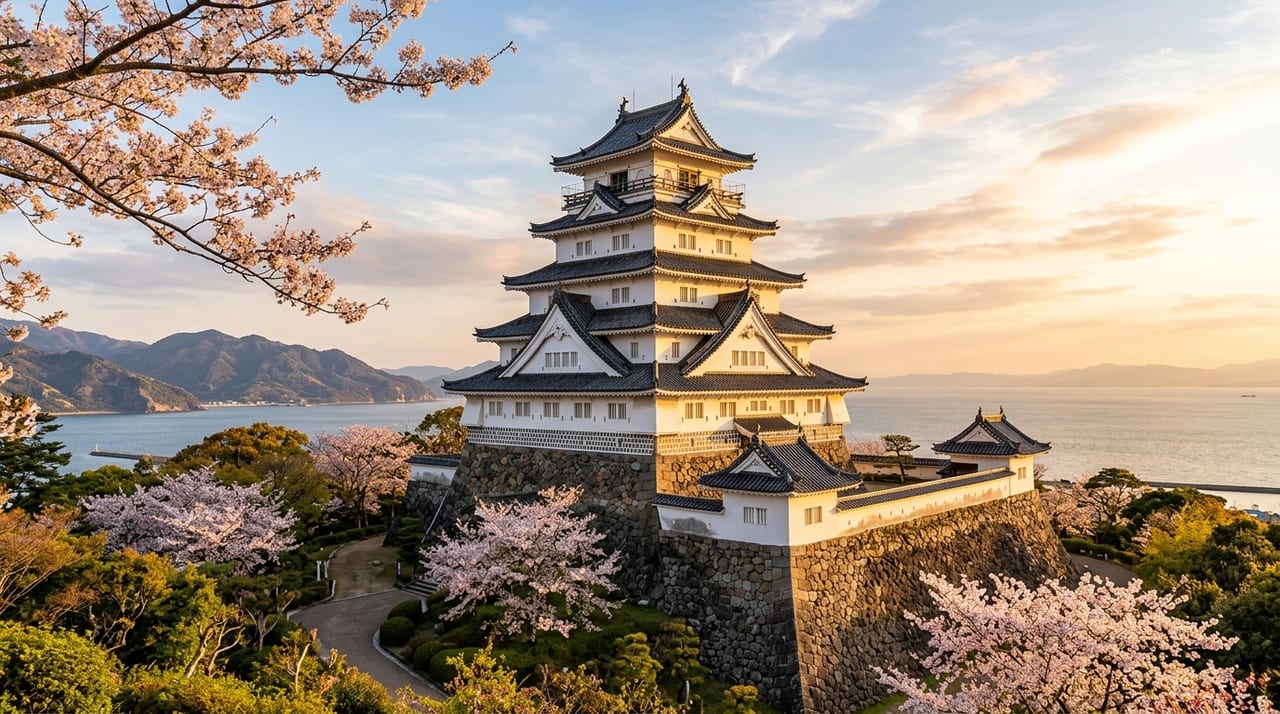
 * Image is for illustrative purposes only.
Kaneda Castle
金田城
Kaneda Castle is a historic castle in the Kyūshū region (Built in 667 (6th year of Emperor Tenji's reign)). Its lord was Built under the imperial order of Emperor Tenji and the Yamato court.
Overview
Overview
Kaneda Castle is an ancient mountain fortress built on Jōyama, a 276-meter peak jutting into Asō Bay in Mitsushima, Tsushima City, Nagasaki Prefecture. According to the Nihon Shoki, it was built in 667 — four years after the allied forces of Yamato and Baekje suffered a crushing defeat against the combined Tang and Silla fleet at the Battle of Baekgang in 663 — together with Takayasu Castle in Yamato and Yashima Castle in Sanuki, as part of a coastal defense network guarding against a feared Tang-Silla invasion.
Structure
Built in the Korean mountain-fortress style, the castle's stone ramparts, made of locally quarried quartz porphyry, extend roughly 2.8 kilometers and, where they keep their original form, reach 6 to 7 meters in height. Well-preserved remains include the First through Third Jōko gate ruins, the South Gate, building foundations on Mount Bingushi, and earthen ramparts — testimony to the border defenses built by ancient sakimori frontier guards overlooking the Tsushima Strait.
Layered with a Modern Fortress
Before the Russo-Japanese War, the Imperial Japanese Army re-fortified the site, and modern gun emplacement ruins still survive on the mountain, making Kaneda a rare case where an ancient Korean-style mountain castle and a modern fortress coexist in layers on the same peak.
Present State
It was designated a National Special Historic Site in 1982, and the Second Jōko gate and the South Gate have since been excavated and restored. In 2017 it was selected as one of Japan's Continued 100 Fine Castles.
Connection to Swords
No swords themselves have been excavated at Kaneda Castle, but archaeological surveys have recovered smithing-related artifacts alongside Sue and Haji pottery, indicating that ironworking to repair and maintain weapons and armor took place within this ancient fortress garrisoned by sakimori frontier guards. As a frontline defense base built after the defeat at Baekgang, maintaining arms was essential to the guards' duties. Nearby Ōkido Shrine at the foot of the mountain also preserves seven bronze halberds from the Yayoi period said to have been unearthed on the castle mountain, now a Nagasaki Prefecture Tangible Cultural Property.
Highlights
- Sannojōko Gate — gate and water-gate remains set in stone ramparts of massive boulders
- South Gate and the First–Third Jōko gates — Korean-style stone ramparts and gate ruins
- Bingushi-yama building ruins — foundations of ancient structures
- Modern gun emplacement ruins — fortifications built by the Imperial Japanese Army before the Russo-Japanese War
- Continued 100 Fine Castles — selected in 2017
* Opening hours and admission fees are subject to change. Please check the official website before visiting.