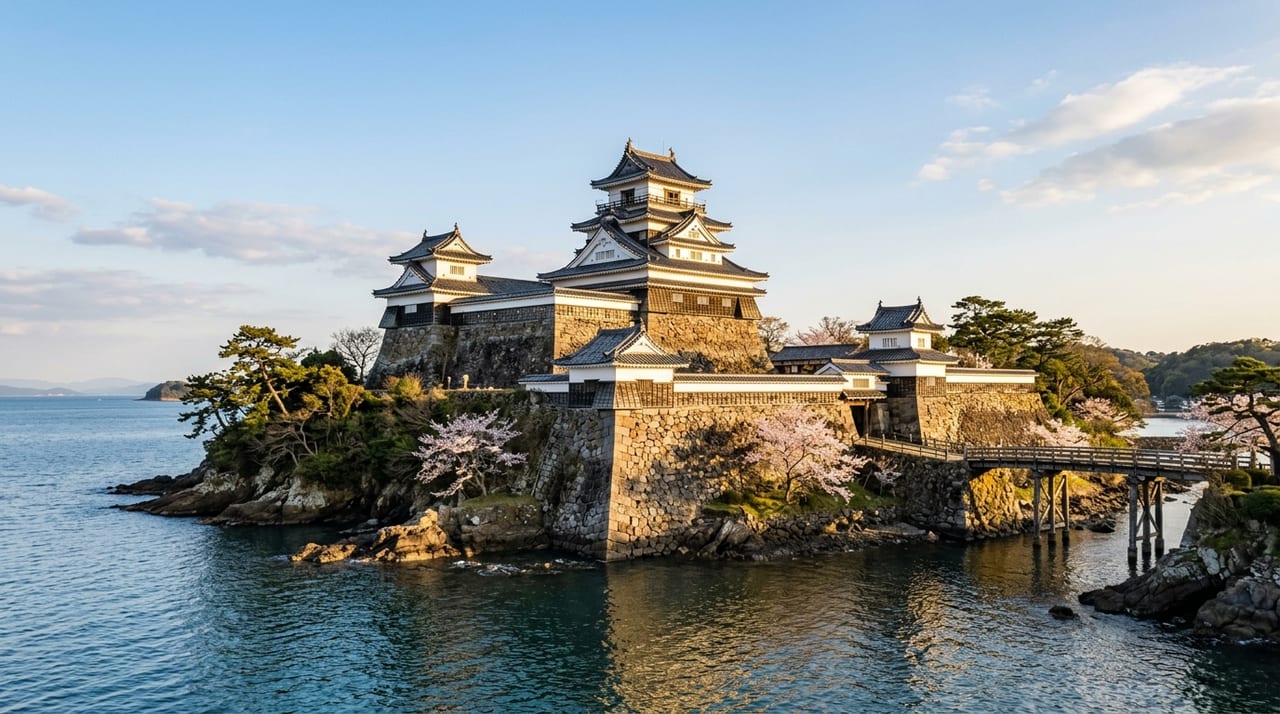
 * Image is for illustrative purposes only.
Usuki Castle
臼杵城
Usuki Castle is a historic castle in the Kyūshū region (Built around 1557 (Kōji 3; several theories exist)). Its lord was Ōtomo Sōrin / Ōta Kazuyoshi / Inaba clan.
Overview
About the Castle
Usuki Castle is a sea castle (suijō) located in Usuki City, Ōita Prefecture. It was built by the Christian daimyō Ōtomo Sōrin around 1557 (Kōji 3; several theories exist) on a rocky island floating in Usuki Bay. Sōrin ruled six provinces: Bungo (Ōita), Chikuzen (northern Fukuoka), Buzen (eastern Fukuoka and northern Ōita), Hizen (Saga and Nagasaki), Higo (Kumamoto), and Chikugo (southern Fukuoka). He was the most powerful sengoku daimyō in Kyushu, and at his peak he held influence over two-thirds of the island. Usuki Castle was a strategically important castle that Sōrin chose to strengthen his control over his retainers and as a base for foreign trade. At high tide, it was surrounded by the sea on all sides and functioned as a natural fortress.
A Castle of a Christian Daimyō
Ōtomo Sōrin actively welcomed the missionary work of the Jesuits. In 1551 (Tenbun 20), he received Francis Xavier in Bungo Funai (present-day Ōita City). In 1578 (Tenshō 6), Sōrin converted to Christianity under the baptismal name “Francisco,” and afterward became known as a fervent Christian. Christian facilities, such as a training center (shūrenjo), were built in the Usuki castle town, and the castle was said to contain a chapel. Nanban culture flourished through trade with Portuguese merchants. Nanban goods brought from abroad, including firearms, gunpowder, glassware, clocks, and carpets, gathered in Usuki, Sōrin's seat, and formed one of the most international castle towns in sengoku Japan.
Glory and Downfall of the Ōtomo Clan
In 1586 (Tenshō 14), Shimazu Yoshihisa of Satsuma advanced north aiming to unify Kyushu, invading the Ōtomo domains one after another. Sōrin asked Toyotomi Hideyoshi for help. In the following year, 1587 (Tenshō 15), the Shimazu surrendered after Hideyoshi's Kyushu campaign. However, Sōrin died of illness in the 5th month of Tenshō 15 (1587) in Tsukumi, in the midst of this war, and the Ōtomo family rapidly declined. After the Ōtomo family was stripped of its domains, Fukuhara Naotaka and Ōta Kazuyoshi served as castle lords. After the Battle of Sekigahara, in 1600 (Keichō 5), Inaba Sadamichi took up his fief, and from then on, through the Edo period, the Inaba family governed Usuki's 50,000 koku.
Castle Remains and Castle Town
Today, the ruins of Usuki Castle retain stone walls, moats, earthen bridges (dobashi), and other remains. The sites of the Ninomaru and Honmaru are beloved by citizens as “Usuki Park.” Usuki is also nationally famous for its stone Buddhas (Usuki Stone Buddhas). The group of rock-carved Buddhas designated as National Treasures speaks to the depth of Buddhist culture. In the castle town of Usuki, samurai residences, merchant houses, and soy sauce warehouses from the domain era remain, conveying the atmosphere of Edo to the present day. Usuki's soy sauce is highly regarded nationwide, and local soy sauce breweries such as Fundokin Soy Sauce continue to brew with great care today. Usuki, where the culture introduced by nanban traders in Sōrin's era merged with Bungo's traditions, attracts many travelers as one of the most historically and culturally rich castle towns in Kyushu.
An International Cultural Heritage
Usuki Castle is an outstanding witness to the extent of international exchange in sengoku-period Japan. As the stage of history left behind by Sōrin, it stands as a representative of Kyushu's castle culture. Ōtomo Sōrin's eventful life, from Kyushu's most powerful daimyō to a Christian who lived for his faith, continues to inspire many historical novels and dramas, steadily enhancing Usuki Castle's historical presence.
Connection to Swords
The sword culture of Ōtomo Sōrin and Usuki Castle can be understood from the perspective of how Japan's sengoku-era transformation through exchange with the nanban (Portuguese and Spanish) embodies a turning point in the history of the Japanese sword. Sōrin was one of the forward-thinking daimyō who quickly adopted the firearms introduced to Tanegashima in 1543 (Tenbun 12) as a military force. Through trade with Portuguese merchants, he secured a stable supply of gunpowder and lead. The spread of firearms brought a major transformation to the role of the Japanese sword, yet at the same time Sōrin was also a patron of traditional sword culture. Bungo swordsmiths held a distinctive position within Kyushu's sword culture, and the Takata school, based in Takata (present-day Ōita City), is well known. It is also said that Sōrin himself owned famous swords as family treasures. Contact with foreign cultures through nanban trade extended even to the designs of sword fittings. So-called nanban tsuba are known as sword fittings that reflect the cultural exchange of this era. At the Usuki City History Museum, visitors can view local historical materials remaining in Usuki, and the former Inaba family residence (Inaba-ke Shimoyashiki) also remains in the castle town. Beyond the view that Sōrin once gazed upon from the sea castle of Usuki, a grand historical scroll spreads out, where the seas of the nanban and Japan's sword culture intersect.
Highlights
- Usuki Castle Ruins (Usuki Park) — remains of the sea castle with stone walls, moats, and earthen bridges; also a famous cherry blossom spot
- National Treasure Usuki Stone Buddhas — a group of rock-carved Buddhas from the Heian to Kamakura periods, one of the greatest masterpieces in the history of Japanese sculpture
- Usuki Castle Town — Edo-period townscape with samurai residences, merchant houses, and soy sauce warehouses
- Usuki City History Museum — exhibits local historical materials remaining in Usuki
- Fundokin Soy Sauce — soy sauce brewery in Usuki founded in 1861 (Bunkyū 1)
* Opening hours and admission fees are subject to change. Please check the official website before visiting.