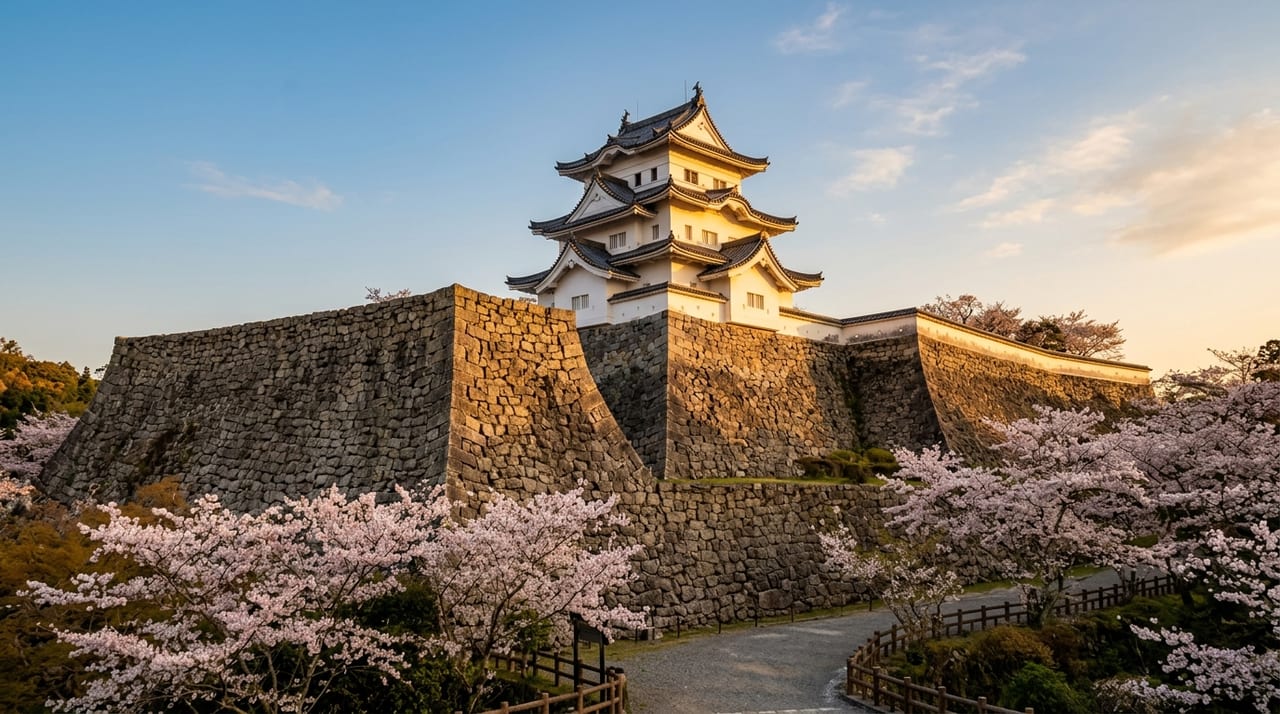
 * Image is for illustrative purposes only.
Tachibanayama Castle
立花山城
Tachibanayama Castle is a historic castle in the Kyūshū region (Traditionally built in 1330 (Gentoku 2) by Ōtomo Sadanori; abandoned in 1601 (Keichō 6) after Kuroda Nagamasa built Fukuoka Castle). Its lord was Ōtomo Sadanori (founder of the Tachibana line); Betsuki Akitsura (Tachibana Dōsetsu); Tachibana Muneshige; Kobayakawa Takakage (with retainer Ura Munekatsu as castellan).
Overview
Overview
Tachibanayama Castle was a medieval mountain fortress built on Mount Tachibana (367m), straddling Higashi-ku in Fukuoka City and the towns of Shingū and Hisayama in Kasuya District, Fukuoka Prefecture. Spanning roughly one kilometer east-west across the entire mountain, it was one of the most important strongholds of the Ōtomo clan's rule over northern Kyushu.
History and Succession of Lords
The castle is said to have been built in 1330 (Gentoku 2) by Ōtomo Sadanori, second son of the Bungo Province military governor Ōtomo Sadamune; Sadanori took the Tachibana name after establishing himself here. During the Sengoku period, the Ōtomo retainer Betsuki Akitsura (later known as Tachibana Dōsetsu) became castellan. Dōsetsu's son-in-law and heir, Tachibana Muneshige, held the castle in 1586 (Tenshō 14) against a large Shimazu army advancing north in its bid to conquer Kyushu. After Toyotomi Hideyoshi's pacification of Kyushu, Muneshige was transferred to Yanagawa, and Kobayakawa Takakage took over the castle, appointing his retainer Ura Munekatsu as castellan. The castle was abandoned in 1601 (Keichō 6) after Kuroda Nagamasa built Fukuoka Castle.
Structure
The castle's main enclosure sat atop Seirōzan (Honjō-yama), the summit of Mount Tachibana, with subsidiary enclosures spread across the entire mountain, including Shiradake, Matsuo-dake, Ibanowo, Ōtawo, Ōtsubura, and Kotsubura. Stone walls survive concentrated around the main enclosure and near Ibanowo/Ōtawo and Kotsubura, with substantial stonework remaining around the gate at the northeastern edge of the main enclosure. Rows of tatebori (vertical obstacle trenches) have also been confirmed on the southern ridge and at Kotsubura.
Connection to Swords
The castellan Tachibana Dōsetsu is traditionally associated with the famed sword "Raikiri," originally named "Chidori." According to legend, when lightning struck near Dōsetsu on a summer day, he instinctively drew Chidori and cut at the bolt, surviving the strike — though it left him partially paralyzed. The sword was thereafter renamed Raikiri ("Lightning Cutter"), and Dōsetsu is said to have continued leading his troops from the front lines, carried on a litter and armed with both a matchlock and Raikiri. A blade traditionally identified as Raikiri is preserved today at the Tachibana Museum in Yanagawa City.
Present Condition
After its abandonment, only scattered stone walls and the remains of an old well survive near the summit, with most of the castle site now covered by dense evergreen broadleaf forest. This forest is designated a National Natural Monument as the "Tachibanayama Camphor Primeval Forest," and the summit remains a popular viewpoint overlooking Hakata Bay.
Connection to Swords
Tachibana Dōsetsu, castellan of Tachibanayama, is traditionally linked to the famed sword "Raikiri" (originally "Chidori"), said to have been renamed after Dōsetsu cut at a bolt of lightning with it. The blade is preserved at the Tachibana Museum in Yanagawa City; Dōsetsu reportedly carried it, along with a matchlock, while directing his troops from a litter at the front lines.
Highlights
- A mountain castle built in 1330 by Ōtomo Sadanori, from which the Tachibana clan took its name
- The site where Tachibana Muneshige held off a large Shimazu army in 1586
- A vast complex of enclosures spanning about 1km east-west, with stone walls surviving near the main enclosure and Ibanowo/Ōtawo
- Associated with the famed sword "Raikiri" (originally "Chidori"), traditionally the blade of castellan Tachibana Dōsetsu
- The forest covering the site is a National Natural Monument, the "Tachibanayama Camphor Primeval Forest"
* Opening hours and admission fees are subject to change. Please check the official website before visiting.