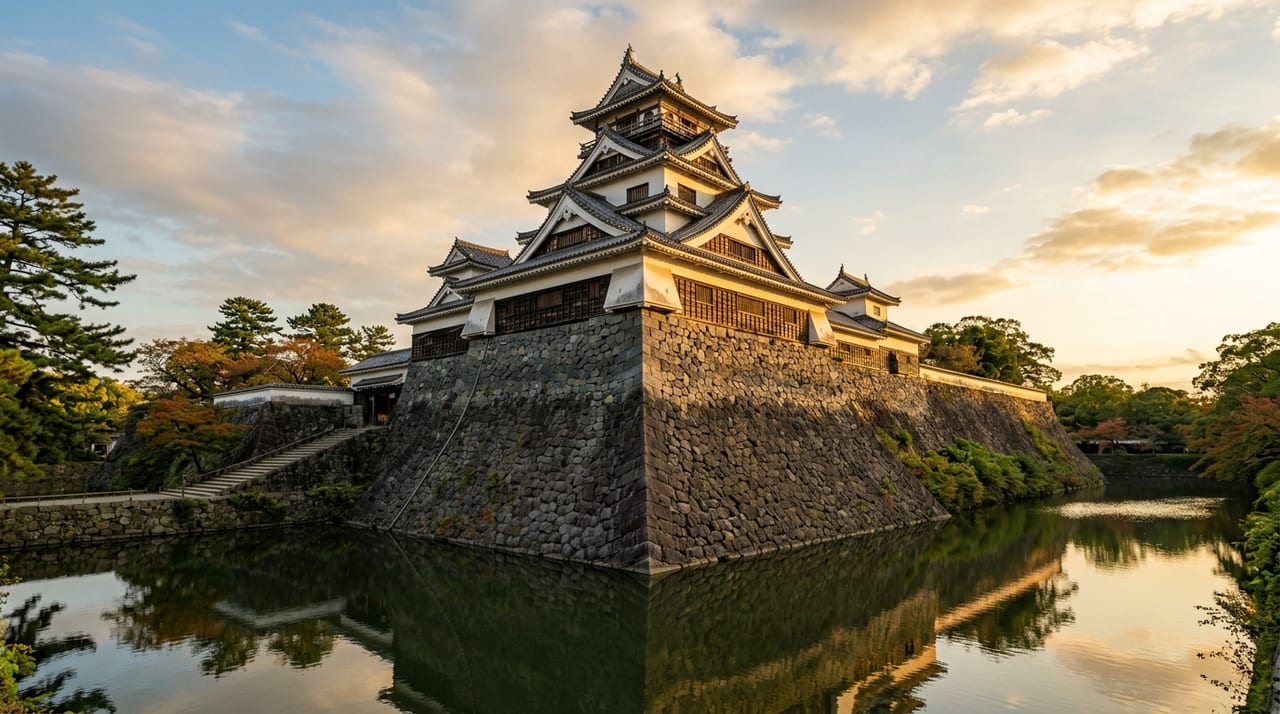
 * Image is for illustrative purposes only.
Kumamoto Castle
熊本城
Kumamoto Castle is a historic castle in the Kyūshū region (Constructed in 1601 (Keicho 6)). Its lord was Kato Kiyomasa.
Overview
About the Castle
Kumamoto Castle is one of Japan's Three Famous Castles, built with utmost dedication by Katō Kiyomasa, who was hailed as the 'Genius of Castle Construction,' and its formidable strength remains a legend more than 400 years after its construction. Completed over a span of seven years beginning in Keichō 6 (1601), this castle is the culmination of Kiyomasa's practical battlefield experience and castle-building theory. Kiyomasa, a retainer raised by Toyotomi Hideyoshi, was counted among the Seven Spears of Shizugatake and was a fierce warrior who fought at the front lines himself during the Bunroku-Keichō campaigns (Korean invasions). That battlefield experience forms the foundation of Kumamoto Castle's defensive philosophy.
Architecture and Structure
The stone walls known as musha-gaeshi have a distinctive curve: gentle at the bottom, but growing steeper toward the top, creating a structure that humans cannot climb. These walls are also called the 'fan gradient,' combining beauty that overwhelms onlookers with military rationality. Within the castle, more than 120 wells were dug, taro stalks were used for the cores of tatami mats, and dried calabash was plastered into the walls. These preparations, unique to Kiyomasa, anticipated prolonged sieges and were applied throughout the castle. This thoroughness proved its power in the Satsuma Rebellion of Meiji 10 (1877).
The Castle Today
The formidable Satsuma army, numbering about 14,000 under Saigō Takamori, besieged Kumamoto Castle, but Tani Tateki and the roughly 4,000 defenders under him held the castle for more than 50 days. Kumamoto Castle remained impregnable even in the age of modern firearms, and Saigō is said to have lamented, 'I was not defeated by the Imperial Army; I was defeated by Lord Kiyomasa.' In the Kumamoto Earthquake of Heisei 28 (2016), the castle suffered severe damage: roof tiles fell from the main keep and many stone walls collapsed. However, restoration of the main keep was completed in Reiwa 3 (2021), and comprehensive restoration work, including the stone walls, is currently underway on a plan of about 35 years.
History of Castle Construction
The restoration process itself has become a valuable opportunity to re-examine Kiyomasa's castle-building techniques. Kumamoto Castle is still deeply loved by the people of Kumamoto as the castle of 'Seishoko-san' (Lord Kiyomasa), and citizens' enthusiasm for recovery from the earthquake reflects the depth of the bond between the castle and its people. Complete restoration of Kumamoto Castle aims for completion in Reiwa 34 (2052), and the process has produced a series of valuable academic discoveries, including the first revelation of the internal structure of stone walls from Kiyomasa's era. Simply watching the restoration unfold is itself an experience of taking part in history.
Castle Lords and Governance
Kumamoto is called the 'Land of Fire,' a powerful land where the majestic nature of Mount Aso and Lord Kiyomasa's castle coexist.
Connection to Swords
Dōtanuki of Higo, the swordsmiths employed by Katō Kiyomasa, are renowned as the most 'practical' group of swordsmiths in the history of Japanese swords. Dōtanuki blades were forged with practicality as the top priority over showy ornamentation or refined hamon: 'does not break, does not bend, cuts well.' Sengoku warlords highly valued this reliability and are said to have chosen Dōtanuki swords when going into battle. In recent years, the Dōtanuki name has become widely known through films, games, and other creative works, and has become a gateway for a new generation interested in Japanese swords. Katō Kiyomasa himself was a fierce warrior who made his name resound for martial valor, and a legendary anecdote survives that during the Bunroku campaign (Korean invasion) he slew a tiger in the mountains of the Korean Peninsula. The katakama-yari (single-hooked spear) that Kiyomasa wielded is famous. Another indispensable element in discussing Kumamoto's sword culture is 'Higo-goshirae.' Higo-goshirae is a style of sword fittings that makes use of the superior craftsmanship of Higo metalworkers, and is characterized by restrained, austere, and dignified designs that avoid excessive ornamentation. Higo metalworking, which began with Hayashi Matashichi, produced master craftsmen including Shimizu Jingo, Hirata Hikozō, and Nishigaki Kanshirō, and was systematized as the 'Four Schools of Higo Metalworking' (Hayashi, Hirata, Nishigaki, Shimizu). Their tsuba are iron-ground pieces with intricate chased metalwork, and as works condensing the warrior's aesthetic, they remain among the most highly esteemed by sword-fitting enthusiasts today. The Kumamoto Prefectural Museum of Art displays Higo swords and sword fittings, where one can appreciate the practical beauty of Dōtanuki and the restrained dignity of Higo metalwork at the same time. The martial aesthetics of Higo, which also resonate with TOUKENZA's aesthetic sense, are well worth a look. Higo metalwork tsuba eschew excessive decoration and are characterized by a restrained dignity that makes the texture of the iron itself stand out; this aesthetic is also expressed as 'the beauty of subtraction.' The practical beauty of Dōtanuki and the restrained dignity of Higo metalwork are two faces of the warrior's aesthetic sense nurtured by the land of Kumamoto, and together they demonstrate the depth of Japanese sword culture.
Highlights
- Musha-gaeshi stonework — The 'fan gradient' creates the ultimate fusion of beauty and defense, symbolizing Kiyomasa's castle-building philosophy
- Restored main tower — Completed in 2021 with newly renovated interior exhibits; a symbol of Kumamoto
- Uto Tower (Important Cultural Property) — A surviving structure from Kiyomasa's era that endured the Kumamoto earthquake
- Kato Shrine — Dedicated to Lord Kiyomasa, offering an ideal vantage point with the main tower looming overhead
- Kumamoto Prefectural Art Museum — Dōtanuki swords and Higo metalworked tsuba and fittings; experience the warrior aesthetic of Higo
- Restoration work site viewing — Ongoing stonework restoration provides a valuable opportunity to reinvestigate Kiyomasa's castle-building techniques
* Opening hours and admission fees are subject to change. Please check the official website before visiting.