New Arrivals — Browse our catalog for the latest authentic Japanese sword arrivals. Browse →
February 15 – September 24, 1877 (Meiji 10)
Kumamoto, Kagoshima, Miyazaki, and Ōita prefectures; main battles in Kumamoto and Kagoshima
Forces
Meiji Government Forces
Satsuma Forces (Saigō Army)
About 10 min read
From February 1877 (Meiji 10), when Saigō Takamori led some 13,000 Satsuma shizoku in besieging Kumamoto Castle, the Satsuma Rebellion, Japan's last civil war, lasted more than half a year. Known as "the last rebellion of the samurai," the war was an explosion of the fierce anger and pride of the shizoku, who had been forbidden to carry swords under the Haitōrei (sword-carrying ban) of Meiji 9. It was also the final stage on which Japan's sword culture played its role as a weapon.
The Meiji government carried out a series of reforms: it abolished the samurai system of the Edo period and implemented equality of the four classes, conscription, and the Haitōrei (1876). The Haitōrei stripped the samurai (shizoku) of their right to carry swords, and it removed from the streets the swords that had been cherished for centuries as the "soul of the samurai."
It was the Satsuma shizoku who reacted most fiercely. Saigō Takamori had broken with the government over the Seikanron (debate on invading Korea) in 1873 and had returned to his hometown of Kagoshima. His disciples gathered one after another at the Shigakkō (military school founded by Saigō), and the mood toward rebellion grew. In January 1877, the government secretly moved weapons and ammunition out of the ammunition depot in Kagoshima. Shigakkō students who opposed this attacked the depot, and that became the direct trigger: the following month, February, a rebellion with Saigō as its leader broke out.
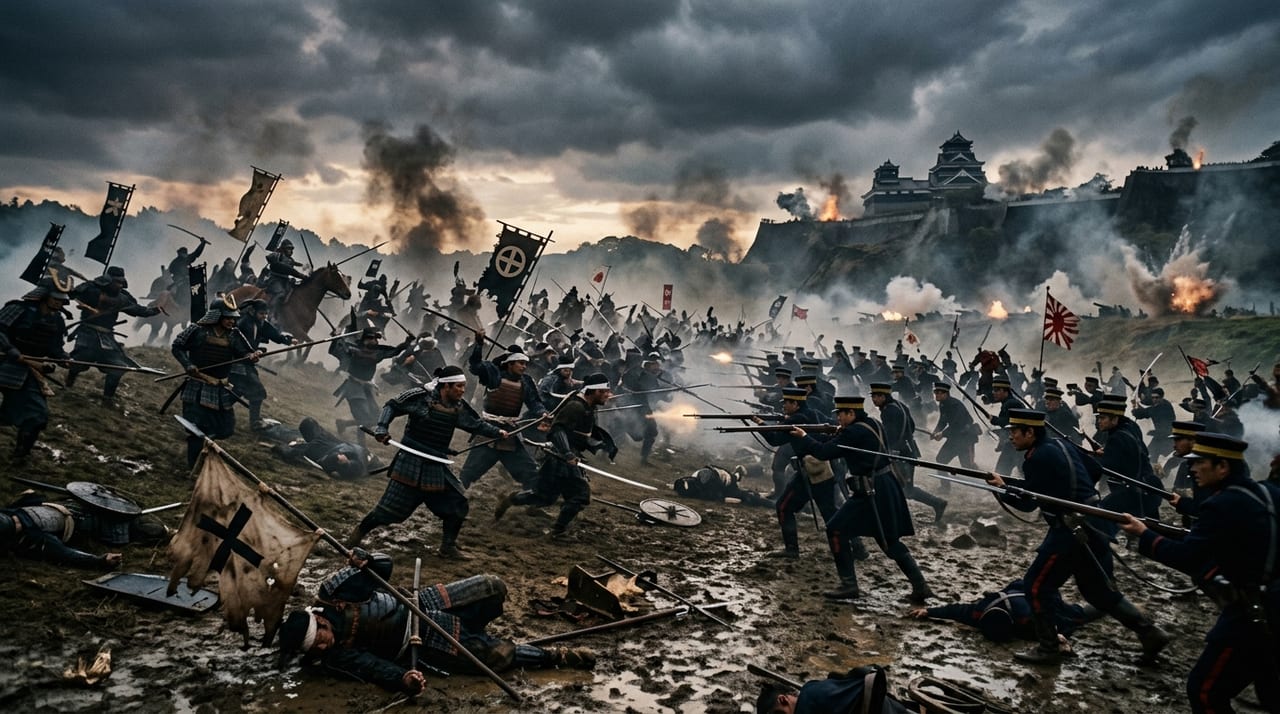
The Satsuma Rebellion is often described symbolically as a battle of "sword versus gun." After the Haitōrei, the Satsuma samurai kept their attachment to the sword, and there is an aspect in which they tried to fight with swords and spears as their main weapons rather than modern rifles. The Meiji government forces, on the other hand, relied mainly on peasant-born conscripts raised through conscription, and they were armed with Western-style weapons, including breech-loading arms such as the Snider rifle.
In reality, however, the Satsuma Rebellion was not fought "with swords alone." The Satsuma army also used rifles and conducted regular positional and field warfare. The image of "sword versus gun" was largely a romantic picture created by kōdan storytelling and newspapers from the Meiji period onward. Still, in battles such as the siege of Kumamoto Castle and the Battle of Tabaruzaka (March 1877), it is recorded that swords and spears were actually used in close-quarters combat at night.
The Battle of Tabaruzaka, which lasted from March 4 to March 20, is one of the fiercest battles of the Satsuma Rebellion. The Satsuma army and the government forces clashed over the supply route to Kumamoto Castle, and fierce gunfire and close-quarters fighting unfolded in the rain.
What stands out in this battle is the outstanding swordsmanship of the Satsuma shizoku. In close-range fighting at night, swordsmen of Satsuma Jigen-ryū (Jigen-ryū and Nodachi Jigen-ryū) charged at the government's riflemen and fought hand-to-hand with their swords. The government forces selected police officers skilled in swordsmanship from among the police units (Keishitai) and formed the Battōtai (drawn-sword unit) to counter the Satsuma drawn-sword attacks.
This paradoxical situation of "using a sword against a sword" had a profound influence on modern Japanese views of Bushido. The Battle of Tabaruzaka, where swords and guns were used side by side, is remembered in Japanese military history as the battlefield where the samurai's sword shone for the last time.
From July onward, the Satsuma army lost its bases one after another and was forced to retreat to Kagoshima. On September 1, the remnants of about 300 men under Saigō Takamori (about 400 including military laborers and others) charged into Kagoshima and barricaded themselves at Shiroyama (Kagoshima City), and the government forces surrounded them.
Shortly before dawn on September 24, the government forces launched a full-scale assault. After being wounded by a bullet, Saigō turned to Beppu Shinsuke and said, "Shin-don, Shin-don, this is far enough." It is said that he then took his own life, with Beppu performing the kaishaku (second's sword stroke). He was 51 by traditional reckoning (49 in full years).
Saigō's head was buried and hidden for fear that the enemy would take it, but it was found after the battle and examined. In later generations Saigō Takamori has been loved as a figure of Keiten aijin ('revere Heaven, love people'), and the bronze statue standing at the foot of Shiroyama remains a symbol of Kagoshima to this day.
The end of the Satsuma Rebellion (September 1877) marked the turning point at which Japanese sword culture fully shifted from "a weapon of battle" to "a spiritual and cultural heritage." With the Haitōrei (1876) prohibiting the public carrying of swords, and with the defeat in the Satsuma Rebellion rejecting armed movements to restore the old order, swords moved out of samurai daily life and into museums and collections.
At the same time, however, the Satsuma Rebellion paradoxically heightened cultural interest in "Bushido" and "the spirit of the sword." Meiji intellectuals found in Saigō Takamori's heroic end "the aesthetics of a vanishing samurai," and this became the cultural soil from which theories of Bushido arose, including Nitobe Inazō's "Bushido" (1900).
Swords ceased to be weapons of the battlefield, but they took on deeper spiritual meaning as the "soul of the samurai" and as a "symbol of Japanese culture." The richness of today's sword culture and sword appreciation rests on this turn "from weapon to art and spirit." The Satsuma Rebellion was the watershed of that transformation.
Saigō Takamori
Leader of the Satsuma Rebellion, died at Shiroyama as Japan's 'last samurai'
Katsu Kaishū
Prominent Meiji-era warrior whose legacy intersected with post-rebellion samurai discourse
Yamaoka Tesshū
Meiji swordsman and martial arts master who preserved samurai values after the rebellion
Sakakibara Kenkichi
Meiji-era sword master who worked to preserve kenjutsu culture after the Haitōrei
Satsuma Rebellion Period
Sword culture of the Satsuma Rebellion era, the last military use of Japanese swords
The Sword Abolition Edict — The Day the Samurai's Soul Was Taken
The Haitōrei sword-ban edict that directly triggered the Satsuma Rebellion
Meiji-Taishō
Meiji era sword culture transition period encompassing the Satsuma Rebellion
Meiji Military Sword Era
Meiji military sword culture and post-Haitōrei transformation
1877年の西南戦争は廃刀令の翌年に起きた「最後の剣戟による大規模内戦」だ。薩摩士族の刀使用、政府軍への刀の急速な供給不足、そして戦後の刀剣需要の変化まで、刀剣史の観点から西南戦争を読み解く。
2026-04-28
1876年の廃刀令が日本刀産業に与えた壊滅的打撃と、明治後期から昭和にかけての美術刀剣としての復興過程を詳述。廃業した刀匠の実態・文化財認識の転換・NBTHKによる現代的保護体制の成立まで追う。
2026-05-05
明治維新の端緒となった戊辰戦争では、旧幕府軍・諸藩の武士たちが刀を手に近代銃砲と戦った。新選組の刀、会津藩士の最後の戦い、そして戦後の廃刀へと続く流れまで、刀剣史の観点から戊辰戦争を読み解く。
2026-04-28
九州・薩摩(鹿児島)の刀剣文化は、平安期に始まる波平派(なみのひらは)を中心に独自の発展を遂げた。島津氏の刀工保護政策、南海貿易で入手した大陸鉄の影響、幕末維新の志士たちが愛した薩摩刀まで、五箇伝に並ぶ独立した刀剣文化圏を詳説する。
2026-04-17