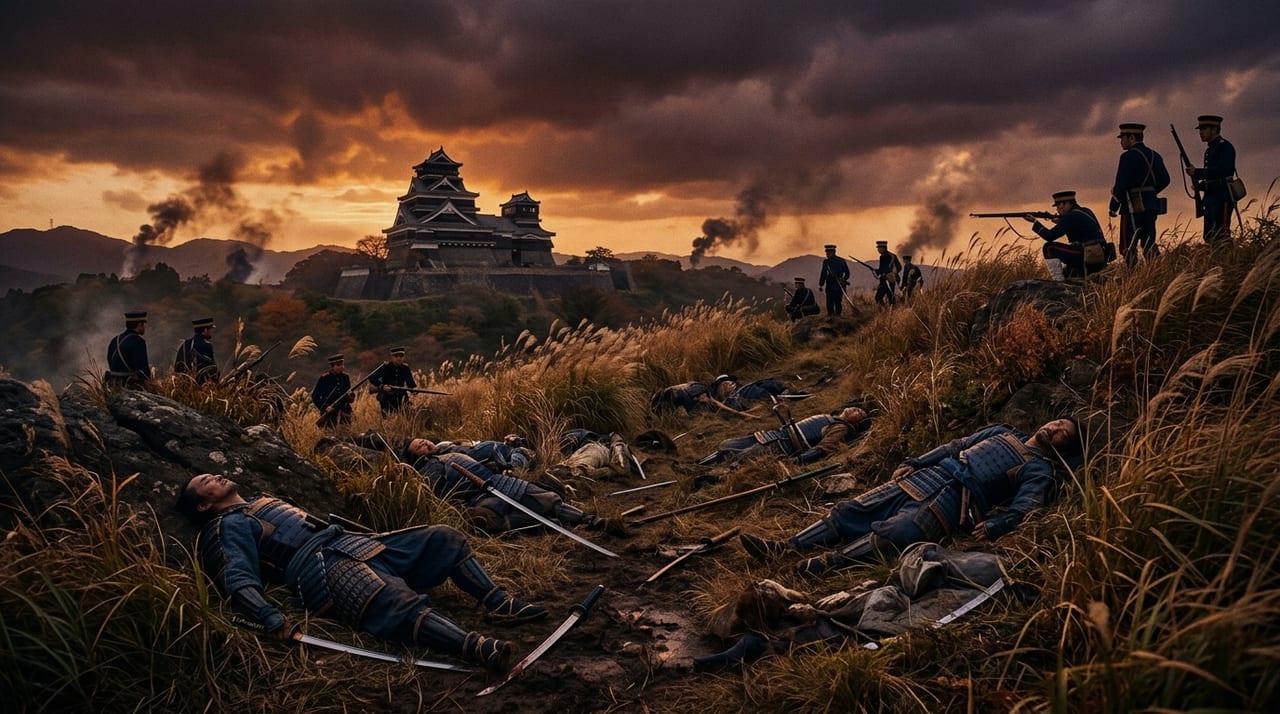
 * Image is for illustrative purposes only.
Satsuma Rebellion Period
西南戦争期
The Seinan War of Meiji 10 was the largest and last rebellion of the shizoku. In this civil war, which broke out the year after the Haitōrei was promulgated, the swords of Satsuma shizoku clashed with government forces armed in the Western style. It was a historic turning point, marking both the shock of the defeat of Japanese sword culture and a foundation for the birth of the military sword system.
Description
The Course of the Seinan War and the Shizoku's Japanese Swords
In February of Meiji 10 (1877), Satsuma shizoku who had rallied around Saigō Takamori, dissatisfied with the policies of the Meiji government (the Haitōrei, the Conscription Ordinance, and the abolition of samurai stipends), raised an army in Kagoshima, and the Seinan War broke out. The Satsuma shizoku army is estimated to have reached nearly 40,000 men at its peak, but it was at a disadvantage throughout against the government army, which numbered some 60,000. One of the most dramatic scenes of this war was close-quarters combat, in which drawn-sword Satsuma shizoku charged the bayonet-armed government forces. In fierce battles such as the 'Battle of Tabaruzaka,' fighting with Japanese swords actually took place. However, against firearms, the conscript army, which had received modern training, held an overwhelming advantage. The Satsuma army was gradually driven into a corner, and the rebellion ended with Saigō's suicide at Shiroyama in September.
Relationship with the Haitōrei and the Crisis of Sword Culture
The Seinan War broke out the year after the Haitōrei, promulgated in March of Meiji 9 (1876) as Meiji 9 Dajōkan Proclamation No. 38. The Haitōrei was an ordinance prohibiting kazoku and shizoku from wearing swords in their daily lives. It was a major historical turning point in which the practice of sword-wearing, long the emblem of the samurai, was made illegal overnight. The Satsuma shizoku's uprising also had an aspect of resistance to this Haitōrei, and the Seinan War took on the character of 'the last resistance over the right to wear swords.' With the defeat in the Seinan War, the political and military resistance of the former samurai class was completely crushed, and the Haitōrei was effectively established. This was also devastating for swordsmiths and sword-fittings craftsmen. With the disappearance of the samurai's daily demand for swords (polishing, remounting, purchasing, and so on), many craftsmen were forced out of business.
The Drawn-Sword Unit and the Emergence of the Modern Military Sword
Notable among the roles of swords in the Seinan War is that the Keishi Battōtai was organized on the government side. Judging that bayonets alone would make it difficult to respond to the close-quarters charges of the Satsuma shizoku, the government selected skilled swordsmen from among the former shizoku, organized them into the drawn-sword unit, and used them as close-combat personnel. This combat experience demonstrated the 'usefulness of military swords' in the context of modern warfare, and it became a foreshadowing of the later practice in which the army came to use Japanese blades for its military swords. Although the Japanese sword lost its standing as a purely practical weapon, it was institutionally preserved as the officers' 'symbol of raised morale' and 'dignified equipment of military officers.'
Impact on the Swordsmith World and the Search for a Meiji Sword Culture
The Meiji 10s (1877–1886) after the Seinan War was the most difficult era for swordsmiths. The loss of demand caused by the Haitōrei, the loss of honorary status, and the collapse of their livelihoods struck swordsmiths all at once. Many swordsmiths went out of business, and the survival of swordsmithing as a profession itself came under threat. Among these, the swordsmiths who survived sought paths toward areas where demand remained: swords dedicated to shrines, swords presented to the Imperial family, orders for the military sword system, and an outlet as art swords.
The Seinan War and the Formation of the Japanese Sword Myth
The fact that the defeated Saigō army's Satsuma shizoku fought to the end with Japanese swords in hand and perished at Shiroyama formed a powerful image in post-Meiji Japanese society of them as 'embodiments of bushidō.' The memory of the Seinan War became linked to the discourse on 'bushidō' and 'Japanese spirit' in the later Meiji, Taishō, and Shōwa periods. It played an important role in the process by which the Japanese sword was mythologized as a cultural icon symbolizing the 'soul of the Japanese people.' It can also be said that the memory of the Seinan War lies at the spiritual origin of the revival of sword culture after the mid-to-late Meiji period. This includes the establishment of the military sword system, the treatment of swords as art objects at the Tokyo Imperial Household Museum (now the Tokyo National Museum), and the academicization of sword research. This paradoxical process of 'defeat and mythologization' became the final key that transformed the Japanese sword from a practical weapon into a cultural symbol.
Characteristics of This Era
- The last civil war in which shizoku fought with Japanese swords in hand. Close-quarters combat at hard-fought sites such as Tabaruzaka simultaneously demonstrated both the combat capability and the limits of the Japanese sword.
- Linked to the Haitōrei. The defeat in the Seinan War sealed the establishment of the Haitōrei, a historic watershed at which the samurai practice of sword-wearing completely disappeared.
- The formation of the Keishi Battōtai foreshadowed the modern military sword system. The usefulness of swords in combat was demonstrated to a certain degree, promoting the trend toward using Japanese blades for officers' military swords.
- Devastating blow to the swordsmith world and the search for survival strategies. Amid successive closures, a shift began toward new sources of demand: dedicatory swords, presentation swords, military swords, and art swords.
- The defeat and deaths of Saigō Takamori and the Satsuma shizoku accelerated the cultural mythologization of the Japanese sword. The notion of 'the Japanese sword as a symbol of bushidō' took root in Meiji society.