New Arrivals — Browse our catalog for the latest authentic Japanese sword arrivals. Browse →
March 28, 1876 (Meiji 9)
Tokyo (issued as a Grand Council of State proclamation, effective nationwide)
Forces
Meiji Government (Proponents)
Shizoku / Former Samurai Class (Opposition)
About 20 min read
On March 28, 1876 (Meiji 9), a proclamation was issued in Tokyo from the Daijō-kan (Grand Council of State), the supreme administrative organ of modern Japan. Grand Council of State Proclamation No. 38, later called the Haitōrei (Sword Abolition Edict), was only a few lines of legal text. Its content, however, was revolutionary: it fundamentally overturned the samurai culture of Japan that had been built up over many years.
“From now on, except when wearing formal court dress or the prescribed uniforms of military personnel, police officers, and other officials, the wearing of swords is prohibited. Notice is hereby given accordingly.”
This single sentence, which banned sword-wearing by anyone other than military personnel and police officers, cut the Japanese sword, the soul of the samurai, off permanently from the daily life of the warrior.
To understand how the Meiji government arrived at the Haitōrei, one must trace the rapid modernization of the eight years since the Meiji Restoration (1868).
After overthrowing the Edo shogunate, the Meiji government made the dismantling of the feudal status system one of its national goals. The abolition of the domains (haihan chiken) in 1871 (Meiji 4) eliminated the han, and the stipends of the shizoku became payments made by the government. In 1873 (Meiji 6), the Conscription Ordinance was enforced, and the creation of a “national army” that included men of peasant origin began. Furthermore, in 1875 (Meiji 8), the Heimin Myōji Hisshō Gimu Rei was issued, obliging commoners to use family names, and the formal principle of equality among the four classes was put in place.
However, the change that most wounded the pride of the samurai, within this series of changes, was the question of the right to wear swords. Wearing a Japanese sword at the waist was the samurai's proof of identity, and for centuries it was the most visible symbol distinguishing samurai from commoners. For the shizoku, who had lost their lords with the abolition of the domains and were beginning to lose their privileged status as warriors before the “national army” created by the Conscription Ordinance, the freedom to wear swords was their last remaining identity.
Even before the Haitōrei, the Meiji government had restricted sword-wearing in stages. In 1870 (Meiji 3), the wearing of swords by commoners was prohibited. In 1871 (Meiji 4), the Danpatsu Dattō Rei made it free for shizoku to wear or remove their swords. However, caution against a complete ban on sword-wearing remained strong. In 1869 (Meiji 2), when Mori Arinori proposed a ban on sword-wearing at the Kōgisho, the proposal had been rejected.
The turning point was the 1873 (Meiji 6) “Political Upheaval” (seihen), which came about when Saigō Takamori resigned from government after the debate over the seikanron (the proposal to invade Korea). With Saigō leaving the government and returning to Kagoshima, an administration centered on Ōkubo Toshimichi was established. Then in December 1875 (Meiji 8), the recommendation of Army Minister Yamagata Aritomo to abolish sword-wearing was adopted, and this was the direct trigger for the issuance of the Haitōrei.
The main text of Grand Council of State Proclamation No. 38, issued on March 28, 1876 (Meiji 9), is short. It consists of the sentence quoted above with only one proviso added: “Provided that the swords of those who violate this shall be confiscated.”
The exceptions were limited to wearing formal court dress (taireifuku) and wearing uniforms while serving as military officers or police officials. What was prohibited was wearing a sword at the waist, not possessing swords. The custom of commoners wearing a wakizashi when traveling or at weddings, funerals, and other ceremonies was also banned by this proclamation.
Samurai from each domain had no choice but to take the swords handed down through generations from their waists and hang them on racks at home. Swordsmiths saw the orders of the samurai, their main customers, vanish overnight, and were forced to close their shops or change trades. The same was true for sword polishers, scabbard makers, hilt wrappers, and other craftsmen related to swords.
The impact of the Haitōrei dealt a devastating blow to the entire sword industry, not only to the samurai. Up to the end of the Edo period (the bakumatsu), many swordsmiths existed throughout Japan. Smiths who had been protected as okakae tōkō (domain-retained swordsmiths) lost their patrons with the abolition of the domains, and then lost their customers with the Haitōrei.
Demand for swords shrank rapidly. Military swords (ceremonial swords for army and navy officers) remained in demand for a while, but the Meiji government initially promoted the introduction of Western-style sabers. Demand for police swords was also only temporary.
The swordsmiths who had made their names as shinshintō (new new swords) masters in the late Edo period also fell into extreme hardship after the Haitōrei. Many of the schools of swordsmiths raised by the successors of Taikei Naotane, Suishinshi Masahide, and others faced the danger of extinction during this period.
Sales of swords also collapsed. A large number of swords flooded the market, and prices crashed. Famous swords that had been passed down as family treasures were sold for next to nothing, and many were said to have been discarded.
1876 (Meiji 9), the year the Haitōrei was proclaimed, was also the year the shizoku lost both their symbol and their livelihood. On August 5 of the same year, the Kinroku Kōsai Shōsho Hakkō Jōrei was promulgated as Grand Council of State Proclamation No. 108. The karoku (hereditary stipends) paid to kazoku and shizoku, and the shōtenroku (merit stipends) given to those who had contributed to the Restoration, were abolished. The kinroku kōsai (commutation bonds) issued in their place amounted to about five to fourteen years' worth of the annual payments. They covered about 310,000 people and totaled about 174 million yen. Interest rates were divided into four levels, 5%, 6%, 7%, and 10%, according to the stipend amount. High-stipend kazoku received larger principal at lower interest, while low-stipend shizoku received higher interest on smaller principal. This series of measures is called chitsuroku shobun.
This design was fatal for lower-ranking shizoku. The interest from small bonds could not support a family, so many shizoku sold their bonds below face value and turned to unfamiliar trades, where they failed. This is the so-called shizoku no shōhō (the shizoku's business ventures). They were banned from wearing swords in March and cut off from their stipends in August. The two pillars that had supported the status of the samurai were removed one after the other within just half a year.
For swords, too, this year was a watershed in the structure of distribution. Shizoku in financial straits parted with their family swords, and swords whose demand had vanished were traded for next to nothing. Swords came to be sold on the market as antiques and objects of art rather than weapons, and some passed through the hands of foreigners who had come to Japan and went overseas. The Shinpūren Rebellion, the Akizuki Rebellion, and the Hagi Rebellion, which broke out in succession in October of the same year, and the Satsuma Rebellion of the following year, Meiji 10, were the eruption of the shizoku discontent that the Haitōrei and the chitsuroku shobun had built up.
The Haitōrei sent shockwaves through shizoku across the country. Most shizoku obeyed the law and stopped wearing swords, but their anger accumulated deeply. Before and after the Haitōrei, shizoku rebellions and uprisings occurred one after another.
The Saga Rebellion of 1874 (Meiji 7) was the first large-scale shizoku rebellion, led by Etō Shinpei, a former Councillor (sangi) who had left the government after the seikanron upheaval. It came before the Haitōrei, and the shizoku's dissatisfaction over the seikanron was its background.
In October 1876 (Meiji 9), the Shinpūren Rebellion (Kumamoto), the Akizuki Rebellion (Fukuoka), and the Hagi Rebellion (Yamaguchi) broke out in succession. These were armed uprisings by shizoku who were dissatisfied with the government's policies, including the Haitōrei.
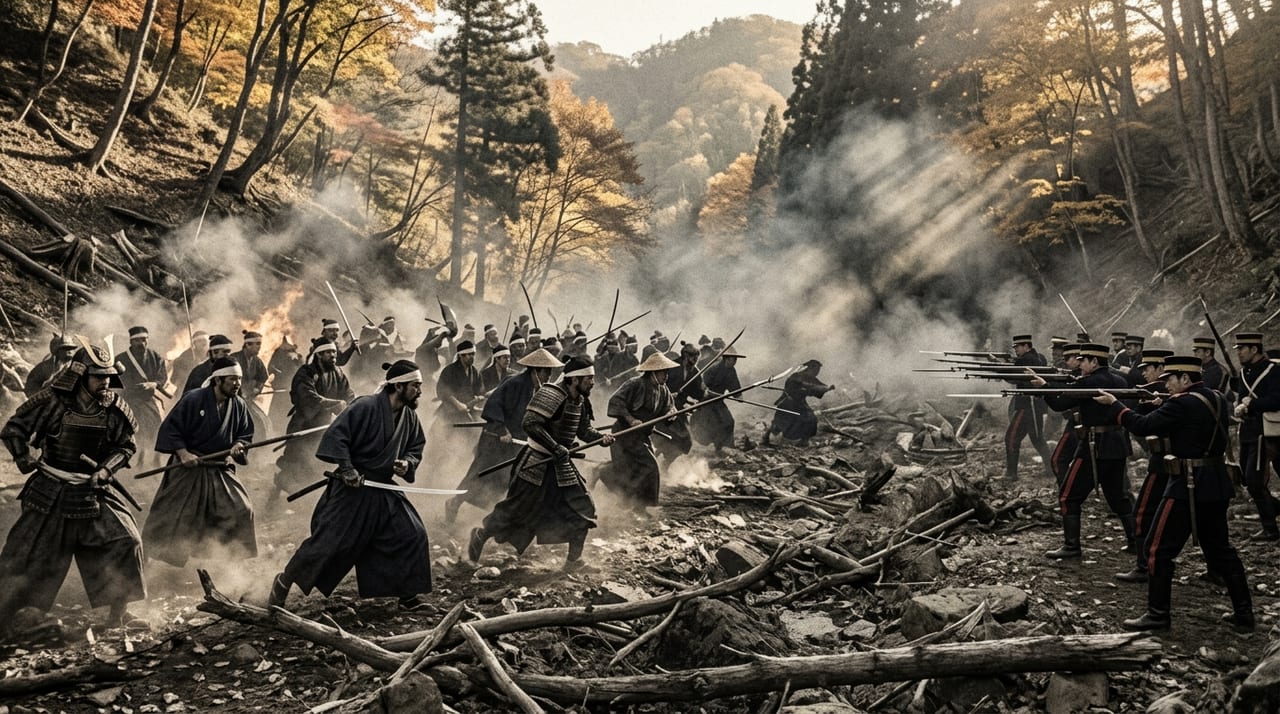
The Shinpūren Rebellion (October 1876, Meiji 9) is especially symbolic. The Kumamoto shizoku group Keishintō (the Shinpūren) condemned the Haitōrei as a “desecration of the traditions of the land of the gods.” From a position of rejecting Western weapons and Western civilization itself, they raided the Kumamoto Garrison, an army base, with only swords and spears. Though they were hopelessly outnumbered and annihilated, the incident has been passed down as a symbol of resistance to the Haitōrei.
In the following year, 1877 (Meiji 10), the Satsuma Rebellion broke out as the culmination of these shizoku rebellions. With Saigō Takamori as their leader, about 13,000 Satsuma shizoku took up arms and fought fierce battles with the Meiji government for more than half a year.
The Haitōrei and the defeat in the Satsuma Rebellion were at once the greatest crisis for the Japanese sword and a turning point toward a new cultural status.
The Japanese sword as a weapon died. But the Japanese sword as cultural property and artwork was reborn from this point.
Earlier, in 1871 (Meiji 4), the Meiji government had sought to preserve old objects through the Daijō-kan proclamation “Koki Kyūbutsu Hozonkata,” which became the starting point of the later cultural property protection system. The Japanese sword was redefined not as a “weapon” but as a “fine art object,” and became subject to collection and display in museums.
In 1897 (Meiji 30), the Ancient Shrines and Temples Preservation Law (Koshaji Hozonhō) was enacted, strengthening the protection of old art objects, including swords. During this period, appraisers of the Hon'ami family led the work of organizing sword lineages and establishing appraisal standards, laying the foundation for modern sword appreciation culture.
Thirty years after the Haitōrei, in the late Meiji period, the Japanese sword had come to be widely recognized as a spiritual symbol of Bushido and as cultural property inseparable from Japanese identity. Nitobe Inazō's Bushido, written in English (1900), positioned the sword as the “soul of the samurai” and spread the spiritual significance of the Japanese sword to the Western world.
Paradoxically, the Haitōrei laid the foundation for protecting Japanese sword culture today.
Because sword-wearing was banned, the sword changed from a “tool to use” into an “art to appreciate.” Polishing and maintenance techniques advanced to preserve the condition of swords, and the academic foundation for appreciating swords was established. Through the preservation activities for swords before and during the war, the requisition of swords during the postwar Occupation after World War II, and the subsequent movement for their return, today's culture of preserving and appreciating the Japanese sword stands on the tradition that began after the Haitōrei.
Even in the present Reiwa era, the Haitōrei (1876) is recognized as the greatest turning point in Japanese sword culture. March 28, the day this proclamation was issued, is widely known among sword enthusiasts as one of the most important dates in the history of the Japanese sword.
Saigō Takamori
Leader of Satsuma shizoku resistance to the Haitōrei; died in the subsequent Satsuma Rebellion
Sakakibara Kenkichi
Meiji-era sword master who championed kenjutsu culture in the wake of the Haitōrei
Yamaoka Tesshū
Meiji-era swordsman and Zen practitioner who preserved samurai spirit and sword culture after the Haitōrei
Katsu Kaishū
Bakumatsu-to-Meiji warrior whose views on samurai culture informed post-Haitōrei bushidō discourse
Okita Sōji
Shinsengumi swordsman who epitomized the sword-wearing samurai culture abolished by the Haitōrei
The Sword Abolition Edict — The Day the Samurai's Soul Was Taken
The era directly corresponding to the Haitōrei edict and its cultural aftermath
Meiji-Taishō
The Meiji-Taishō era of sword culture transformation in which the Haitōrei was issued
Satsuma Rebellion Period
The military sword culture of the Satsuma Rebellion era, which the Haitōrei directly triggered
Meiji Military Sword Era
The post-Haitōrei transformation of swords into Meiji-era military and ceremonial blades
The Meiji Sword Ban and the Beginnings of Sword Preservation
The Meiji-era sword preservation movement that emerged in direct response to the Haitōrei
Bakumatsu
The final era of sword-wearing culture that the Haitōrei brought to a close
1876年の廃刀令によって刀剣需要を失った刀工たちが、鍛造技術を生かして包丁鍛冶・農具鍛冶・鋏鍛冶へ転身していった経緯を、関市の刃物産地化などの事例とともに解説する。
2026-10-18
1871年の散髪脱刀令から1873年の徴兵令、1876年の廃刀令に至る十年間、西洋式軍制改革がどのように武士の帯刀慣行を変えていったかを解説する。
2026-09-30
廃刀令で困窮した剣術家たちが見世物興行で技を残し、後に大日本武徳会という全国組織へと結実していった歴史をたどる。
2026-09-13
1876年の廃刀令が日本刀産業に与えた壊滅的打撃と、明治後期から昭和にかけての美術刀剣としての復興過程を詳述。廃業した刀匠の実態・文化財認識の転換・NBTHKによる現代的保護体制の成立まで追う。
2026-05-05