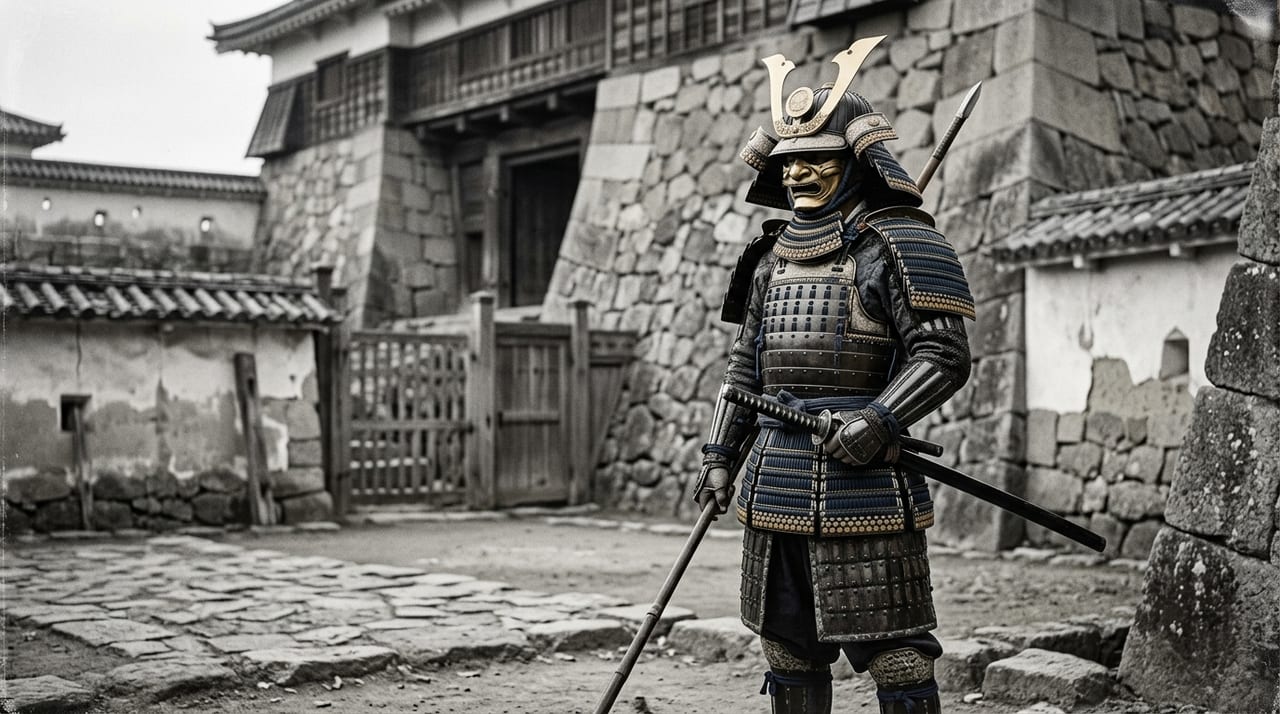
 * Image is for illustrative purposes only.
Katsu Kaishū
勝海舟
The Man Who Saved Edo Without Drawing His Sword
Description
From Swordsman to Navy Man
In Bunsei 6 (1823), Katsu Kaishū (real name: Katsu Yoshikuni) was born into the household of a hatamoto. In his youth he studied swordsmanship at Shimada Toranosuke's dojo and received a full certificate of mastery in Jikishinkage-ryū, becoming an outstanding swordsman. Kaishū, however, soon turned to the study of Western learning, in particular rangaku, gunnery, and naval arts. This shift shows his exceptional intellect and flexible mind. It was the decision of a master swordsman to choose, beyond his own weapon, the weapon of a new age.
Crossing the Pacific on the Kanrin Maru
In Ansei 7 (1860), Kaishū boarded the Kanrin Maru as chief instructor (kyōjukata tōdori) of the Naval Training Institute (Gunkan Sōrenjo), crossed the Pacific Ocean, and reached San Francisco. This voyage was a symbolic event in Japan's modernization. Through this experience, Kaishū became convinced that fundamental reform was necessary for Japan to deal on equal terms with the Western powers. After returning home, he devoted himself to developing the navy. While serving as vice commissioner of warships (gunkan bugyō-nami) and then commissioner of warships (gunkan bugyō), he established the Kobe Naval Training Center.
Meeting Sakamoto Ryōma
In Bunkyū 2 (1862), a young man visited Kaishū. That was Sakamoto Ryōma. Ryōma is said to have initially visited with the aim of assassinating Kaishū, but he was overwhelmed by Kaishū's words and became his disciple. Kaishū explained to Ryōma the importance of the navy and the inevitability of opening the country, which had a decisive influence on the formation of Ryōma's ideas. The relationship between the two became a spiritual bond beyond that of teacher and disciple. Ryōma later played an active role in important moments of the late Tokugawa and Meiji Restoration period, such as mediating the Satchō Alliance.
Bloodless Surrender of Edo Castle
In the 3rd month of Keiō 4 (1868), Katsu Kaishū met with Saigō Takamori and achieved the bloodless surrender of Edo Castle. This historic negotiation prevented the tragedy of Edo's citizens being caught up in the flames of war, and it is praised by later generations as Kaishū's greatest achievement. Kaishū held a sword but did not draw it, and avoided the greatest crisis. This was a moment that embodied the spiritual significance of the sword as the supreme form of the samurai. Kaishū moved history not through force but through words, wisdom, and sincerity. His example shows the ultimate expression of 'the union of the pen and the sword' (bunbu ryōdō) in the samurai ideal.
Sword and Kaishū's Thought
Kaishū was a swordsman who held a full certificate of mastery in Jikishinkage-ryū. On the recommendation of his teacher, Shimada Toranosuke, he also studied Zen.
Activities after the Meiji Restoration
After the Meiji Restoration, Kaishū held important posts in the new government, including Navy Minister (kaigun-kyō) and Privy Councillor. Through his writings and talks, including 'Hikawa Seiwa,' he passed on the realities of the late Tokugawa and Restoration period to later generations. Kaishū witnessed the end of the age of the samurai with his own eyes, and he sought to carry the samurai spirit that the sword symbolizes into the new Meiji era: sincerity, good faith, and a sense of the big picture. In Meiji 32 (1899), Kaishū died at the age of 75 (full age). As a man who moved the times while holding a sword without drawing it, his name is inscribed in Japanese history.