New Arrivals — Browse our catalog for the latest authentic Japanese sword arrivals. Browse →
August 1945 – 1948
Japan-wide (under GHQ occupation)
Forces
General Headquarters (GHQ) / Supreme Commander for the Allied Powers
Japanese sword preservation advocates
About 16 min read
On August 15, 1945 (Shōwa 20), Japan's defeat was declared through the broadcast of Emperor Shōwa's voice (Gyokuon-hōsō). The General Headquarters of the Allied Powers (GHQ) began disarmament and the confiscation of weapons throughout Japan the following month, and it made swords, along with firearms and artillery, subject to confiscation. This order threatened at its root the heritage of Japanese sword culture built over several centuries, and it became one of the greatest crises in the history of culture.
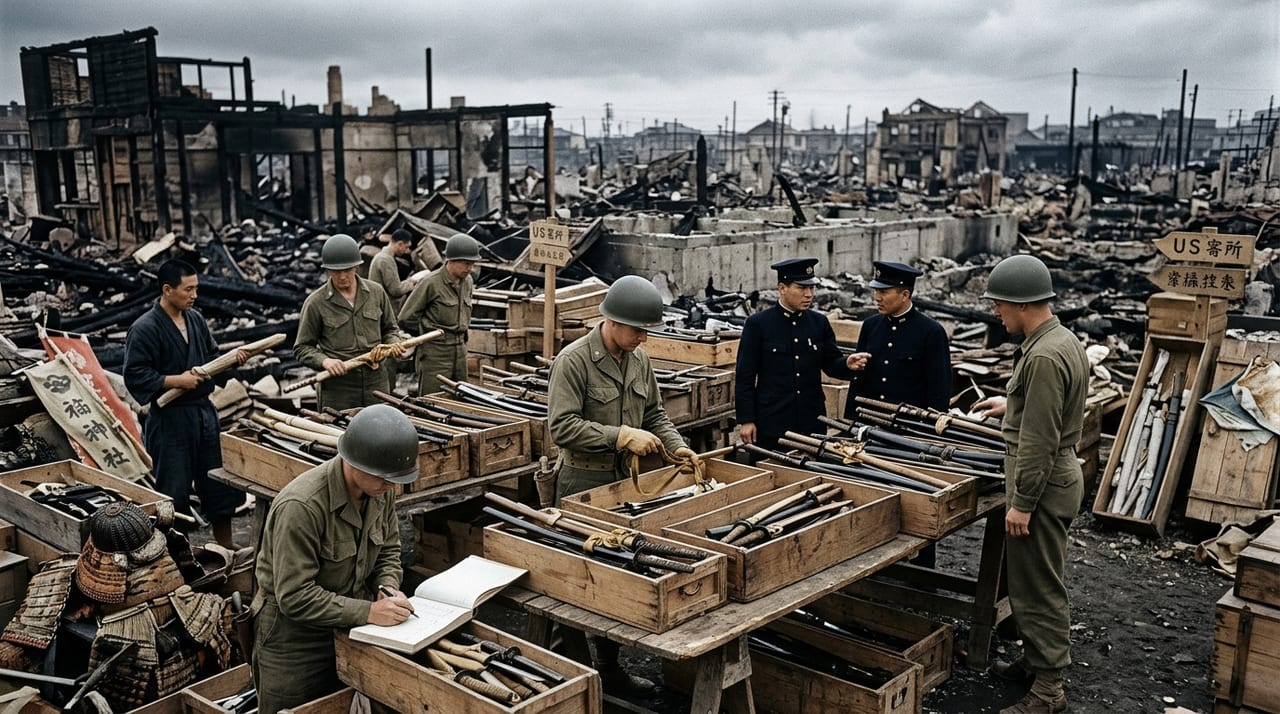
The disarmament directives issued by GHQ (the various directives following the signing of the "Instrument of Surrender" on September 2, 1945) made all swords held by civilians subject to confiscation as "potential weapons," not only military arms. Orders to report and surrender swords were issued to police stations and Occupation Forces garrisons across the country, and swords were collected from households, shrines, and temples nationwide.
The total number of swords confiscated is not known precisely, but it is estimated that the figure may have reached several hundred thousand. Many of them were destined for disposal (dumping into the sea or melting down). Without protective measures, the finest examples of Japanese swords, including works by the celebrated smiths Masamune, Chōgi, and Kotetsu, could have been lost forever.
Of particular concern were swords such as the "Honjō Masamune," a famous blade handed down through the Tokugawa shogunal family that was designated a former National Treasure (kyū-kokuhō) in 1939, whose whereabouts became unknown after confiscation. Tokugawa Iemasa submitted the Honjō Masamune to the Mejiro police station in December 1945. It was handed over to a U.S. military sergeant in January 1946, after which its whereabouts became unknown, and it remains missing to this day.
Sword researchers, swordsmiths, and cultural figures acted immediately in response to this situation. The strategy they adopted was to argue to GHQ that "Japanese swords are not weapons but works of art and cultural properties."
At the center were Honma Junji and Satō Kan'ichi, who were investigating National Treasures at the Ministry of Education. Honma approached Prime Minister Prince Higashikuni Naruhiko, and on September 29, 1945, GHQ issued a memorandum stating that swords of antique value held by well-meaning Japanese could be kept by them after examination. Furthermore, under the Firearms and Swords Possession Prohibition Ordinance (Imperial Ordinance No. 300) of June 1946, the policy was adopted to permit possession of swords that had been examined and certified as "art swords" (bijutsu tōken).
From 1946, under GHQ supervision, a registration system for "art swords" began to operate. Owners reported their swords to the competent police station, and swords certified as art swords after examination by experts were permitted to be possessed. This registration system is the direct predecessor of the sword possession permit system in the present Firearms and Swords Possession Control Law (Jūtōhō).
However, many problems remained. Because examinations could not keep pace, many swords were discarded, and in rural areas many households surrendered their swords without knowing that a registration system existed. Also, many swords that U.S. soldiers took home as souvenirs after confiscation were carried back to their home country, and many of them have not returned to Japan (some have been returned in later years through the efforts of bereaved families).
In 1948 (Shōwa 23), following consultations with GHQ, the "Society for the Preservation of Japanese Art Swords" (abbreviated as Nittōho; English name: Society for the Preservation of Japanese Art Swords = NBTHK) was formally established. Hosokawa Moritatsu assumed the position of its first president.
The main duties of Nittōho are as follows.
First is the operation of the examination system for Jūyō Tōken. Nittōho appraises the quality, period, and maker of swords, and by certifying outstanding examples as Jūyō Tōken, Tokubetsu Jūyō Tōken, Tokubetsu Hozon Tōken, and so on, it established objective standards of evaluation for swords as cultural properties. This examination system forms the foundation of today's Japanese sword market and collecting culture, and its appraisal certificates (Nittōho appraisal documents) carry international authority.
Next is the training and support of swordsmiths. Because the livelihoods of swordsmiths were threatened amid postwar economic turmoil, Nittōho held examinations of newly made swords (Shinsaku Meitō-ten, New Sword Exhibition) to promote the technical improvement and livelihood support of active swordsmiths.
And finally, there is the introduction of Japanese sword culture abroad and the prevention of its outflow. Reflecting on the large-scale outflow of swords overseas during the Occupation period, Nittōho, alongside introducing Japanese swords internationally, also worked to restrict the removal of important swords from the country.
The crisis of GHQ's sword confiscation paradoxically promoted the institutional development of Japanese sword culture. Without the crisis, the founding of Nittōho and the sword possession permit system under the Jūtōhō might not have been put in place so early.
The "art sword registration system" that began during the GHQ Occupation was carried over into the Firearms and Swords Possession Control Law (Jūtōhō), enacted in 1958 (Shōwa 33). This law established a system in which possession of swords with a blade length of 15 centimeters or more (swords, wakizashi, tantō, and so on) was in principle prohibited, and possession was permitted only for those holding a registration certificate.
Registration certificates are issued by the prefectural boards of education. The Firearms and Swords Registration Certificate, which records the period, maker, and form of a sword, continues to be stored and handed down together with the sword today. This system was designed with the art sword registration system of the GHQ Occupation period as its direct precedent, and it is the result of the logic that "Japanese swords are cultural properties" being fixed as is in the legal system.
Today's Japanese sword culture, including its examination system, preservation techniques, and international appreciation culture, is built on the sword protection movement that survived the crisis of GHQ's confiscation. Swords lost to confiscation cannot be recovered, but there is no doubt that the struggle of those who continued to insist, in burned-out Tokyo, that "this is not a weapon but art" has become the cornerstone of modern Japanese sword culture.
That the Japanese sword lives on today is owed not to a victory on the battlefield but to the victory of a cultural argument waged in studies under the Occupation. That very paradox lies at the heart of the historical significance of the GHQ sword confiscation.
The number of swords taken home by U.S. military personnel during the GHQ confiscation period is not precisely known. Some are still held today by private American collectors and museums, and cases of their return, achieved through the efforts of bereaved families, local governments, and researchers, are reported intermittently.
A representative example is the case in which U.S. military veterans or their families came forward saying they "wanted to return them to Japan" and donated swords to Japanese museums or shrines. Such "returns of confiscated swords" continue even today, more than seventy years after the war, showing that the historical event of GHQ's confiscation is a cultural issue still in progress.
Among the confiscated swords, a particular focus is on the votive swords (hōnōtō) taken from shrines and temples across the country. Votive swords are cultural properties directly tied to the history of their shrines, and their return restores the cultural integrity of those shrines. Nittōho and the Agency for Cultural Affairs have also been actively involved in these return efforts, showing that the historical reckoning with GHQ's confiscation continues to this day.
The GHQ sword confiscation was the greatest existential crisis in the history of Japanese swords, and at the same time a turning point that promoted the institutional establishment of swords as cultural properties. Japanese swords became symbols of bushidō through the Sword Abolishment Edict (Haitōrei), the Satsuma Rebellion, and the Russo-Japanese War. By overcoming the greatest trial after the Second World War, they completed the foundation of today's Japanese sword culture.
Postwar Sword Confiscation Era
Era directly corresponding to the GHQ sword confiscation period
Occupation Period and Sword Preservation
Allied occupation era — the backdrop of the sword preservation movement and NBTHK founding
Showa-to (Military Saber Period)
Era of Showa military swords that became the direct target of the postwar confiscation