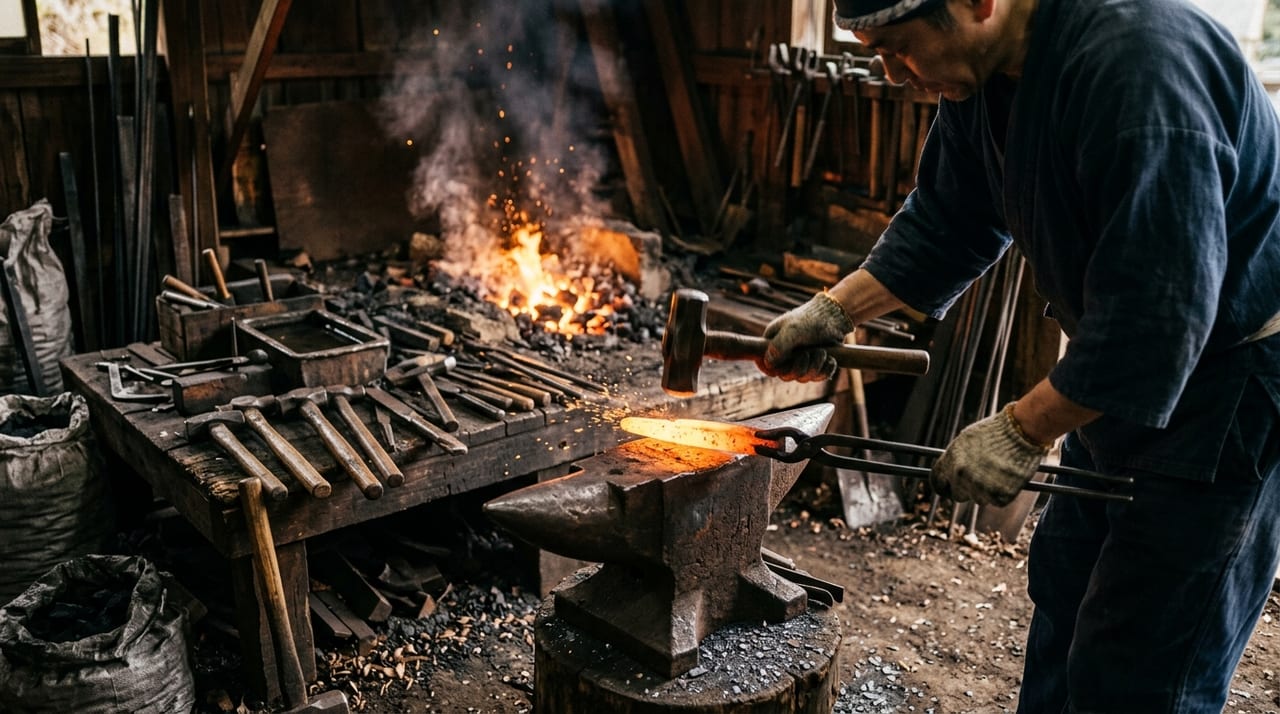
 * Image is for illustrative purposes only.
Takahashi Sadatsugu
高橋貞次
Description
Takahashi Sadatsugu was a modern swordsmith born in April 1902 in Saijō, Ehime Prefecture (formerly Ōmachi village, Nii District). His given name was Kin'ichi, and Sadatsugu was his name as a swordsmith. In 1917, at the age of fifteen, he entered the tutelage of Imperial Household Artist Gassan Sadakazu I and his son Sadakatsu, where he mastered the sword-making techniques handed down in the Gassan family and the fundamentals of blade carving for which the Gassan school was known. After completing his training, he became a trainee at the Chūō Tōken-kai (Central Sword Association) in Tokyo and continued to hone his craft. In 1923 he became independent in his hometown of Saijō and took the art names Ryūōshi and later Ryūsen. He was one of the representative figures of the sword world of the Shōwa era, and he died in August 1968.
Among his honors, the most notable is that in 1955 he was certified as the first holder of Important Intangible Cultural Property (a so-called Living National Treasure) in the field of swords. This was a landmark moment in which the technique of sword-making itself was officially recognized as intangible cultural property that the nation should protect, and Sadatsugu became the first holder of that designation. Prior to this, in 1938, he received the Prime Minister's Prize at the Shinsaku Meitō-ten (new sword exhibition), and in 1944 he was appointed chief swordsmith of the great forge of Atsuta Jingū. He also made many sacred treasure swords for shrines and temples. In 1951 he forged sacred treasure swords for the periodic rebuilding (Shikinen Sengū) of Ise Jingū, and he left many other treasure swords made for official use, including the sacred swords of Kamakura (Tsurugaoka) Hachimangū. He also forged protective swords (mamori-gatana) for the Imperial family.
In his style, he excelled in the Bizen-den tradition and was particularly skilled at the splendid chōji-midare hamon (temper line). His jigane was finely refined and rich in nie, and he made it his principle to produce works of high dignity modeled on old masterpieces. In addition, he showed extraordinary skill in the blade carving of the Gassan school he inherited from his teacher, and he skillfully added carvings such as dragons, giving his works a distinctive character. Works of dignity, marked by excellent forging and a keen edge, are highly valued as among the finest of modern swordsmiths.
Overall, Sadatsugu was the foremost modern swordsmith, with works classed as saijō-saku, and he was a figure who symbolized the postwar revival of the Japanese sword and the movement to preserve swords. The fact that he was the first holder of Important Intangible Cultural Property (a so-called Living National Treasure) in the field of swords shows that sword-making since the modern era regained a firm footing as traditional art, and his name is still passed down today as a benchmark of modern swords.
Famous Works
- Katana, sacred treasure for the Shikinen Sengū at Ise Grand Shrine (Shōwa 26)