Postwar Swordsmiths: The Showa-Era Craftsmen Who Prevented Technical Extinction and the Secret Forging Under Occupation Prohibition
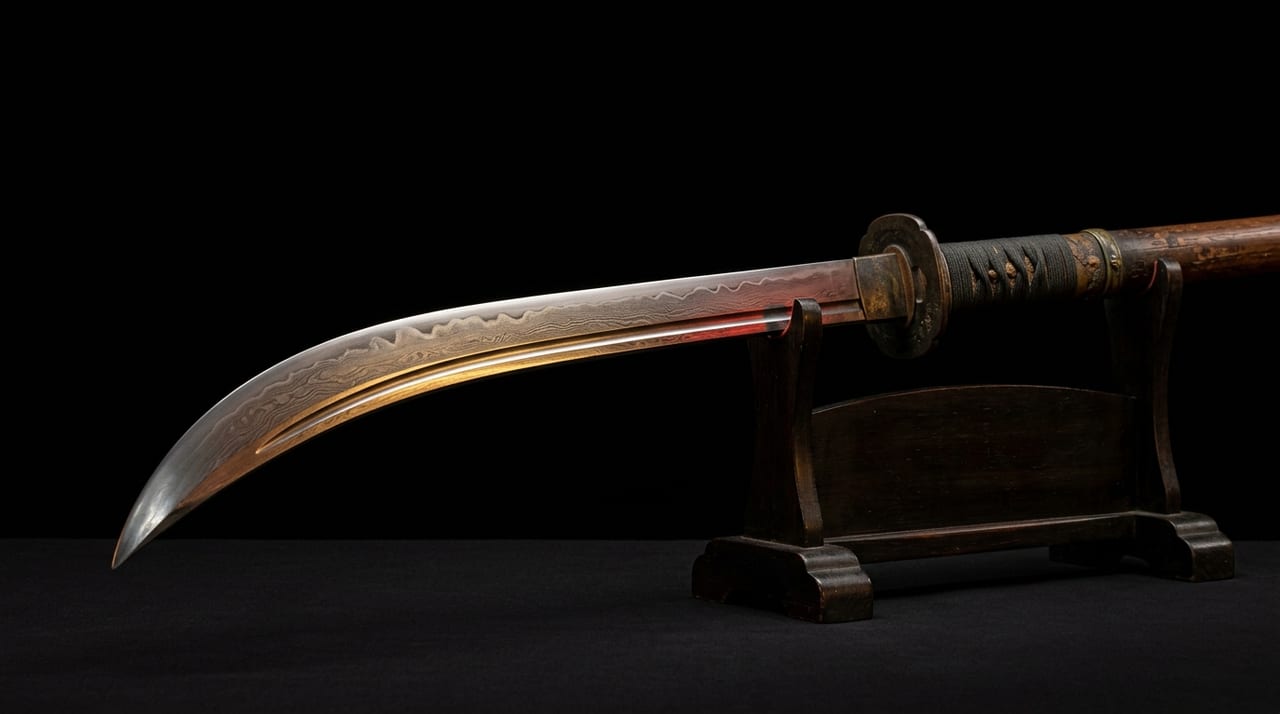 * Image is for illustrative purposes only.
Table of Contents
The Reality of the GHQ Ban — The Legal Basis for "Japanese Sword Manufacturing Prohibition"
The prohibition on Japanese sword manufacturing under GHQ occupation after the war's end is often misunderstood. It is often spoken of as an "immediate and complete ban," but the reality was more complex.
The core of the disarmament directives issued by GHQ from Showa 20–22 (1945–1947) was to regulate the "possession and carrying" of swords and their "use as weapons." Regarding manufacture and preservation as works of art and craft, there were neither clear permission provisions nor prohibition provisions. The actual implementation was left to the judgment of local American military civil affairs teams, and the reality was that responses varied by region. There also remain testimonies that sword smiths were tacitly tolerated in some regions, and it should be considered that an "all-out ban" as a system never materialized.
However, even if it was a legal gray zone, it was difficult to actively engage in manufacturing under the watchful eye of the occupation forces. Most sword smiths were forced to change occupations to make a living, and the environment in which they could continuously practice forging techniques was effectively lost. Technique is something that maintains precision through repetition. Being deprived of the opportunity to swing the hammer meant the degradation of embodied knowledge accumulated over decades.
"Secret Forging" — Repurposing and Concealment to Protect Technique
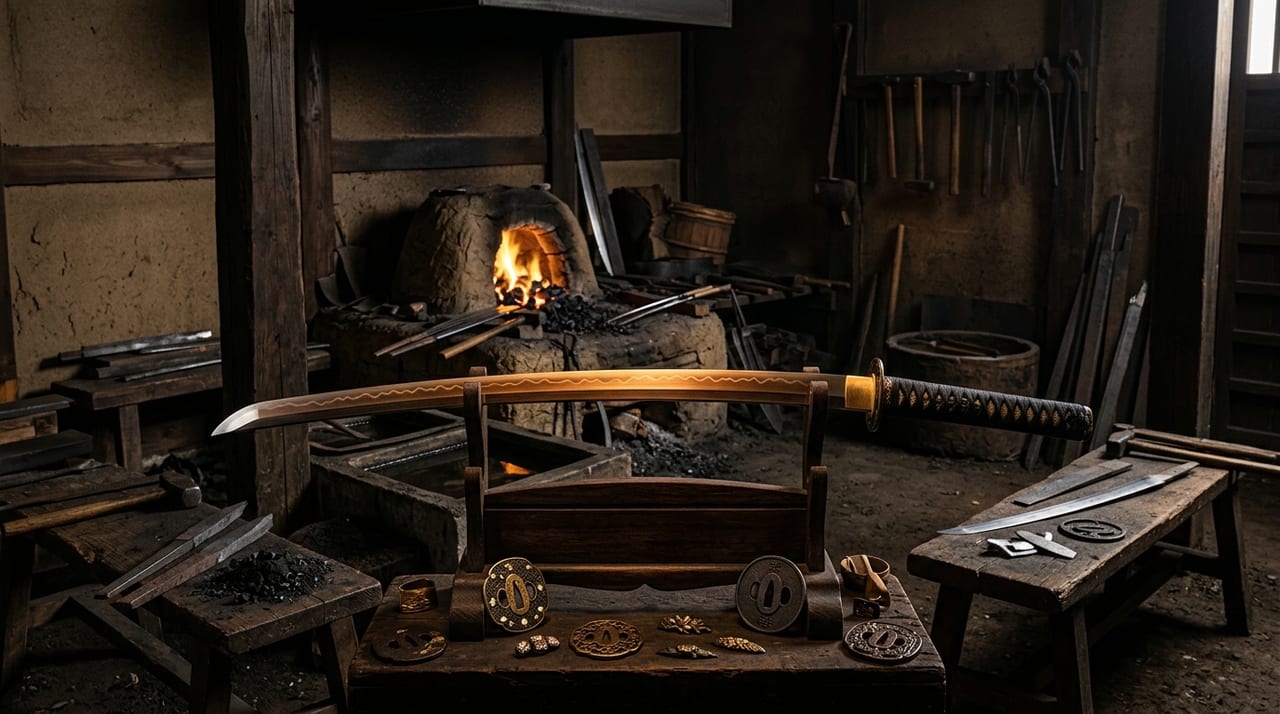
Not all completely laid down their hammers. Some sword smiths, fearful of a break in technique, continued their forging practice while changing its form.
- Repurposing for Farm Tools and Blade Forging: This was the most common method. The occupation forces did not regulate the manufacture of everyday blades such as sickles, hoes, kitchen knives, and chisels. The technical foundation of sword smithing and farm tool forging — steel selection, fire-making, forging, and tempering — were fundamentally the same, and many sword smiths maintained their technical sensibility while striking farm tools. The act of carefully striking a single kitchen knife was, so to speak, hands-on training in forging a "miniature version" of a sword.
- Preservation of Tools and Materials: This was an important form of resistance. The natural whetstones used in sword polishing (nagura, chu-nagura, finishing stones), the mixing ratios of soil used in tempering, the types of lacquer used in sheath coating. There were polishers and sword smiths who recorded this knowledge and passed it on orally to their apprentices. Preserving physical technical heritage was also long preparation for future revival.
- Informal Transmission to Apprentices: This is said to have occurred. Without being able to maintain formal master-apprentice relationships, examples of secretly transmitting techniques to young practitioners in village storehouses and private workshops have been recorded in later oral history surveys. It was this underground-stream-like transmission that became the foundation enabling rapid revival after the ban was lifted.
Showa 28 — Lifting the Ban and the Tamahagane Problem
In Showa 28 (1953), the manufacture of new swords was formally resumed by approval of the Cultural Properties Protection Commission for artistic sword making. It should be noted that the Firearms and Swords Control Law was enacted in Showa 33 (1958), and the basis for resuming sword making was not this law. Sword smiths who had endured the occupation period reopened their workshops and began verifying and restoring their techniques.
However, the greatest challenge confronting them immediately after the ban was lifted was the procurement of tamahagane. The tatara iron-making process had come to a near-complete standstill due to the chaos of the wartime and postwar periods, and there was no stable supply route for obtaining the pure tamahagane that would serve as raw material. Many sword smiths continued their work of recovering their forging intuition while using Western steel or reused steel from old swords as temporary substitutes. While not the ideal state in terms of sword quality, it was a necessary choice to maintain their technical sensibility.
The tamahagane problem began to move toward resolution in the late 1960s through the tatara iron-making revival project led by the Japanese Sword and Art Preservation Association (NBTHK). When the NBTHK tatara in Shimane Prefecture began operations and stable tamahagane supply to sword smiths became a reality, the quality of Japanese swords again approached the standards of antiquity.
The Role of NBTHK — Rendering Technique Visible and Fostering Competition Through Institutional Frameworks
The Japanese Sword and Art Preservation Association functioned not merely as an appraisal and preservation institution, but as an institutional designer of contemporary sword culture.
From Showa 32 (1957) onward, the "New Sword Exhibition of Master Craftsmanship" regularly held by NBTHK became the official arena where sword smiths competed. Exhibited works were evaluated by expert judges on the surface grain, hamon, form, and overall finishing of the blade, and exceptional works were given the honor of awards. Competition functioned as a force promoting quality improvement, and the standard of contemporary swords rose markedly from the 1960s through the 1970s.
The establishment of qualification and certification systems was also a major contribution. Certification systems were established for specialist craftspeople in each process, such as blade smiths, polishers, fitters, sheath makers, and handle wrap specialists, and systems were put in place to ensure technical standards and foster the next generation. Without this system, the craftspeople of each process might have scattered, and it might have resulted in a situation where "a blade could be forged but not polished, and could be polished but not fitted."
The Living National Treasures of the Showa Era — Embodiments of the Chain of Technique
When speaking of the history of the Showa era through which sword culture revived after the difficulties of the occupation period, certain names carry special weight.
| Sword Smith | Characteristics |
|---|---|
| Miyairi Yukihira | Based in Nagano, he continued his independent study and reproduced the techniques of the Soshu tradition at a high level (deeply studied Shizu Kaneuji and Yamaura Kiyomaro). He devoted himself to training apprentices and passed his technique on to many contemporary sword smiths. |
| Gassan Sadaichi (Second Generation) | Active primarily in Osaka, he revived the distinctive grain formation known as Gassan forging for the modern era. |
| Sumitani Masamine | Known for his scholarly approach to pursuing the traditional surface grain of Bizen forging while combining scientific analysis with forging practice. |
| Takahashi Sadatsugu | Excelled in the choji hamon of the Bizen tradition, was proficient in blade carving, and embodied the techniques of the five schools at a high level. |
What these Living National Treasures have in common is that they were a generation that spent their youth and prime years during the occupation period. Living through the gray zone of the prohibition and causing their technique to blossom explosively after the ban was lifted, they walked their lives as smiths beside the danger of discontinuity. It can be said that this tension gave rise to the density embedded in their works.
What Postwar Sword History Tells the Present
The technique that Showa-era sword smiths preserved and rebuilt through the adversity of the GHQ occupation period is the direct wellspring of contemporary sword culture. Most of the sword smiths active today are either in the lineage of disciples of the Living National Treasures or belong to the generation of their grandidisciples. The chain of technique remains alive today, with the works submitted each year to the New Sword Exhibition serving as proof.
The feel of steel forged as farm tools in the age of "secret forging," the tempering soil ratio secretly transmitted in storehouses, the recorded sequence of whetstone grades — all of these reside in invisible form in every contemporary blade. The Showa-era sword smiths were not merely "survivors"; they were bridges that passed the essence of culture on to the next generation. The craft of the Japanese sword can exist today as living technique only because of their quiet resistance and determination.