 * Image is for illustrative purposes only.
Showa-to (Military Saber Period)
昭和刀(軍刀期)
An era of upheaval when vast numbers of military sabers were manufactured alongside the rise of militarism. Quality ranged extremely widely, from industrial mass-produced sabers to authentic nihonto forged by Yasukuni smiths and government-designated smiths using traditional methods. Following the birth of Living National Treasure designations and postwar sword confiscations, nihonto began a new path as fine art.
Description
The Rise of Militarism
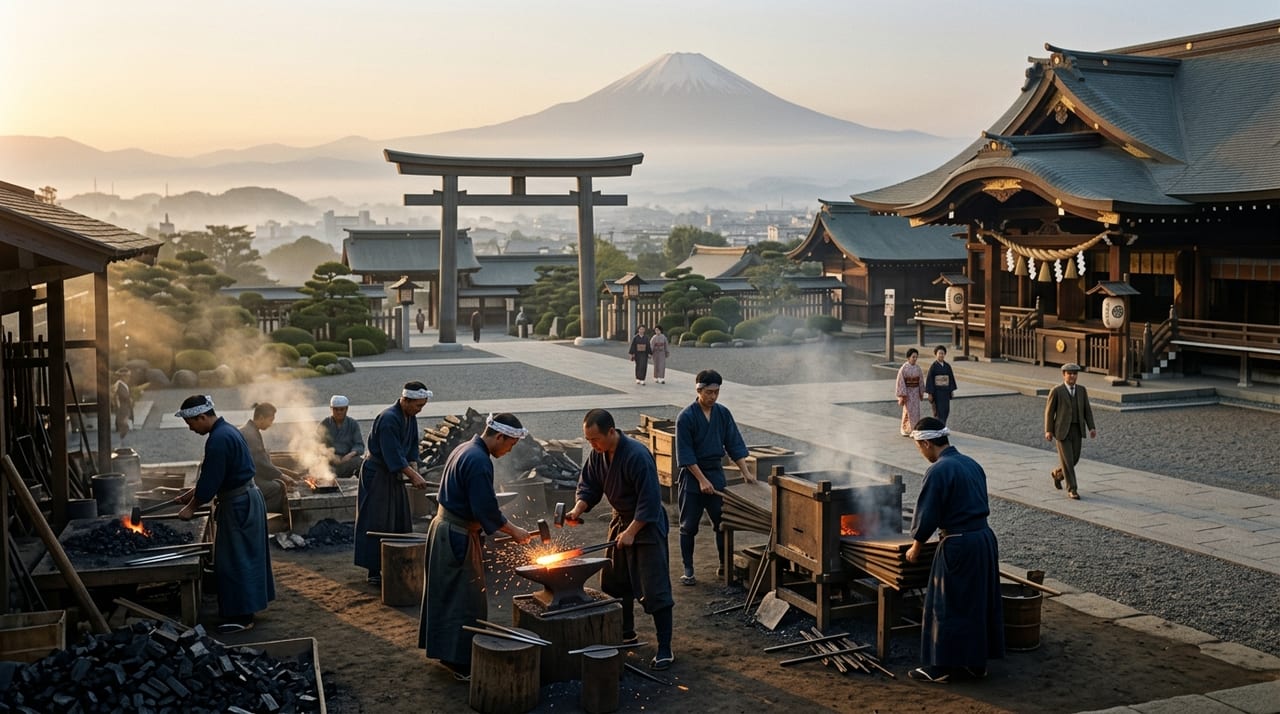
In the early Shōwa era, interest in the Japanese sword revived alongside the rise of militarism. Within the movement to extol the “Japanese Spirit” that had continued since the Taishō era, the Japanese sword was re-evaluated as a spiritual symbol that went beyond a mere weapon, and momentum grew to revive the military sword. In 1933 (Shōwa 8), the Nihontō Tanren-kai (Japanese Sword Forging Society) was established within the grounds of Yasukuni Shrine, aiming to combine the preservation of traditional forging techniques with the production of military swords.
Production of Military Swords
From the outbreak of the Second Sino-Japanese War (1937) to the end of the Pacific War (1945), an enormous number of military swords were produced for officers and non-commissioned officers of the Japanese forces. Army officers were obligated to procure swords at their own expense, and naval officers were likewise, so demand for military swords never ceased throughout the war. Military swords produced in this period are broadly classified into three types according to quality and method of manufacture.
Emphasis on Practicality
The first type consists of mass-produced swords made from modern industrial steels such as spring steel (the material used for automobile springs) and stainless steel. These are called “sunobe-tō” (blanks-forged swords) or “zōhei-tō” (military-manufactured swords), and were shaped by press working or mechanical drawing. Because they did not go through the traditional processes of folded forging and hardening, they are, in the strict sense, industrial products that cannot be called “Japanese swords.” However, they fulfilled a certain function in terms of practicality on the battlefield and were produced in large quantities.
Semi-Traditional Swords
The second type is represented by the Mantetsu-tō (South Manchuria Railway swords) and the Gunsui-tō (Gunsui swords), which are semi-traditional in their manufacture. Mantetsu-tō were made by the South Manchuria Railway Company Limited using the iron-making technology of Manchuria (northeastern China); they combine steel and pure iron produced by modern iron-making, and each blade was forged individually to completion. Gunsui-tō are swords made using Gunsui steel, which was electrically smelted by Gunma Suiden (Gunma Hydroelectric Power Company). These occupy a position intermediate between fully mass-produced goods and traditional Japanese swords, and their quality varies.
Japanese Swords of Traditional Forging Methods
The third type consists of legitimate Japanese swords made from traditional tamahagane (steel produced in a tatara furnace) and forged using the ancient folded forging method by smiths certified as Yasukuni tōshō (Yasukuni swordsmiths) and jumei tōkō (mandated smiths). Yasukuni tōshō were smiths who belonged to the Nihontō Tanren-kai of Yasukuni Shrine and engaged in sword forging; Ikeda Yasumitsu and others are representative figures. Their works were forged in faithful adherence to traditional methods, and are formally certified as art swords even in modern appraisal. They are often mounted in military fittings (gunto koshirae) such as the Type 98 gunto koshirae and the Type 3 gunto koshirae, but the quality of the blades themselves is high, and many works possess appreciative value comparable to kotō (old swords) and shintō (new swords).
Showa Masters and the Postwar Period
Notable Shōwa-era masters include the smiths who were certified as Living National Treasures (Holder of Important Intangible Cultural Property) after the war. Gassan Sadaichi II (Osaka, Shōwa era) was the grandson of the first Gassan Sadaichi and produced dignified works while faithfully preserving the tradition of the ayasugi-hada (diagonal grain pattern). He was certified as a Living National Treasure in 1971 (Shōwa 46), opening the way for the ayasugi-hada unique to the Gassan school to be protected at the national level. Takahashi Sadatsugu studied the styles of old swords from the Taishō era onward, became well versed in the Gokaden (five traditions), and in 1955 (Shōwa 30) became the first smith to be certified as a Living National Treasure. Miyairi Akihira (later Miyairi Yukihira), in Sakaki, Shinano Province (Nagano Prefecture), devoted himself to the revival of the Sōshū-den (Sōshū tradition), and was later certified as a Living National Treasure.
Following the end of the war on August 15, 1945 (Shōwa 20), the General Headquarters of the Supreme Commander for the Allied Powers (GHQ) carried out a large-scale sword confiscation as part of the disarmament of Japan. Through this seizure, a large number of swords were collected and destroyed. However, through the earnest negotiations of the Japanese parties concerned (especially the predecessors of the NBTHK), swords of artistic and historical value were protected as “art objects.” This decision was decisively important for the survival of the Japanese sword, and the modern culture of the Japanese sword stands on the success of these negotiations.
The military sword period is the era that most demands knowledge and discernment from collectors. The range of quality is extremely wide, from industrially mass-produced goods to art works worthy of Living National Treasures, and the quality of the blade cannot be judged from the fittings (gunto koshirae) alone. A multifaceted examination is required, including confirmation of origin, scrutiny of the forging grain and hamon (temper line), and authentication of the signature, and obtaining the advice of a reliable expert is recommended.
Characteristics of This Era
- Industrially mass-produced swords made from spring steel and stainless steel (sunobe-tō and zōhei-tō) were produced in large quantities. They were shaped by press working or mechanical drawing and are industrial products that did not go through traditional forging processes
- Legitimate Japanese swords made from traditional tamahagane using the folded forging method were also produced by Yasukuni tōshō and jumei tōkō. The works of smiths who belonged to the Nihontō Tanren-kai of Yasukuni Shrine are still formally certified as art swords today
- Semi-traditional swords such as Mantetsu-tō (made by the South Manchuria Railway) and Gunsui-tō (made from Gunsui steel of Gunma Suiden) also exist. Made from steel produced by modern iron-making, they occupy a position intermediate between fully mass-produced goods and traditional Japanese swords
- Distinctive military fittings such as the Type 98 gunto koshirae and the Type 3 gunto koshirae. There was a transition from saber-type designs to Japanese sword styles, and the type of fitting is a clue to the year of manufacture
- After the war, GHQ carried out a large-scale sword confiscation, and a large number of swords were seized and destroyed. Through the earnest negotiations of the Japanese parties concerned, swords as art objects were protected, and this decision determined the survival of the modern Japanese sword culture
- With the revision of the Law for the Protection of Cultural Properties (1954), the Living National Treasure (Holder of Important Intangible Cultural Property) system was created. Gassan Sadaichi II, Takahashi Sadatsugu, and Miyairi Yukihira were certified, and the national-level protection of traditional sword-forging techniques began
- The range of quality is the widest in the history of the Japanese sword, with industrial mass-produced goods and art works worthy of Living National Treasures existing in the same era. A high level of discernment to distinguish origin and quality is essential for collectors
- Army officers sometimes procured family-heirloom famous swords or newly made swords at their own expense and had them mounted in gunto koshirae to wear. Famous old swords may be contained within military fittings, so careful investigation is necessary