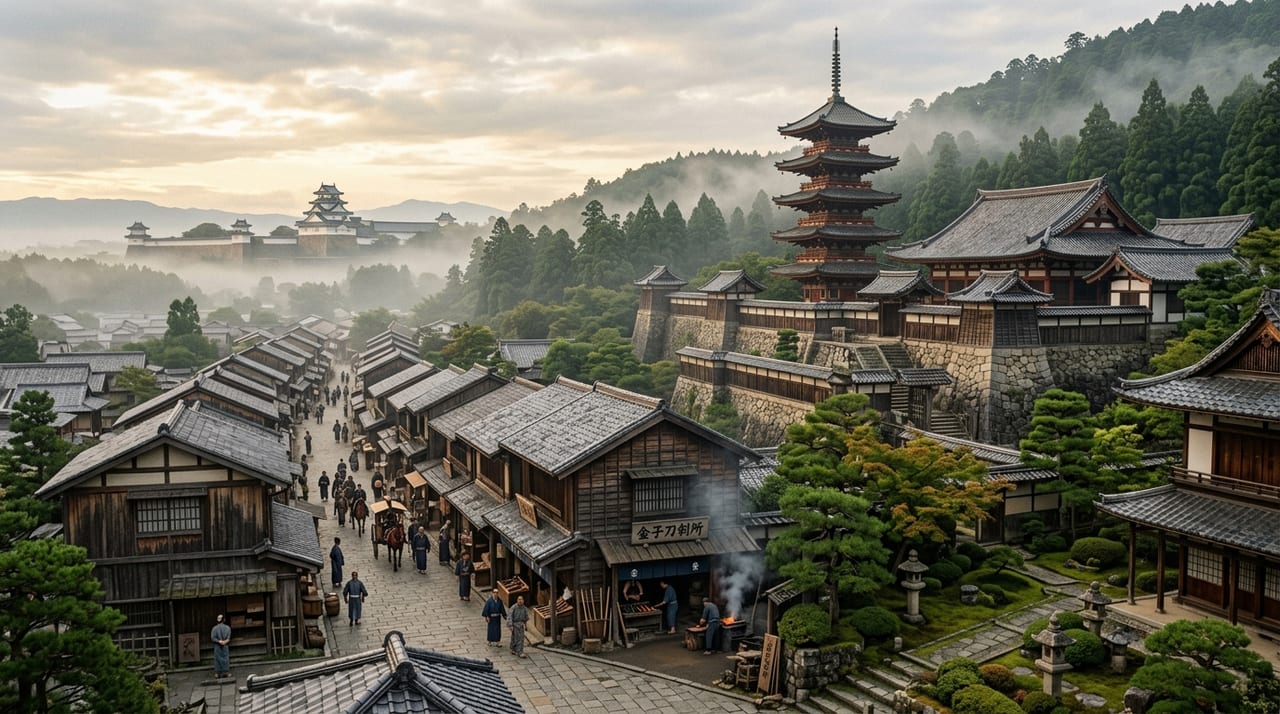
 * Image is for illustrative purposes only.
Emperor Go-Toba's Gobankaji System and Kiku-gosaku — Imperial Sword Promotion in Late Insei Period
後鳥羽上皇の御番鍛冶と菊御作——院政末期の刀剣振興
In 1208 (Jōgen 2), Retired Emperor Go-Toba established the Gobankaji system, summoning master smiths from across the country on a monthly rotation basis, and personally participated in forging, leaving behind 'Kiku-gosaku' blades engraved with chrysanthemum crests on their tangs. This system dramatically elevated the technical standards of Japanese sword-making, bringing together twelve top smiths from Bizen, Bitchu, and Awataguchi in a national sword promotion undertaking.
Description
Historical Background
Retired Emperor Go-Toba (1180–1239) was the 82nd emperor and reigned from 1183 to 1198. After abdicating, he continued to rule through insei. It is also said that after his older half-brother, Emperor Antoku, drowned at the Battle of Dan-no-ura, taking with him the Kusanagi no Tsurugi, one of the Three Sacred Treasures essential to imperial succession, the Retired Emperor's deep concern over that loss turned him toward swords.
In the second year of Jōgen (1208), the 29-year-old Retired Emperor created the Gobankaji system, which summoned skilled smiths from the provinces to Kyoto on a monthly rotation. The system was distinguished not merely by commissioning swords, but by the unusual personal involvement of the Retired Emperor, who applied the yakiba (hardening the blade) himself.
Structure of the Gobankaji System
The Gobankaji was a twelve-smith system (also called the Jōgen Gobankaji), in which one smith was selected each month to assist the Retired Emperor in making swords. There are various theories about the ranking, but master smiths from each region were chosen: from Bizen, Norimune, Nobufusa, Muneyoshi, Sukemune, Yukikuni, Sukenari, and Sukenobu; from Bitchū, Sadatsugu, Tsunetsugu, and Tsugiie; and from Awataguchi, Kuniyasu and Kunitomo.
Among them, Awataguchi Kuniyasu and Kunitomo were renowned smiths representing the Awataguchi school of Kyoto, and Bungo Yukihira appears in the ranking of the twenty-four-smith roster (4th month). The fact that the selected smiths came mainly from Bizen, Bitchū, and Awataguchi shows that the most advanced sword-making technology of the time was concentrated in specific regions of the Kinai and western Japan, not in eastern Japan.
Characteristics of Kiku-gosaku
Swords that the Retired Emperor forged himself through the Gobankaji had a sixteen-petal chrysanthemum crest finely engraved on the nakago (tang). This is why they are called Kiku-gosaku. The use of the chrysanthemum crest as the imperial emblem is said to have begun with Retired Emperor Go-Toba, and Kiku-gosaku were its forerunners.
Very few Kiku-gosaku survive. The tachi Kiku-gosaku held by the Kyoto National Museum is designated an Important Cultural Property. A Kiku-gosaku is also held by the Kurokawa Institute of Ancient Cultures, and it too is designated an Important Cultural Property. It is also said that at the time of the Jōkyū War (1221), the Retired Emperor forged swords to inspire the warriors' fighting spirit.
Representative Smiths and Style
The smiths who took part in the Gobankaji combined their own traditional techniques with the high standard of quality demanded by the court, forming the golden age of Japanese swords from the early to middle Kamakura period. The flowing jigane and the hamon with abundant nie of the Awataguchi brothers Kuniyasu and Kunitomo, and the clean, refined workmanship of Bizen's Norimune, centered on konie, together represent the aesthetics of Japanese swords in the Gobankaji era.
The tachi inscribed with Yukihira's name (Bungo Yukihira), known as the Kokin Denju no Tachi, is a National Treasure held by the Eisei Bunko.
Historical Significance
The Gobankaji system of Retired Emperor Go-Toba was the first and most famous national effort in which the court systematically tried to raise the technical and cultural standards of Japanese swordmaking. Through this system, sword-making skills that had been dispersed across the provinces were temporarily concentrated in Kyoto. This produced technical exchange and mutual stimulation, which promoted the dramatic development of Japanese swords in the Kamakura period.
The system ended when Retired Emperor Go-Toba was exiled to Oki after the Jōkyū War. However, the master smiths nurtured by the Gobankaji remained active in various regions afterward and laid the foundation for the golden age of Japanese swords. Even today, 800 years after the Jōkyū War, Oki carries on efforts to pass down the sword culture connected to Retired Emperor Go-Toba through the Shin-Gobankaji Project.
Characteristics of This Era
- Gathering of renowned provincial smiths in Kyoto under the monthly-rotation bankaji system
- Direct participation of Retired Emperor Go-Toba (yakiba) and the sixteen-petal chrysanthemum crest on the nakago
- Technical exchange among Bizen, Bitchū, and Awataguchi smiths and the leap forward of Kamakura-period swords