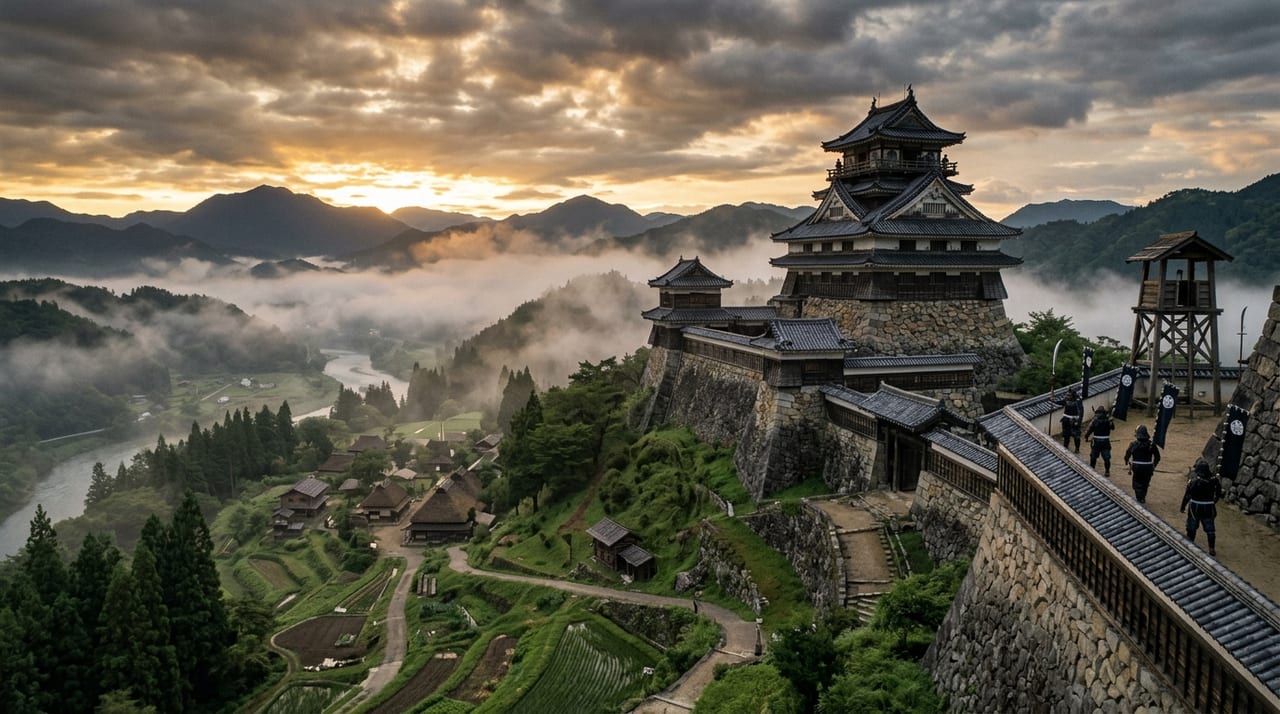
 * Image is for illustrative purposes only.
Eiroku Era — On the Eve of Nobunaga's Ascent
永禄(えいろく)
Sword culture during the Eiroku era (1558–1570), spanning the Battle of Okehazama (1560) and Oda Nobunaga's entry into Kyoto (1568). Mass-produced blades from Sue-Bizen and Mino dominated the battlefield as smiths under Nobunaga's emerging patronage began searching for new aesthetic directions — all while the spread of firearms began to reshape the sword's role in warfare.
Description
The Eiroku era (1558–1570) encompasses twelve years of extraordinary historical density in Japan's Sengoku period. In 1560 (Eiroku 3), Oda Nobunaga defeated Imagawa Yoshimoto at the Battle of Okehazama; in 1568 (Eiroku 11), he entered Kyoto with Ashikaga Yoshiaki as his nominal shogun. Within this short span, the struggle for Sengoku hegemony entered a new phase, and sword culture underwent a major corresponding transformation.
The Eiroku-era sword market was dominated by mass-produced blades from Sue-Bizen and Sue-Mino. Sue-Bizen, centered on Osafune in Bizen Province, mass-produced affordable practical combat blades. The standard form was the uchigatana. To meet the insatiable demand of the age of war, efficient production systems took priority over individual smith identity. Blades marked "Sukesada" and "Kiyomitsu" were supplied in great quantities throughout the nation's battlefields. In Sue-Mino, centered on Seki (present-day Seki, Gifu Prefecture), blades bearing marks such as "Kanemoto" and "Kanesada" were mass-produced, and swords from both production regions formed the primary equipment of Sengoku warlords.
From a technical perspective, what stands out in the Eiroku era is the diversification of hamon (blade pattern) styles. In addition to the gunome and chōji hamon established in the Nanboku-chō and Muromachi periods, more simplified notare and suguha were adopted for mass-produced blades. This change was not merely a decline in quality, but rather a reflection of rational design thinking that anticipated combat damage, repair, and re-polishing in actual warfare. Meanwhile, high-ranking warriors and daimyo continued to commission high-quality custom-made blades, and accomplished smiths throughout the country produced masterwork-quality pieces to individual order.
One of the most significant changes in Eiroku-era sword culture was the rapid spread of firearms (tanegashima). The seeds of firearms tactics—which would culminate at the Battle of Nagashino in 1575 (Tenshō 3)—can be traced to this era. The spread of firearms did not diminish the sword's primary role; rather, it specialized and purified the sword's function in close-quarters combat. The systematization of swordsmanship techniques—drawing, striking, and counter-striking—into formal schools is a characteristic feature of this period.
Nobunaga's entry into Kyoto in 1568 (Eiroku 11) refocused the center of sword culture back toward Kyoto and the Kinai region. Nobunaga was renowned as a connoisseur of swords and showed strong interest in collecting named blades. Nobunaga's aesthetic judgment and political application of swords—gifting prized blades to forge alliances, bestowing named blades as honors for battlefield achievement—foreshadowed the "meibutsu politics" of the subsequent Toyotomi and Tokugawa periods.
The Eiroku era occupies a special position in Japanese sword history as the period of maximum political and social upheaval during the transition from late-Kotō to Keichō Shintō. The technical knowledge and experience accumulated by the smiths who lived through this era would become the foundation that gave the subsequent Momoyama and Keichō periods their distinctive vitality.
Characteristics of This Era
- Peak of Sue-Bizen and Sue-Mino mass production — affordable combat blades dominating battlefields amid insatiable Sengoku demand
- Rapid firearms diffusion and the specialization of the sword — the sword's function refined to close-quarters combat as kenjutsu schools systematized
- Nobunaga's blade collecting and the dawn of meibutsu politics — post-Kyoto entry sword diplomacy prefiguring the Toyotomi-Tokugawa named-blade culture
- Diversification of hamon and rational mass-production design — simplified temper patterns suited to battlefield repair and re-polishing
- Transitional tension between late-Kotō and Keichō Shintō — the maximum turbulence of Sengoku forging the technical foundations for the next era