New Arrivals — Browse our catalog for the latest authentic Japanese sword arrivals. Browse →
September 12, 1568 (Eiroku 11)
Kannonji, Gamō District, Ōmi Province (present-day Ishidera, Azuchi-chō, Ōmihachiman, Shiga)
Forces
Oda-Ashikaga allied forces
Rokkaku forces
About 17 min read
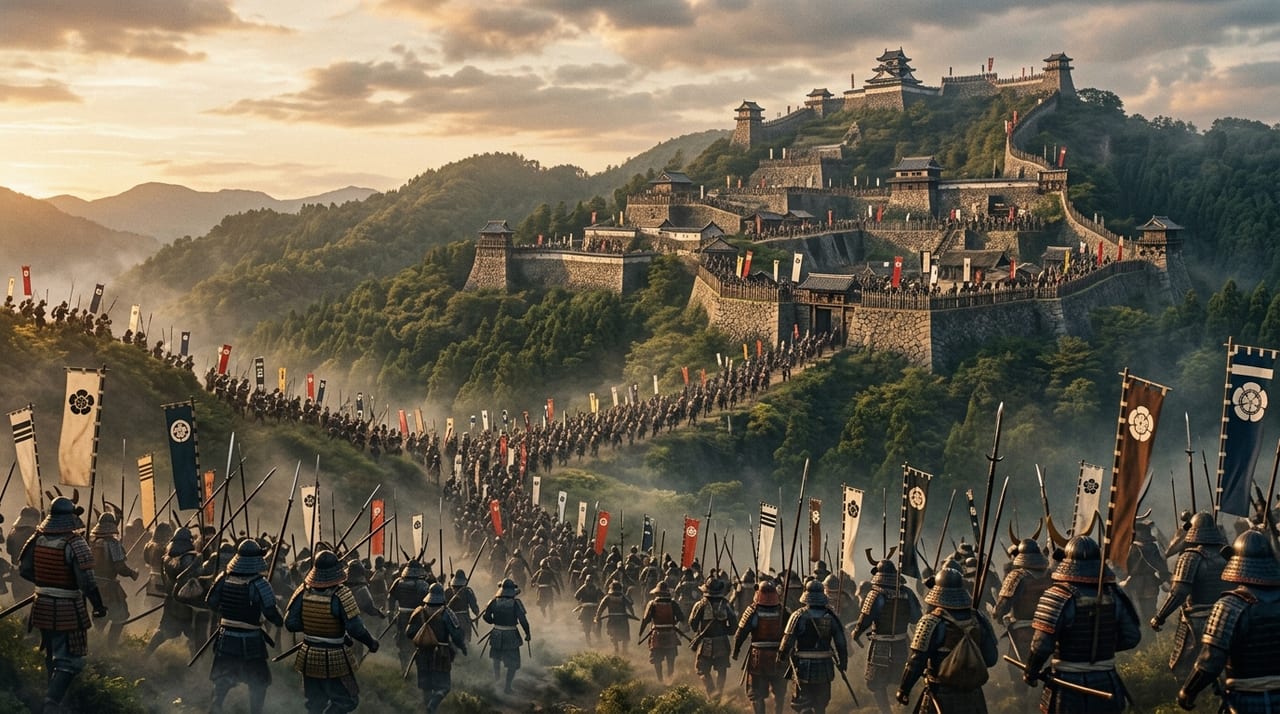
Built atop Mount Kinugasa (approx. 432 meters) in Gamō District, Ōmi Province, Kannonji Castle was the stronghold of the prestigious Rokkaku clan, rulers of southern Ōmi, and one of Japan's largest medieval mountain castles, with over a hundred enclosures cascading from the mountainside to the summit. Its development began in the Nanboku-chō period and was greatly expanded through the 15th and 16th centuries, and in the sheer scale of stonework covering the entire mountain, it was unprecedented among mountain castles of its day. In September of Eiroku 11 (1568), this great fortress confronted the massive army of Oda Nobunaga as he marched toward Kyoto—and met a dramatic end, surrendering almost without a fight.
As powerful shugo daimyō of the Muromachi shogunate, the Rokkaku clan governed the southern half of Ōmi Province. Under the leadership of Rokkaku Sadayori, the clan wielded great influence over politics in Kyoto, serving in a guardian-like role for Shogun Ashikaga Yoshiharu, and at its height its authority is said to have extended from the Tōsandō road all the way into the Kinai region. Kannonji Castle was far more than a mere military stronghold; it functioned as a castle-town in which numerous retainers maintained residences within and below its walls, its prosperity symbolizing the Rokkaku clan's power over southern Ōmi—and this advanced urban functionality is regarded as a forerunner of the early-modern castle towns that would follow. The reckoning with Nobunaga came in the generation of Sadayori's successor, Rokkaku Yoshikata (who took the Buddhist name Jōtei after retirement), and his son Yoshiharu. By this time, though the Rokkaku still held a solid base in southern Ōmi, they had failed to fully keep pace with the rapidly shifting political landscape of Kyoto. The more than one hundred enclosures stretching from the mountainside to the summit of Mount Kinugasa embodied, in their very scale, the magnitude of Rokkaku power.
In September of Eiroku 11 (1568), Oda Nobunaga marched into Ōmi Province at the head of a great army, supporting Ashikaga Yoshiaki, the candidate for the next shogun, in his bid to enter Kyoto. Yoshiaki, after the assassination of the 13th shogun Ashikaga Yoshiteru in Eiroku 8 (1565), had wandered from region to region seeking backing for his claim to the shogunate, and Nobunaga sought to secure legitimate grounds for his march to the capital by championing Yoshiaki's cause. Nobunaga had requested Rokkaku Yoshikata's cooperation beforehand, and envoys of Yoshiaki and Nobunaga held seven days of negotiations with Yoshikata at Kannonji Castle, but Yoshikata refused. Nobunaga is said to have promised that if Yoshiaki achieved his aim, Yoshikata would be raised to the rank of "deputy of the realm," but Yoshikata never accepted the offer. With negotiations broken down, Nobunaga resolved to force his way through by arms. On September 12, Oda forces under commanders including Niwa Nagahide and Kinoshita Tōkichirō (the future Toyotomi Hideyoshi) launched an attack on Mitsukuri Castle, a satellite fortress of Kannonji. A daytime assault was repelled by the defenders' resistance, but that night the Oda army carried out a night attack, and Mitsukuri Castle fell in a single night. Niwa Nagahide and Kinoshita Tōkichirō, who led the night assault on Mitsukuri, would both go on to become trusted senior vassals and daimyō supporting the Nobunaga regime: Nagahide earned the nickname "Rice Gorōza" as a deeply trusted elder statesman, while Tōkichirō would later change his name to Hashiba and then Toyotomi as he rose to become the ruler of Japan. The Battle of Kannonji Castle thus stands as one starting point in the careers of these young Oda retainers, who built up military merit here on their path to prominence.
Upon receiving word that the satellite fortress of Mitsukuri had fallen overnight, Rokkaku Yoshikata and his son Yoshiharu abandoned any thought of resistance at their main stronghold of Kannonji Castle, deserting it and fleeing toward Kōga. That Kannonji Castle—celebrated as one of Japan's mightiest fortresses—was surrendered almost without a fight in the face of Nobunaga's overwhelming army effectively ended Rokkaku rule as daimyō of southern Ōmi. Nobunaga subsequently entered Kyoto with little further resistance and installed Ashikaga Yoshiaki as the 15th shogun. Behind Yoshikata's insistence on seven days of negotiation and his reluctance to risk armed confrontation lay the fact that the Rokkaku still possessed the pride and resources of southern Ōmi's premier daimyō house—but in the end, this delay in judgment proved fatal. After being driven from Kannonji Castle, Yoshikata and Yoshiharu are said to have gone into hiding in Kōga and repeatedly attempted resistance against Nobunaga, but they never regained the power to rule southern Ōmi as they once had. Following the fall of Kannonji, Nobunaga brought Ōmi almost directly under Oda control, making full use of the province's importance as a crossroads linking Kyoto with the eastern provinces. This whole sequence of events is frequently cited in later war chronicles and castle histories as an episode demonstrating that even a formidable mountain fortress could become powerless in the face of an overwhelming army and political isolation.
Ōmi, one of the provinces closest to Kyoto, had long served as a central hub for the production, trade, and aesthetic appreciation of Japanese swords. The 15th and 16th centuries, during which Kannonji Castle flourished, marked the apex of the classical kotō sword era, when the Five Great Traditions—Bizen, Sōshū, Yamashiro, Mino, and Yamato—each produced their finest masterworks. As rulers of Ōmi who oversaw the flow of goods toward the capital, the Rokkaku clan directly benefited from this sword culture; successive heads of the clan, including Sadayori, are said to have maintained relationships with swordsmiths and metalworkers in Kyoto, contributing to the development of Ōmi's own sword culture. After Nobunaga's bloodless seizure of Kannonji Castle, the region would become an even more central stage for sword culture. The many celebrated swords Nobunaga collected are said to have traveled back and forth between Gifu Castle and Azuchi Castle. Today, the Shiga Prefectural Azuchi Castle Archaeological Museum, adjacent to the ruins of Azuchi Castle, displays archaeological materials related to Sengoku-era Ōmi arms and swords, offering a place to learn about the castle and sword culture of Ōmi alongside Kannonji Castle itself.
The remains of Kannonji Castle survive across the entirety of Mount Kinugasa today, with stone walls, enclosures, gate complexes, and dry moats preserved in remarkably good condition. The stonework around the main citadel in particular, built using the nozura-zumi (natural-stone) technique, is especially imposing and conveys the sophistication of medieval stone-wall construction to this day. Within the mountain stands the ancient temple Kannon-shōji, and this castle—uniquely combining fortress and temple in a form known as a "shrine-temple castle"—occupies a distinctive place in the history of Japan's medieval castle architecture. Kannon-shōji remains the 32nd station of the Saigoku Thirty-Three Kannon Pilgrimage and continues to draw many worshippers today, illustrating the historical character unique to Kannonji Castle, where mountain fortress and religious faith became one. From the summit of Mount Kinugasa, visitors can take in a sweeping view of Lake Biwa and the Ōmi Plain, encompassing the full panorama of the southern Ōmi that the Rokkaku once ruled.
The bloodless surrender of Kannonji Castle signified more than the fall of a single sengoku daimyō—it marked a turning point in which the medieval paradigm of mountain-castle warfare gave way to a new era of magnificent administrative-military castle complexes built on plains and lowland hills. Not long after, Nobunaga began construction of Azuchi Castle in the immediate vicinity of Kannonji, creating a castle-town with continental-inspired design and cutting-edge architectural technology. This new style of castle architecture, centered on a soaring tenshu keep, transformed Japan's very conception of castle-building—shifting away from the medieval notion of holing up in a mountain fortress to defend, and toward an early-modern castle that proclaimed its lord's authority to the realm as the center of politics and economy. Barely a few years separated the Battle of Kannonji Castle in Eiroku 11 from Nobunaga's establishment of his full-fledged base for "tenka fubu" (bringing the realm under the sword) at Azuchi. The rapid expansion of power achieved in this short span shows the seeds of Nobunaga's own distinctive style of rule, one that did not rely on old authorities or the traditional forms of castle-building. The Battle of Kannonji Castle thus heralded both the end of the medieval mountain-castle era and the dawn of the new age that Nobunaga was about to forge.
This entire sequence of events surrounding the Battle of Kannonji Castle extended beyond the struggle over a single region of southern Ōmi—it stands as a symbolic episode in Japanese history at large, marking the process by which the authority of the Muromachi shogunate became wholly hollowed out and a new order of governance based on raw power took its place. Looking back at how swiftly Nobunaga would go on to seize control of most of the Kinai region within just a few years, it becomes clear that the bloodless fall of Kannonji Castle held decisive significance as the starting point of that ascent.