New Arrivals — Browse our catalog for the latest authentic Japanese sword arrivals. Browse →
October, Eiroku 12 (1569)
Mimasetoge Pass, Aiko District, Sagami Province (present-day Mimase, Aiko District, Kanagawa Prefecture)
Forces
Takeda Rear-Guard
Hojo Pursuit Force
About 12 min read
In the eleventh month of Eiroku 11 (1568), Takeda Shingen invaded Suruga and effectively destroyed the Imagawa clan. This broke the "Kōsōsun Triple Alliance" concluded in 1554—an alliance binding Takeda, Hojo, and Imagawa in mutual non-aggression.
The Imagawa's decline meant that Suruga fell under Takeda control, a grave threat to the Hojo. The Hojo domain—Sagami, Musashi, and Izu—now directly bordered Takeda territory, and relations deteriorated rapidly. Hojo Ujimasa grew hostile over the Imagawa's legacy territories and was forced into an unprecedented position: an "Etsu-Sō Alliance" with Uesugi Kenshin, traditionally the Hojo's greatest enemy, emerged to counter Takeda expansion.
Against this backdrop, Shingen launched an invasion of Sagami in the ninth month of Eiroku 12 (1569) with a large force. His aim was to besiege Odawara Castle, the Hojo stronghold, but the fortress proved impregnable. After several days of siege, Shingen lifted the siege and began his march home to Kai—the prelude to the Battle of Mimasetoge.
To return to Kai, the Takeda army had to cross the mountainous terrain of Sagami via a mountain pass. Mimasetoge Pass, located near present-day Aiko District in Kanagawa Prefecture, was a critical point on this return route.
The Hojo, anticipating the Takeda withdrawal, assembled a pursuit force and concentrated it around Mimasetoge Pass. The pursuit was led by Hojo Ujiteru and his younger brother Ujikuni, though Hojo Ujimasa advanced as a supporting force but did not arrive in time for the main battle. Hojo military strength is disputed in the sources, estimated between twenty and forty thousand.
Whether Takeda Shingen had foreseen this situation or whether securing the retreat route was simply standard military practice is unclear. In either case, Shingen was prepared for battle at Mimasetoge. The Takeda army divided into a main force and a rear-guard, positioning themselves to receive the pursuing force at the pass.
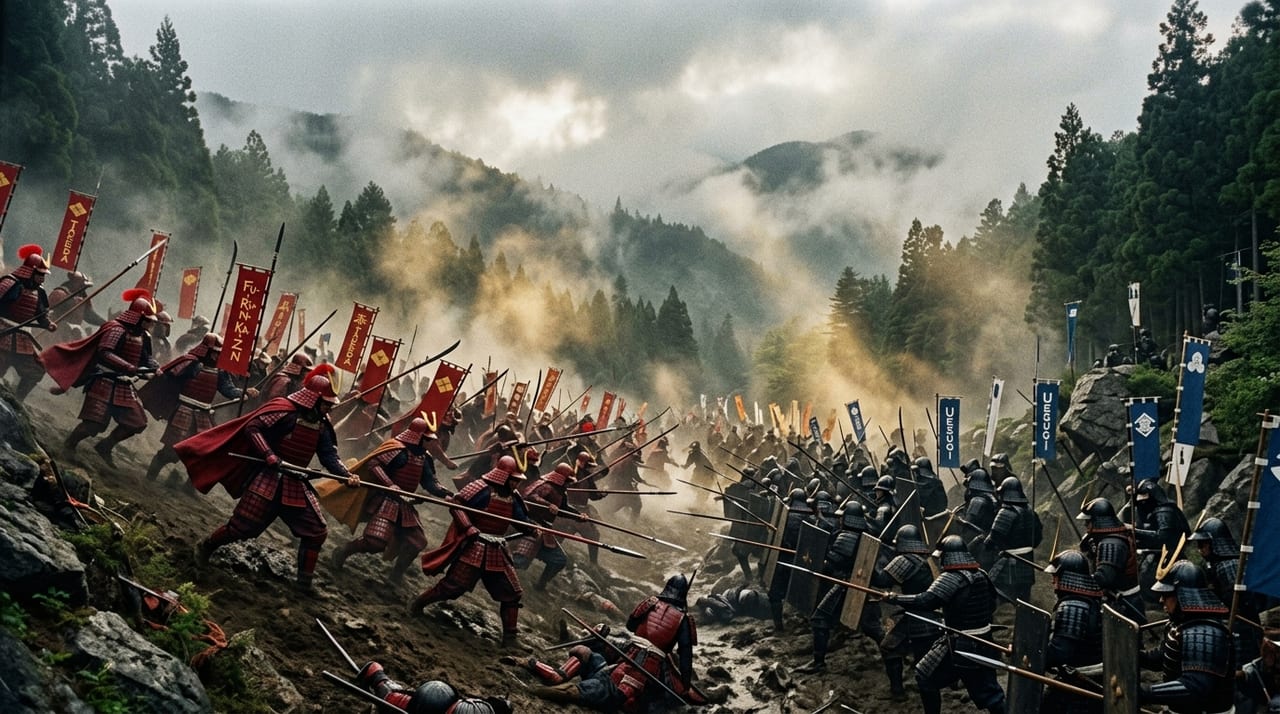
Yamagata Masakage was an indispensable figure in the Battle of Mimasetoge. Masakage commanded the Takeda army's elite unit known for its "Red Armor."
"Red Armor" refers to units whose armor, banners, horse-gear, and equipment were all uniformly lacquered red. This striking unified appearance was not merely aesthetic but calculated for battlefield visibility and psychological intimidation. The visual impact of a red-armored mass charging forward shook enemy morale.
At Mimasetoge, the red-armored unit under Masakage's command launched a fierce charge against the Hojo pursuit force arrayed at key positions on the pass. The steep mountain terrain prevented the larger Hojo force from deploying effectively, neutralizing their numerical advantage. The Takeda army successfully repulsed the Hojo pursuit, maximizing the terrain's defensive advantages.
In this battle, Takeda samurai commander Asari Nobumine fell in combat. Nobumine was a prominent Takeda general whose death was a significant loss for Takeda.
The Battle of Mimasetoge draws historians' attention because of the strategic intent Takeda Shingen demonstrated throughout his Sagami campaign.
Shingen surely knew that storming Odawara Castle would be difficult. Yet why did he lead a large force into Sagami, besiege Odawara, and then withdraw?
One interpretation is the "demonstration strategy" theory. Shingen's goal was not to capture Odawara Castle but to prove internally and externally that "the Takeda army can freely march to the Hojo's stronghold." This damaged the Hojo's prestige and impressed upon the daimyo of Kanto the Takeda's superiority.
Another is the "plundering expedition" theory. As the Takeda army passed through Sagami, it looted the region and brought resources and personnel back to Kai. Military expeditions could serve as financial supplements for Sengoku daimyo.
Whichever interpretation is correct, the Takeda army's victory at Mimasetoge enabled safe passage home and achieved its strategic objectives.
After the Battle of Mimasetoge, the Takeda-Hojo conflict continued. Hojo Ujimasa conducted complex diplomacy with both Takeda Shingen and Uesugi Kenshin while struggling to maintain Hojo dominance in Kanto.
The Hojo faced multifaceted challenges. In the east, tension with the Satomi clan (Shimosa and Awa); in the west, Takeda pressure; in the north, Uesugi Kenshin's Etsu-Sō Alliance—pressure from three directions. Ujimasa was a capable administrator, but facing two giants simultaneously had diplomatic limits.
When Shingen died of illness in Genki 4 (1573), four years after the Sagami invasion, Takeda pressure on Kanto temporarily eased. But under Takeda Katsuyori, relations remained strained, and Takeda-Hojo tension persisted intermittently until the Takeda clan's fall in Tenshō 10 (1582).
Yamagata Masakage's Red Armor unit demonstrated at Mimasetoge had profound influence on posterity. After the Takeda clan's destruction, the tradition of the Red Armor was inherited by Ii Naomasa, one of the Tokugawa Four Heavenly Kings.
Ii Naomasa actively recruited Takeda survivors and absorbed Takeda military knowledge, tactics, and equipment into the Tokugawa army. The symbol of this was the inheritance of the Red Armor tradition. The red-lacquered armor tradition that shone at Mimasetoge continued after the Takeda's fall as the "Ii Red Armor," living on until the Battle of Sekigahara.
Military culture during the Sengoku period was transmitted through the absorption of the defeated's techniques by the victor. The Battle of Mimasetoge is recorded as a Takeda victory, yet the martial arts, tactics, and equipment of the generals who fought there lived on in Japanese military history long after the Takeda clan's destruction.
Sagami Province, the site of Mimasetoge, holds special significance in the history of the Japanese sword. The Soshu tradition, centered on Kamakura, was established by master swordsmiths like Masamune, Yukimitsu, and Sadamune. As one of the Five Great Traditions of Japanese swordmaking, it exerted enormous influence.
During the Hojo era, swordsmiths gathered in the Odawara castle town, making it a center of Kanto sword culture. The successive Hojo rulers, beginning with Ujiyasu, were known to be lovers of swords, and references to swords appear in materials such as the "Hojo Sandai-ki."
The swords borne by the Hojo soldiers who clashed with the Takeda army at Mimasetoge were surely practical blades forged by swordsmiths of Sagami or Mino. The swords scattered in the Mimasetoge mountains have slept in the soil of the hills for four hundred years.