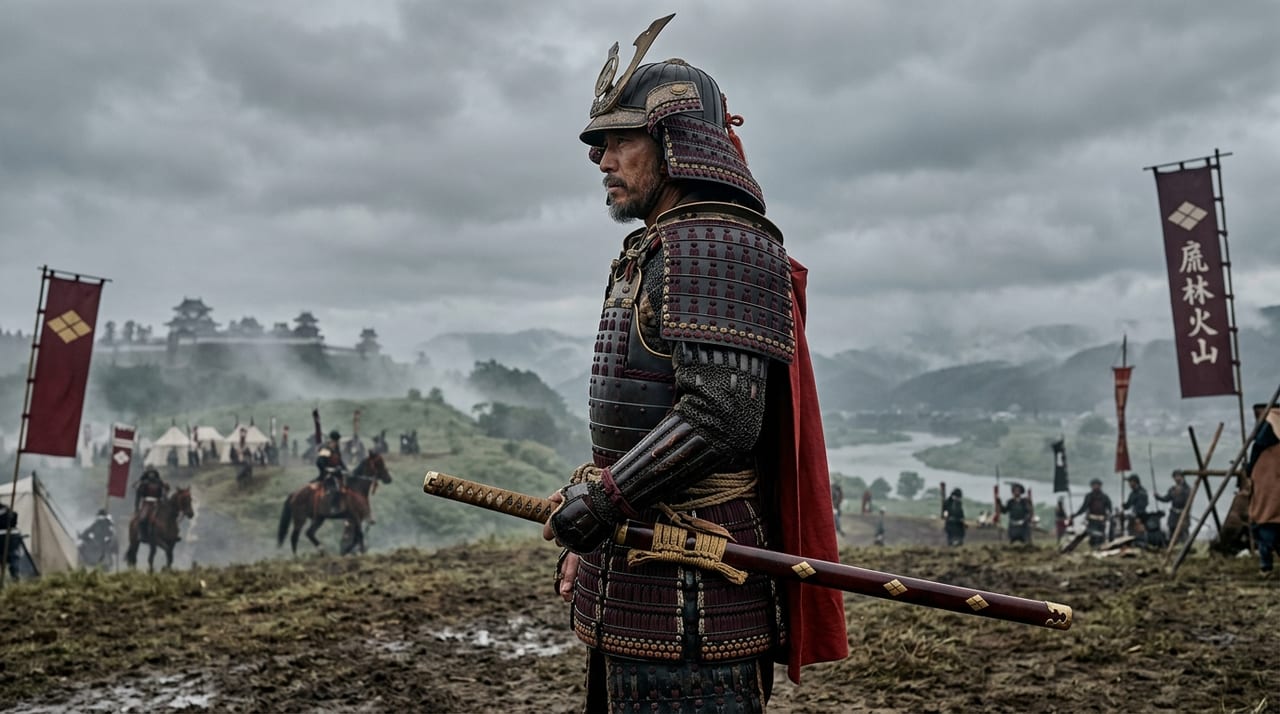
* Image is for illustrative purposes only.Takeda Nobushige
武田信繁
The Perfect Deputy — Shingen's Most Trusted Brother, Fallen at Kawanakajima
Description
The Takeda Clan's Treasure: Nobushige
Born in Kai Province in Daiei 5 (1525), Takeda Nobushige served as vice commander under his older brother Shingen in the Takeda military coalition, the most formidable force of samurai in the Sengoku period, embodying the ideal of a Kai warrior and renowned general. Known by the title Tenkyū, he was so highly esteemed within the Takeda household for his character, martial prowess, and strategic wisdom that his brother Shingen himself openly declared himself inferior to Nobushige—a remarkable admission from a man not known for humility. The precepts recorded by Nobushige himself, known as "Nobushige's Memoranda (Ninety-Nine Articles of Household Law)," set down the principles of the samurai way and exerted a profound influence on martial thought in later ages.
The Battle of Kawanakajima and His Final Stand
In September of Eiroku 4 (1561), the Fourth Battle of Kawanakajima was passed down through history as one of the most brutal clashes of the Sengoku period. An unprecedented event occurred when Uesugi Kenshin drove directly into the Takeda command post, and the legendary scene of "Three Cuts, Seven Cuts"—in which Shingen narrowly escaped destruction by warding off Kenshin's sword with his war fan—became widely renowned. In the chaos of that battle, Nobushige fought valiantly in the front lines until he at last fell to the Uesugi spear wall. The loss of his younger brother inflicted upon Shingen a wound that never fully healed; it is said that from that time onward, Shingen constantly made offerings before Nobushige's memorial tablet.
Tenkyū's Taste in Swords
Nobushige was known throughout the Takeda household as a man of exceptionally keen discernment in sword appraisal. The Takeda clan had maintained a long-standing tendency, from the time of Takeda Nobutoyo, to favor the works of master swordsmiths in the Sōshū school—disciples in the line of Masamune—and Nobushige likewise favored the powerful, vibrantly forged blades of the Sōshū tradition. The "Tenkyū-Masamune," transmitted as a sword owned by Nobushige, is a masterwork that bears the unmistakable character of the Sōshū Masamune line, its refined jigane and spirited hamon embodying the soul of a warrior who endured the fierce battle of Kawanakajima. Furthermore, a long sword bearing the signature "Kagekō" of Osafune is transmitted as one of Nobushige's swords, a masterwork that manifested the fusion of Bizen Osafune technique with Sōshū tradition.
The Samurai Ideal
The memoranda compiled by Nobushige are known to have set forth the principles that a samurai must uphold, concentrating the teachings of bushidō on four pillars: filial piety toward parents, loyalty to one's lord, benevolence toward one's retainers, and self-mastery. Shingen held these memoranda in high regard and is said to have employed them in the education of his legitimate son Yoshinobu. After Nobushige's death, the Kai military coalition gradually lost its cohesion, foreshadowing the catastrophic defeat at the Battle of Nagashino. This stands as evidence of how invaluable Nobushige's presence was to Shingen.
Swordsmiths and Blade Culture of Kai
Kai Province, governed by the Takeda, possessed its own collective of swordsmiths known as the "Kai swordsmiths," who supplied the weaponry needs of the Takeda samurai corps. Nobushige is believed to have regularly used the works of these local swordsmiths as his everyday martial equipment. While strongly influenced by the Sōshū tradition, the Kai swordsmiths maintained a practical, combat-oriented style rooted in the mountain landscape and character of Kai Province, and produced numerous tachi and uchigatana well suited to the cavalry tactics that the Takeda military coalition prided itself upon.
Notable Swords
- Tenkyū-Masamune — the magnificent tachi attributed to the Masamune school, associated with Nobushige's title Tenkyū; the blade's powerful nie-deki hamon and supple jigane embody the Sōshū aesthetic that the Takeda clan prized; carried into the chaos of Kawanakajima, this sword stands as the emblem of the perfect deputy who died at the front
- Kagemitsu tachi from Osafune — a long-sword by the renowned Bizen Osafune master Kagemitsu, carried by Nobushige on campaign; its technical excellence bridges the Bizen and Sōshū traditions, perfectly matching the refined but battle-ready taste of the Takeda inner circle