New Arrivals — Browse our catalog for the latest authentic Japanese sword arrivals. Browse →
10th month, Eiroku 12 (1569)
Mimasetoge Pass, Aiko District, Sagami Province (present-day Mimase, Aiko District, Kanagawa Prefecture)
Forces
Takeda army
Hōjō pursuit force
About 13 min read
In Eiroku 11 (1568), Takeda Shingen invaded Suruga and effectively destroyed the Imagawa clan. This was an act in which Takeda himself broke the 'Kōsōsun Triple Alliance' concluded in 1554, an alliance in which the Takeda, Hōjō, and Imagawa had each sworn mutual non-aggression.
The decline of the Imagawa, which put Suruga under Takeda control, posed a grave threat to the Hōjō. The Hōjō sphere (Sagami, Musashi, and Izu) now bordered Takeda territory directly, and relations between the two deteriorated rapidly. Hōjō Ujimasa clashed with the Takeda over the Imagawa's former territories, and an unthinkable situation arose: the 'Etsu-Sō Alliance' between Uesugi Kenshin and the Hōjō was formed.
Against this backdrop, Shingen set out from Kōfu in the 8th month of Eiroku 12 (1569) with an army of 20,000 and marched south through Kōzuke and Musashi. On the 1st day of the 10th month of Eiroku 12 (1569), he laid siege to Odawara Castle, the Hōjō home base. But rather than launching a direct assault on the formidable castle, he set fire to the castle town four days later and set out on the road back to Kai. This was the prelude to the Battle of Mimasetōge.
The route the Takeda army had to take back to Kai crossed a pass through the mountainous terrain of Sagami. Mimasetōge Pass, located near present-day Aikawa Town in Aiko District, Kanagawa Prefecture, was a key point on that return route.
The Hōjō anticipated the Takeda retreat route and gathered their pursuit force around Mimasetōge Pass. The pursuit was led by Hōjō Ujiteru and his younger brother Ujikuni. Hōjō Ujimasa advanced as a separate rear reinforcement but did not reach the battle in time. The forces of Ujiteru and Ujikuni that took position at Mimasetōge are said to have numbered 20,000, and the main body of Ujimasa's army, just over 20,000 men, followed behind them.
Whether Takeda Shingen anticipated this situation, or whether securing the retreat route was simply a natural military precaution, he had set up positions for an interception at Mimasetōge. The Takeda army divided into three units: one to hold the front against the Hōjō, one to control Tsukui Castle, and a detached force hidden in the mountains to strike the flank. In this way, they prepared to meet the pursuers at the pass.
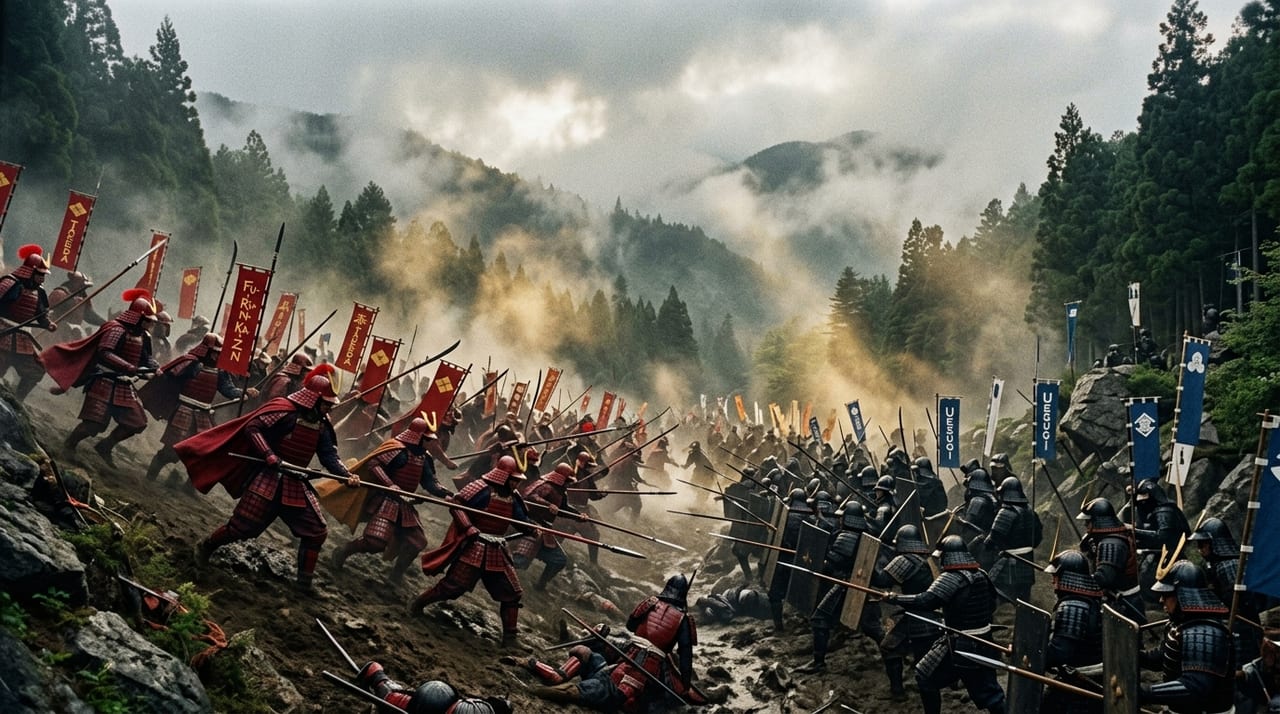
No account of the Battle of Mimasetōge can omit Yamagata Masakage. Masakage was the commander of the elite Takeda unit known for its Red Armor (Akazonae).
Red Armor refers to a unit whose armor, standards, and horse gear were all uniformly painted red. This striking uniform was not mere aesthetics; it was calculated for visibility on the battlefield and for psychological intimidation. The visual shock of a charge by a red mass was meant to shake the enemy's morale.
In the Battle of Mimasetōge, the Hōjō had the upper hand in the early stages. But when Masakage's detached unit crossed Shida Pass and launched a surprise attack on the Hōjō from high ground, the battle is said to have swung sharply toward the Takeda. The Takeda made maximal use of the pass's terrain and succeeded in repelling the Hōjō pursuit force.
In this battle, Asari Nobutane, a senior Takeda commander, was killed. Asari Nobutane was a prominent Takeda general, and his death was a major loss for the Takeda.
The reason historians pay close attention to the Battle of Mimasetōge is the question of the strategic intent Takeda Shingen displayed throughout his invasion of Sagami.
Shingen surely knew that taking Odawara Castle would be difficult. Yet why did he lead a large army into Sagami, besiege Odawara, and then withdraw?
One interpretation is the 'shimei kōdō' (show of force) theory. Shingen's aim was not to capture Odawara Castle, but to demonstrate to both allies and rivals that the Takeda army could freely enter the Hōjō home territory. By this reading, he sought to damage Hōjō prestige and impress upon the daimyō of Kantō the Takeda's superiority.
The other is the 'ryakudatsu kōgun' (plunder march) theory. The Takeda army seized goods along the way through Sagami and carried those goods and people back to Kai. For a Sengoku daimyō, military campaigns could also serve as a means of financial replenishment.
Whichever interpretation is correct, the victory at Mimasetōge allowed the Takeda army to return safely and achieve its strategic aims.
Even after the Battle of Mimasetōge, hostilities between the Takeda and Hōjō continued. Hōjō Ujimasa conducted complex diplomacy with both Takeda Shingen and Uesugi Kenshin while struggling to maintain his control of Kantō.
The Hōjō faced many challenges at this time. In the east, they faced tensions with the Satomi clan of Awa; in the west, they bore Takeda pressure. Moreover, Uesugi Kenshin, with whom they had concluded the Etsu-Sō Alliance, did not carry out the promised deployment into Shinano, and the Hōjō sent letters urging Kenshin to fulfill the agreement.
Afterward, the Hōjō broke with the Uesugi, and in Genki 2 (1571), two years after the Sagami invasion, they again formed an alliance with the Takeda. This alliance broke down again under Takeda Katsuyori, and the two houses remained in conflict until the Takeda house fell in Tenshō 10 (1582).
The exploits that Yamagata Masakage's Red Armor displayed at Mimasetōge had a great influence on later generations. After the Takeda house fell, the tradition of the Red Armor was inherited by Ii Naomasa, one of the Four Heavenly Kings of the Tokugawa.
Ii Naomasa actively took in Takeda survivors and absorbed the Takeda army's military knowledge, tactics, and equipment into the Tokugawa forces. The embodiment of this is the inheritance of the Red Armor. The tradition of red armor that shone at Mimasetōge continued after the fall of the Takeda as the 'Ii Red Armor,' carried through the Battle of Sekigahara and on into the Edo period.
Sengoku military culture was passed down through the absorption of the losers' techniques by the victors. The Battle of Mimasetōge is recorded as a Takeda victory, but the martial arts, tactics, and equipment of the commanders who fought there lived on in Japan's military history even after the Takeda house fell.
Sagami Province, the stage of the Mimasetōge battle, holds a special place in the history of Japanese swords. The Sōshū tradition (Sōshū-den), centered on Kamakura, is a technical system established by brilliant swordsmiths such as Masamune, Yukimitsu, and Sadamune, and it held enormous influence as one of the five traditions of Japanese swords.
In the age of the Hōjō, swordsmiths gathered in Odawara's castle town, which became a center of sword culture in Kantō.
The swords carried by the Hōjō soldiers who clashed with the Takeda army at Mimasetōge were most likely battle-ready blades forged by smiths of Sagami and Mino. The swords scattered in the mountains of Mimasetōge now lie in the earth of the mountain, where they have rested for more than 450 years.