New Arrivals — Browse our catalog for the latest authentic Japanese sword arrivals. Browse →
5th–6th day of the 1st month, Eiroku 12 (1569)
Honkokuji at Rokujō Horikawa, Kyoto, Yamashiro Province (present-day Shimogyō Ward, Kyoto City; the temple relocated to Yamashina Ward in 1971)
Forces
Ashikaga Yoshiaki's forces (defenders and relief army)
Miyoshi Triumvirate forces
About 12 min read
In the fifth month of Eiroku 8 (1565), the 13th shogun Ashikaga Yoshiteru was attacked at the Nijō Palace by the forces of Matsunaga Hisamichi and others, who were allied with the Miyoshi Triumvirate (Miyoshi Nagayasu, Miyoshi Sōi, and Iwanari Tomomichi), and was killed after a fierce fight (the Eiroku Incident). With the shogunate left without a shogun, the Muromachi shogunate saw Yoshiteru's younger brother, Ichijōin Kakukei (later Ashikaga Yoshiaki), return to secular life and put himself forward as a candidate for the next shogun. However, due to obstruction by the Miyoshi Triumvirate, he was unable to enter Kyoto and spent his days wandering from place to place. Meanwhile, the Miyoshi Triumvirate installed Ashikaga Yoshihide, Yoshiteru's cousin, as the 14th shogun and carried forward their own administration.
After relying on Asakura Yoshikage of Echizen, Yoshiaki came to place himself under the protection of Oda Nobunaga, who had brought Owari and Mino under his control. In the ninth month of Eiroku 11 (1568), Nobunaga, upholding Yoshiaki, led a large army to Kyoto. Pushing aside resistance from the Miyoshi Triumvirate, the Rokkaku clan, and others, he pacified Kyoto and its surrounding area in a short time. On the 18th day of the 10th month of that same year, Yoshiaki received the imperial appointment as Sei'i Taishōgun from the court and formally assumed the post as the 15th shogun. At this time, the temple chosen as Yoshiaki's temporary residence was Honkokuji, a Nichiren Buddhist temple located in Rokujō, Kyoto. After achieving the purpose of his march to the capital, Nobunaga returned to his home province of Mino on the 26th day of the 10th month.
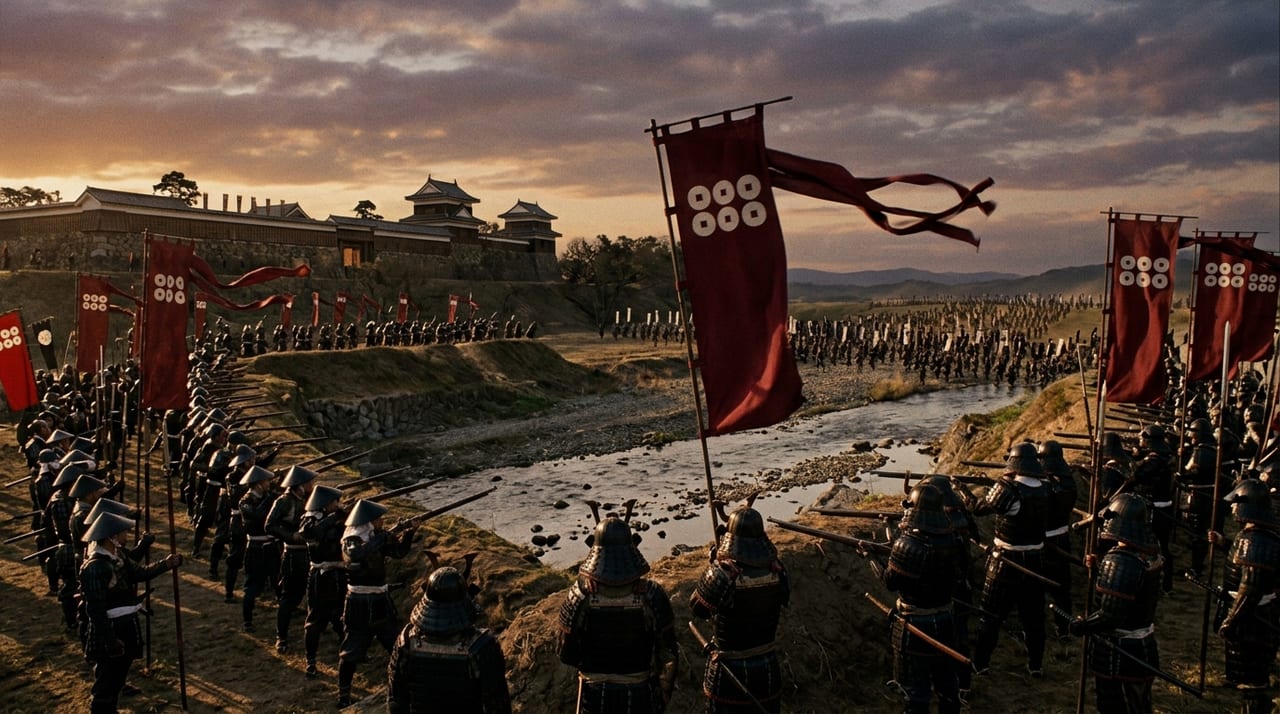
Seeing Nobunaga's departure from the Kinai region as an opportunity, the Miyoshi Triumvirate regrouped their forces in the Kawachi and Awa areas and prepared a counterattack aimed at retaking Kyoto and eliminating Yoshiaki. On the 4th day of the 1st month of Eiroku 12 (1569), the Triumvirate's forces began to move in a way that cut off Yoshiaki's escape routes. In the early hours of the 5th day of the 1st month, they broke into central Kyoto and surrounded and attacked Honkokuji. Among the Triumvirate's forces were also commanders who, each for their own reasons, bore enmity toward the Nobunaga-Yoshiaki side, such as Saitō Tatsuoki, driven out of Mino by the Oda clan, and Ogasawara Sadayasu (and Ogasawara Nobusada), driven out of Shinano by the Takeda clan. The war chronicle Ashikaga Kiseiki records their total as "over ten thousand."
Besides Yoshiaki himself, Akechi Mitsuhide, who had been guarding Yoshiaki's person since the march to the capital, and shogunal retainer Hosokawa Fujikata and others were stationed at Honkokuji. This Honkokuji Incident is also known as a reliable early record of Akechi Mitsuhide's military actions in the historical sources. The temple's defenses were by no means sufficient, but Mitsuhide and the others fought valiantly with a small force and endured a night of fighting.
News of the raid on Honkokuji immediately reached the commanders of the Kinai region who were close to Yoshiaki's side. On the 6th day of the 1st month, the forces of Miyoshi Yoshitsugu of Kawachi (head of the main Miyoshi line, who had turned to Nobunaga's side), Hosokawa Fujitaka, Ikeda Katsumasa of Settsu, Araki Murashige, and others gathered one after another around the Katsura River. They set up a position to strike the Triumvirate's army besieging Honkokuji from behind. Caught in the pincer attack, the Miyoshi Triumvirate's army collapsed completely and fled toward Shikoku. In this battle, Ogasawara Nobusada, who had sided with the Triumvirate, is said to have died. There is also an anecdote that Nobunaga himself, while in Mino, received this urgent report and hastily led his forces toward Kyoto, pushing through snowy mountain roads. However, by the time he arrived, the fighting had already ended.
The Honkokuji Incident resulted in exposing the vulnerability of Yoshiaki's personal protection, and Nobunaga took this as an occasion to introduce policies strengthening his control over shogunal authority. On the 14th and 16th days of the 1st month of Eiroku 12, Nobunaga prohibited misconduct and arbitrary actions by shogunal retainers and enacted the "Denchū Gohatto," which imposed a certain framework on the shogun's exercise of governmental affairs, and had Yoshiaki approve it. This is regarded as a turning point in which the initiative in the Nobunaga-Yoshiaki relationship tilted greatly toward Nobunaga.
Furthermore, Nobunaga ordered the construction, near the former Nijō Road, of a new palace (the Nijō Palace) with solid stone walls and moats as a shogunal residence to replace the poorly defended Honkokuji. It is said to have been completed in barely 3 months, with materials and labor mobilized from the daimyō, temples, and shrines. In the 4th month of that same year, Yoshiaki moved to this new Nijō Palace, and for some time thereafter maintained his arrangement as shogun under the Nobunaga regime.
Although relatively small as a single military clash, the Honkokuji Incident holds important historical significance from two perspectives: the power relationship between Oda Nobunaga and Ashikaga Yoshiaki, and the political rise of Akechi Mitsuhide. For Nobunaga, it became an opportunity to use the shogun's military vulnerability as a pretext for strengthening control. For Mitsuhide, it became an early achievement establishing his presence as a commander directly under Yoshiaki. After the incident, diplomatic relations between Nobunaga and Yoshiaki and the Mōri clan were strengthened, and a system for containing the Miyoshi in the direction of Shikoku was continuously maintained until around Tenshō 4 (1576).
This series of events is recorded in multiple sources, including the Shinchō Kōki and Ashikaga Kiseiki. Although there are some discrepancies among the sources regarding the composition of the commanders who took part and the scale of their forces, the incident continues to hold an important place in the study of Sengoku-period political history. It is regarded as a symbolic event showing both the fragility of Yoshiaki's regime and the rapid expansion of Nobunaga's power.
The fighting at Honkokuji was close combat in the confined space of a temple, and is considered to have been mainly hand-to-hand fighting with tachi and uchigatana. That Akechi Mitsuhide, who would later stand at a turning point of history in the Honnō-ji Incident, first left his traces as a commander in the defensive fighting at Honkokuji is also an intriguing episode in tracing the human history of the samurai who wore nihontō.