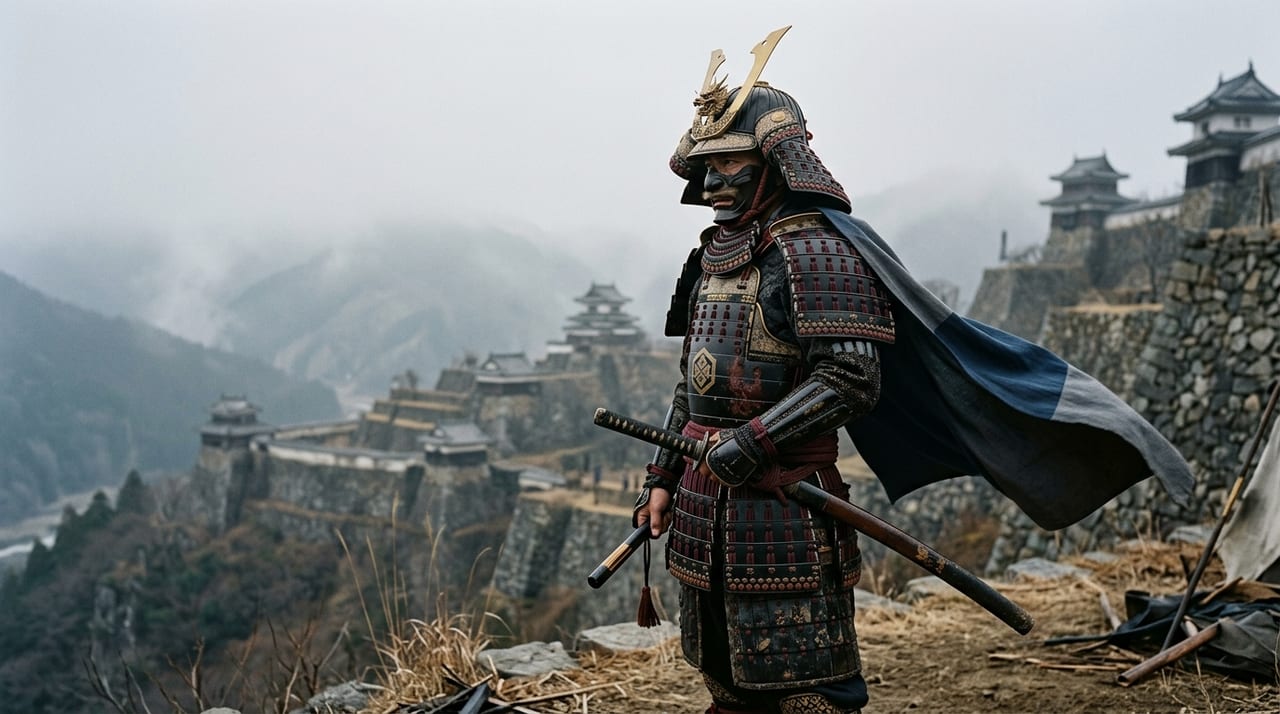
 * Image is for illustrative purposes only.
Hōjō Ujimasa
北条氏政
4th Head of the Later Hōjō Clan, Lord of Odawara Castle
Description
Hōjō Ujimasa (1538–1590) was a Sengoku period warrior and the fourth head of the Later Hōjō clan, who built a major power base in the Kantō region. With Odawara Castle in Sagami Province as his base, he established a vast sphere of control across most of Kantō at the height of his power.
Ujimasa was the second son of Hōjō Ujiyasu. After the early death of his elder brother Ujichika, he became the heir. Under his father's tutelage, he grew into a warrior of excellence in both civil and martial arts. He succeeded to the headship of the family in 1559 and, while continuing to confront powerful neighbors such as the Takeda, Uesugi, Satake, and Satomi, sought to expand the territory of the Hōjō clan. In particular, he carried out strategic diplomatic and military actions, including the Battle of Mimasetoge (1569), a confrontation with Takeda Shingen, and his intervention in the Otate Conflict (1578), which followed the death of Uesugi Kenshin. He steadily expanded the foundation of Kantō rule he had inherited from his father, Ujiyasu, and at its height the Hōjō clan held a vast sphere of control extending across the provinces of Musashi, Sagami, Izu, Kazusa, Shimōsa, Kōzuke, Shimotsuke, and Hitachi.
The castle complex and castle town of Odawara Castle, completed in Ujimasa's era, functioned as the largest fortified city in Kantō, and its scale boasted enough strength to meet the invasion of the paramount ruler Toyotomi Hideyoshi. However, in 1590, during Hideyoshi's Siege of Odawara, he chose to hold Odawara Castle and, after a siege lasting three months, was forced to surrender. This episode also gave rise to the anecdote passed down to posterity as "Odawara hyōjō" (a metaphor for being unable to reach a decision indefinitely).
In relation to Japanese swords, the Later Hōjō clan was an important bearer of sword culture in Kantō. In Ujimasa's era, swordsmiths who carried on the Sōshū tradition (Sōshū-den) were active in Sagami Province.
After the surrender, Ujimasa was ordered to take his own life together with his younger brother Ujiteru, and on 10 August 1590 (Tenshō 18/7/11) he died by seppuku at Odawara. He was 53 years old. Ujimasa's end, which brought to a close in a single generation a family history of more than a century, is passed down to posterity as the inevitable outcome of an age in which the Sengoku paramount powers were swallowed by the tide of national unification.