New Arrivals — Browse our catalog for the latest authentic Japanese sword arrivals. Browse →
27th day of the 12th month of Eiroku 11 – 17th day of the 5th month of Eiroku 12 (1569)
Tōtōmi Province, Kakegawa Castle (present-day Kakegawa, Shizuoka Prefecture)
Forces
Tokugawa Ieyasu's Forces (Besieging)
Imagawa Ujizane's Forces (Defending)
About 14 min read
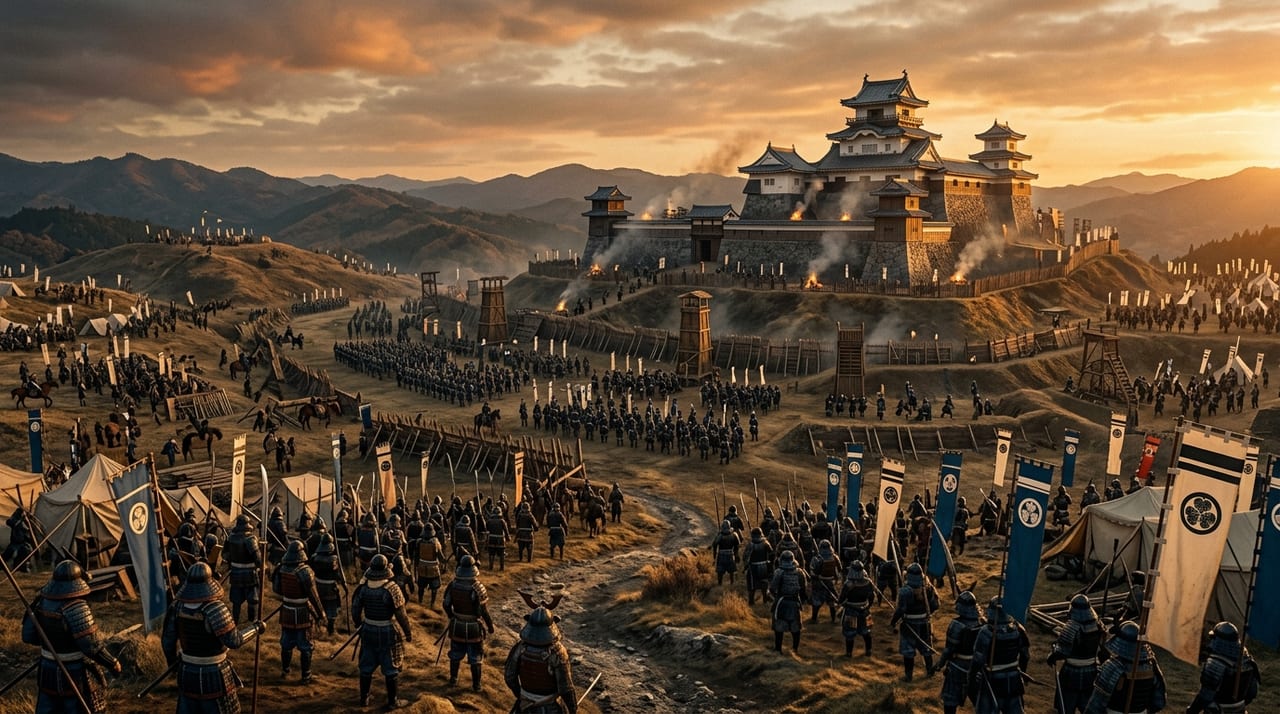
In the 12th month of Eiroku 11, Tokugawa Ieyasu's forces besieged Kakegawa Castle (present-day Kakegawa, Shizuoka Prefecture) in Tōtōmi Province. Holed up inside the castle was Imagawa Ujizane, the eldest son of Imagawa Yoshimoto, the hegemon of Tōkai, and the 12th head of the Imagawa house.
However, the forces remaining in Ujizane's hands were already on the verge of collapse. Eight years earlier, at the Battle of Okehazama (1560), his father Yoshimoto was killed in action, and in Eiroku 11 (1568), Takeda Shingen, who had been an ally, began an invasion of Imagawa territory. Under Shingen's invasion, the Imagawa local lords defected one after another to the Takeda and Tokugawa side, and the Imagawa castles fell one after another. Kakegawa Castle was Ujizane's last bastion.
This battle is a vivid episode illustrating the “light and shadow of the Sengoku period.” In contrast to the sword-wielding shogun Ashikaga Yoshiteru (Eiroku Incident, 1565), Ujizane has been remembered by later generations as “a lord who preferred waka and kemari to the sword.” Although he was the head of a warrior house, he is saddled with the reputation of having made light of martial arts. Such an assessment clings to Ujizane. His surrender at Kakegawa Castle etched that reputation into history.
Imagawa Yoshimoto (1519–1560) was the most powerful figure in Tōkai during the Sengoku period. Ruling the three provinces of Suruga, Tōtōmi, and Mikawa, and known as “the finest archer of the Tōkaidō,” Yoshimoto led a large army (estimated at 25,000 to 45,000) into Owari in the 5th month of Eiroku 3 (1560). On the way, he was killed by Oda Nobunaga's surprise attack at Okehazama. He died at the age of 42.
Yoshimoto's death was fatal for the Imagawa house. Having suddenly lost a powerful lord, the Imagawa lost Mikawa when Matsudaira Motoyasu (later Tokugawa Ieyasu) declared independence (Eiroku 3 to Eiroku 5). Even so, Ujizane maintained his father's domains of Suruga and Tōtōmi and retained a certain degree of power.
The problem, however, lay in Ujizane's own qualities. Ujizane was fond of kemari, composed waka, and was excellent in cultural accomplishments. However, in terms of the political judgment and military acumen required of a Sengoku daimyō, he fell far short of his father, Yoshimoto. Control over his retainers also loosened, and in the face of Takeda Shingen's invasion (Eiroku 11, 1568), the Imagawa house's retainers disintegrated.
In the 12th month of Eiroku 11 (1568), Takeda Shingen began his invasion of Suruga. The Kō-Sō-Sun Tripartite Alliance among the Takeda, Imagawa, and Hōjō, formed in Tenbun 23 (1554), collapsed here.
There are various theories regarding the reasons for Shingen's invasion, but one is the judgment that, as the weakening of the Imagawa reduced the military value of the alliance, it would be more practical to divide Imagawa territory between the Takeda and Tokugawa. Shingen secretly concluded an agreement with Tokugawa Ieyasu and invaded under a plan to divide Imagawa territory east and west.
Ujizane was unable to mount effective resistance against the Takeda invasion. The local lords of Suruga surrendered to the Takeda one after another, and Ujizane was driven out of Sunpu (present-day Shizuoka City) and fled to Kakegawa Castle in Tōtōmi. Suruga effectively fell into Takeda hands.
Tokugawa Ieyasu, who had concluded a secret pact with Takeda Shingen, began his invasion of Tōtōmi. The Imagawa local lords submitted to the Tokugawa one after another, and most of Tōtōmi came under Ieyasu's control.
Kakegawa Castle became the last stronghold of the Imagawa side. Ujizane holed up in Kakegawa Castle and asked for reinforcements from the Hōjō clan, the family of his wife, Lady Hayakawa. Lady Hayakawa's father, Hōjō Ujiyasu, sent reinforcements to Satta Pass in Suruga to confront the Takeda army, but was unable to lift the siege of Kakegawa Castle.
The Tokugawa siege of Kakegawa Castle began on the 27th day of the 12th month of Eiroku 11. Castellan Asahina Yasutomo and others defended it well, and the siege lasted nearly half a year.
Finally, on the 17th day of the 5th month of Eiroku 12 (1569), Ujizane concluded a peace agreement with Tokugawa Ieyasu. He surrendered Kakegawa Castle under the terms that the lives of his retainers would be spared and that, after the Takeda forces were driven out of Suruga, Ujizane would again be made lord of Suruga. Ujizane then fled to seek refuge with the Hōjō clan, together with his wife, Lady Hayakawa, and came under the protection of the Hōjō.
From the perspective of sword culture, the story surrounding the Battle of Kakegawa Castle and Imagawa Ujizane carries a unique significance.
As the foremost daimyō house in Tōkai, the Imagawa house was also renowned for its possession and management of fine swords. The sword “Yoshimoto Samonji,” which Oda Nobunaga seized when Imagawa Yoshimoto was killed at Okehazama, is now also called “Sōsan Samonji” and is a well-known blade even in the sword world. This sword passed from Miyoshi Masanaga (Sōsan) to Takeda Nobutora, who presented it to Yoshimoto. After Yoshimoto's death it was passed down through Nobunaga, Toyotomi Hideyoshi, Hideyori, and Tokugawa Ieyasu, and it is also called “the sword that won the realm.”
Yet Ujizane himself, while inheriting this “legacy of famous swords,” was unable to embody the “values of martial arts” that the sword symbolized. Known as a master of kemari, Ujizane has often been described by later generations as “a cultured lord who knew nothing of martial arts.”
This assessment is not necessarily fair. Ujizane may have lacked the ability as a Sengoku daimyō, but as a cultured man who loved waka, kemari, and the performing arts, he survived into the Edo period, and his cultural accomplishments have since been highly regarded. Moreover, Ujizane maintained a long life under Tokugawa protection (died in the 12th month of Keichō 19 [January 1615], aged 77) and was generously treated by Ieyasu. Ironically, the “Imagawa that abandoned martial arts” survived thanks to the “Tokugawa that won by martial might.”
Eiroku 12 (1569), the year the Battle of Kakegawa Castle ended, was the year in which the balance of power in Tōkai fundamentally changed.
Takeda Shingen took control of Suruga, and Tokugawa Ieyasu took control of Tōtōmi. The Imagawa's “rule over three provinces,” which had once governed Mikawa, Tōtōmi, and Suruga, collapsed completely. In its place emerged the axis of conflict “Takeda versus Tokugawa,” staged in Tōkai, and this opened the way to the Battle of Mikatagahara, fought in the 12th month of Genki 3 (January 1573).
From the perspective of swords, it is important that the collapse of the Imagawa house scattered and transferred the sword collection handed down through the Imagawa family. Like Yoshimoto's “Sōsan Samonji,” the process by which famous swords passed to new owners according to the outcomes of battles is a major feature of Sengoku-period sword history, and the Battle of Kakegawa Castle forms one episode of it.
After this battle, Kakegawa Castle also functioned as the Tokugawa's “base for control of Tōtōmi,” and it would later also become known as the castle of Yamauchi Kazutoyo (who was transferred to Tosa after Sekigahara). The history of Kakegawa Castle was etched at the turning point of “the end of the Imagawa and the beginning of the Tokugawa.” When Imagawa Ujizane left the castle, he must have worn a sword, yet the “warrior world” that the sword symbolized no longer accepted him.
Tokugawa Ieyasu
Tokugawa Ieyasu — besieged Kakegawa Castle and forced Ujizane's surrender, completing his conquest of Tōtōmi Province.
Imagawa Yoshimoto
Imagawa Yoshimoto — the distant cause of the Kakegawa siege; his death at Okehazama started the Imagawa decline that culminated here.
Takeda Shingen
Takeda Shingen — invaded Suruga in 1568, coordinating (by agreement with Ieyasu) to squeeze the Imagawa from two directions; the immediate context of the Kakegawa siege.
Hōjō Ujimasa
Hōjō Ujimasa — Ujizane's brother-in-law who sent relief forces to Kakegawa but could not break Ieyasu's siege.