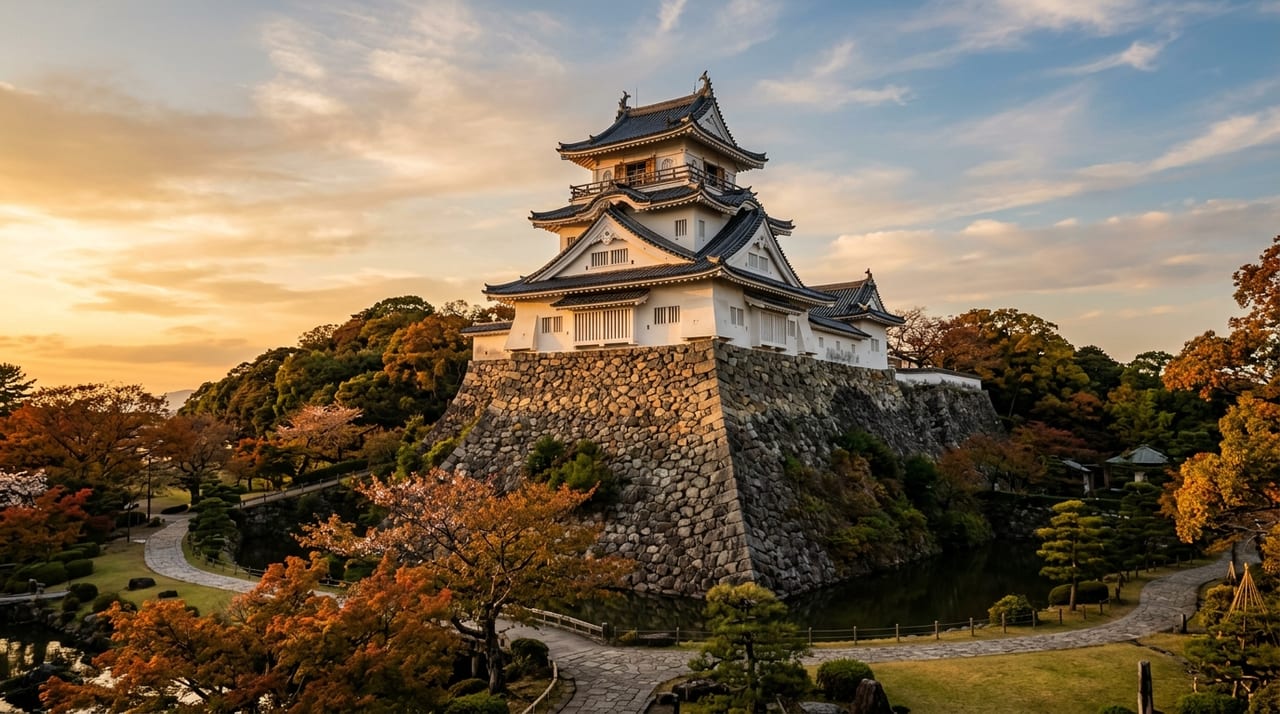
 * Image is for illustrative purposes only.
Hamamatsu Castle
浜松城
Hamamatsu Castle is a historic castle in the Chūbu region (Ieyasu entered in 1570 (Genki 1)). Its lord was Tokugawa Ieyasu.
Overview
About the Castle
Hamamatsu Castle is a hilltop flatland castle (hirayamajiro) standing on a hill in the central part of Hamamatsu, Shizuoka Prefecture, now developed as Hamamatsu Castle Park. Tokugawa Ieyasu entered the castle at age 29 in Genki 1 (1570) and spent approximately 17 years there until his move to Sunpu in Tenshō 14 (1586). This period was the most difficult era of Ieyasu's lifetime, and includes the humiliating experience of being crushingly defeated by Takeda Shingen's vast army at the Battle of Mikatagahara in Genki 3 (1572). However, Ieyasu grew dramatically from the hardships of his Hamamatsu years, and the period has been passed down to posterity as the "Hamamatsu training years," as if embodying the saying "adversity in youth is worth seeking out." Hamamatsu Castle holds the alternate name "Castle of Advancement" and is known as an auspicious castle where successive lords rose to prominence.
The Battle of Mikatagahara and Ieyasu's Retreat
In the 12th month of Genki 3 (1572), during Takeda Shingen's westward campaign, Shingen led his Takeda army of approximately 27,000, threatening Hamamatsu. Ieyasu sallied forth from Hamamatsu Castle together with reinforcements dispatched by Oda Nobunaga, and clashed head-on with the Takeda army at Mikatagahara (present-day northern Hamamatsu). However, he was utterly defeated by the Takeda army, which had deployed in the fish-scale formation (gyorin no jin) and lay in wait. Ieyasu fled back to Hamamatsu Castle with his life barely intact. The famous legend holds that he had a portrait of himself painted so as never to forget the defeat (the "Shikamizō"), but this tradition is said to have no documentary basis. From this defeat Ieyasu learned deeply, and thereafter pursued the path to the unification of the realm through cautious military tactics and diplomacy. The Battle of Mikatagahara was the greatest of Ieyasu's failures, yet it was also the greatest lesson that shaped him into a true warlord.
The Legend of the Castle of Advancement
The origin of the name "Castle of Advancement" for Hamamatsu Castle lies in the fact that successive lords, beginning with Tokugawa Ieyasu, all advanced and prospered. During the Edo period, influential daimyo who served as Bakufu senior councillors (rōjū) and junior elders (wakatoshiyori) were frequently placed as Hamamatsu domain lords, and the tradition that "Hamamatsu Castle lords rise to prominence" became firmly established. Indeed, multiple individuals advanced from Hamamatsu domain lord to Rōjū or Kyōto Shoshidai, making Hamamatsu Castle one of the elite career paths of Bakufu politics. This "Castle of Advancement" tradition lives on in the present day, with many visitors coming to Hamamatsu Castle to pray for employment, promotion, and examination success.
The Nozura-style Stone Walls and the Present Keep
The stone walls of Hamamatsu Castle are a typical example of nozura-zumi (uncut stone stacking), possessing an unsophisticated beauty achieved by skillfully stacking irregular natural stones. Nozura-zumi is typical of Sengoku-period stonewall technology and represents a valuable historical record of technique that preceded the later development of uchikomi-hagi and kirikomi-hagi. The keep built during the era of the Horio clan was lost by the early Edo period, leaving only the keep base (tenshudai). The present keep, built in Shōwa 33 (1958), is a reinforced-concrete replica, and its interior is a museum that exhibits historical materials on Tokugawa Ieyasu and the history of Hamamatsu. Following the broadcast of the NHK taiga drama "Dōsuru Ieyasu" in Reiwa 5 (2023), the number of tourists visiting Hamamatsu surged, and the fame of Hamamatsu Castle increased further nationwide.
Hamamatsu's Industrial Culture
Hamamatsu began as the castle town of Tokugawa Ieyasu, but in modern times it has developed into an industrial city known around the world as the "Capital of Musical Instruments" and the "Capital of Motorcycles." It is the birthplace of world-renowned enterprises such as Yamaha and Kawai (musical instruments) and Suzuki and Honda (automobiles and motorcycles), and the DNA of manufacturing shares common ground with the pragmatic spirit of Ieyasu's "Hamamatsu training years." Lake Hamana's eels are known as a national brand, and together with Hamamatsu gyoza they form Hamamatsu's two great gourmet dishes, captivating tourists.
Connection to Swords
The connection between Hamamatsu Castle and swords can be understood through Tokugawa Ieyasu's view of swords and the lessons of his defeat at the Battle of Mikatagahara. Tokugawa Ieyasu was one of the greatest patrons and collectors of Japanese swords, and as Sei-i Taishōgun (Commander-in-Chief of the Barbarian-Subduing Army), the supreme authority of the realm, he demonstrated the authority and dignity of the Japanese sword to the whole country. Ieyasu made Hamamatsu Castle his residence from 1570 to 1586. At the Battle of Mikatagahara (1572), he suffered a crushing defeat at the hands of the Takeda army, and this defeat is passed down together with the legend of the "Shikamizō" portrait. The sword most celebrated as Ieyasu's personal blade is "Sohaya no Tsuruki," a tachi said to have been forged by Miike Tenta Mitsuyo, a swordsmith of the late Heian period, and said to be a copy of the sacred sword Sohaya no Tsurugi, which appears in the legend of Sakanoue no Tamuramaro. In accordance with Ieyasu's last wishes, the sword was deposited at Kunōzan Tōshōgū in Shizuoka City, and it is now held by the shrine as an Important Cultural Property. Hamamatsu Castle was the castle of Ieyasu's training years. Mizuno Tadakuni, the rōjū who led the Tenpō Reforms, also served as lord of Hamamatsu domain from 1817 to 1845. Hamamatsu Castle's tenshu displays armor and weapons materials connected with Tokugawa Ieyasu, including Kindami gusoku armor, and it draws many visitors as a spot connected with "Dōsuru Ieyasu." Today Hamamatsu is known as a city of musical instruments and the automobile industry, but the spirit of ultimate craftsmanship embodied in the Japanese sword and the spirit of precision industry for which Hamamatsu is world-renowned resonate deeply in their shared principle of "forging materials to their ultimate limits."
Highlights
- Replica tenshu (the interior is a museum) — displays Ieyasu-related armor and weapons materials, and a replica of the "Shikamizō" portrait
- Mikatagahara Battlefield — about 15 minutes by car from the castle; the site of Ieyasu's greatest defeat
- "Castle of Advancement" prayers — a steady stream of modern visitors seeking good fortune in career advancement and examination success
- Lake Hamana eel — a nationally known brand. Slowly savor it at a long-established eel restaurant in the castle town, where the aroma of kabayaki drifts through the air
- Yamaha and Suzuki corporate museums — experience the origins of world-famous musical instrument, motorcycle, and automobile brands
- Kunōzan Tōshōgū — in Shizuoka City; a Tōshōgū older than the one at Nikkō that enshrines Ieyasu, and home to the sword Sohaya no Tsuruki
* Opening hours and admission fees are subject to change. Please check the official website before visiting.