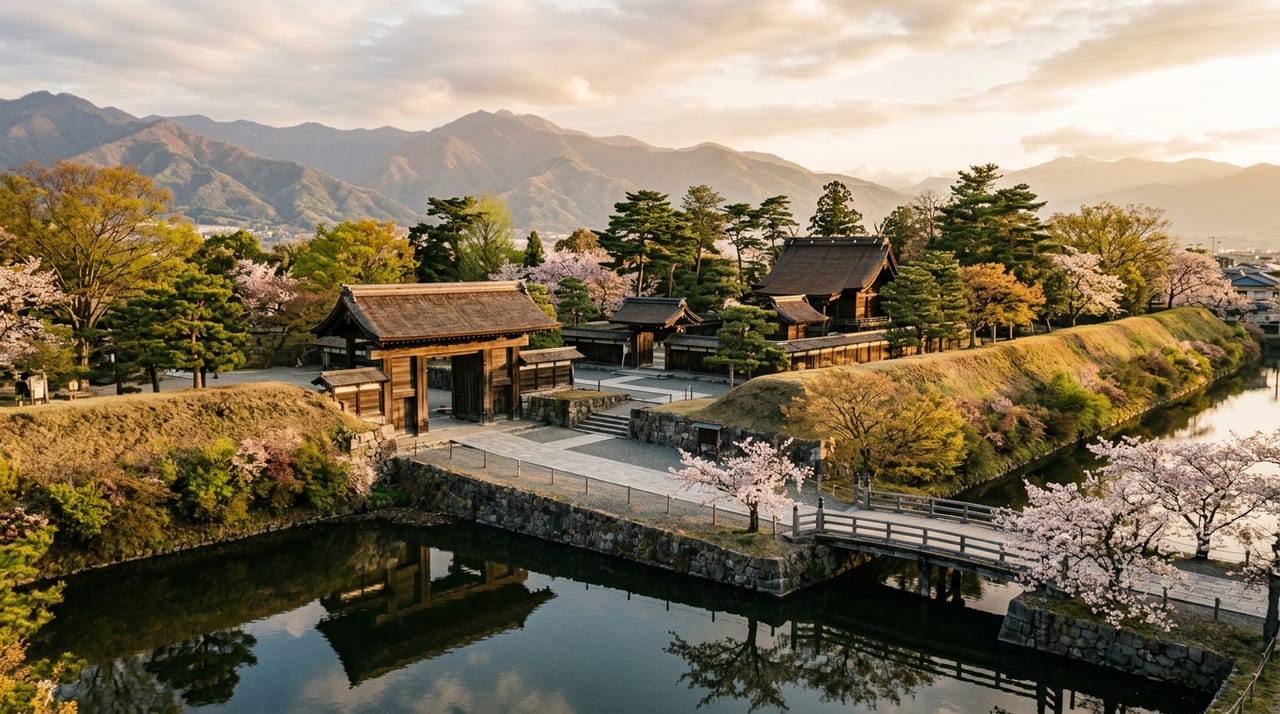
 * Image is for illustrative purposes only.
Tsutsujigasaki Yakata (Takeda Clan Residence)
躑躅ヶ崎館(武田氏館)
Tsutsujigasaki Yakata (Takeda Clan Residence) is a historic castle in the Chūbu region (Built in 1519 (Eishō 16)). Its lord was Takeda Shingen / Takeda clan.
Overview
About the Castle
Tsutsujigasaki Yakata (Takeda Clan Residence) was the residence of Takeda Shingen, the 'Tiger of Kai.' It served as the home base for three generations of the Takeda clan, Takeda Nobutora, Takeda Shingen, and Takeda Katsuyori, for about 60 years, and was the center of politics and military affairs in Kai Province. In 1519, Shingen's father, Takeda Nobutora, built the residence on this site in the Kōfu Basin and moved his base here from Isawa. Whereas most Sengoku daimyo based themselves in mountain castles, Tsutsujigasaki Yakata was a square residence built on flat ground. It embodies Shingen's famous saying: 'People are the castle, people are the stone walls, people are the moat; compassion makes allies, enmity makes enemies.'
Battles and Warfare
Shingen considered the unity of his retainers and the trust of the people to be the strongest defense, more important than the physical strength of a castle, so he deliberately chose a residence with weak fortifications as his base. This idea is not just a pleasant story. It also reflects the fact that the Takeda military was specialized for offense. The residence was enough precisely because of the aggressive strategy of striking out before enemies could invade Kai. Shingen led a formidable force of retainers, represented by the Twenty-Four Generals of Takeda, and showed outstanding leadership in many battles, including the Battles of Kawanakajima and the Battle of Mikatagahara.
Present Day
In particular, at the Battle of Mikatagahara in 1572, he inflicted a devastating defeat on Tokugawa Ieyasu, and it is recorded as the most humiliating defeat of Ieyasu's life. Shingen was also a skilled statesman in gold mining (Kōshū gold) and flood control (Shingen embankment, Shingen-zutsumi), which put Kai's economic foundation on a firm footing. At the Battle of Nagashino in 1575, Katsuyori, who had succeeded Shingen, suffered a crushing defeat to the combined Oda-Tokugawa forces, and the Takeda family was destroyed in 1582. Today the site of Tsutsujigasaki Yakata has been developed as Takeda Shrine, which enshrines Shingen as its main deity.
Architecture and Structure
Within the grounds, the earthen ramparts, moats, and tiger-mouth gate (koguchi) from the residence period remain in good condition, and excavations have also confirmed the remains of a garden and buildings. Takeda-dōri avenue, which runs from Kōfu Station to Takeda Shrine, is a beautiful approach lined with cherry trees. The Shingen-kō Festival (held annually in April) features a procession of more than a thousand armored warriors, and it has been certified by Guinness World Records as the 'largest gathering of samurai.' The mountains surrounding the Kōfu Basin preserve the terrain of Kai Province, which Shingen used as a 'natural stronghold.' Erin-ji Temple is Shingen's family temple and is also the place where Kaisen Jōki's famous words 'With the mind extinguished, even fire is cool' originated.
Sightseeing and Experiences
Kai Province is also well known as a producer of grapes, and the wineries of Katsunuma are the birthplace of Kōshū wine. The unexpected combination of Takeda history and wine forms the appeal of a modern trip to Kōfu.
Connection to Swords
Takeda Shingen, the 'Tiger of Kai,' led a cavalry force hailed as the strongest in the Sengoku period, and his knowledge of swords was deep, backed by his practical battlefield experience as a commander. The legend of the one-on-one duel between Shingen and Uesugi Kenshin at the Fourth Battle of Kawanakajima in 1561 is passed down as the most dramatic moment in the history of the Japanese sword. The episode in which Kenshin struck at Shingen from horseback and Shingen blocked the blow with his gunbai (war fan) has been depicted repeatedly in later paintings and literature, and it became the prototype for scenes of warlords facing each other with blades. It is also said that the gunbai bore sword scars. Whatever the truth of that, the influence of this legend on the Japanese view of warriors and swords is immeasurable. The treasure hall of Takeda Shrine houses the tachi 'Yoshioka Ichimonji' (Important Cultural Property), donated by the Sanjō family, the natal family of Lady Sanjō, Shingen's principal wife; Shingen's gunsen (folding war fan); and a painting of the Twenty-Four Generals of Takeda, allowing visitors to come into direct contact with the martial world of the strongest Sengoku commander. Shingen's military strategy and deep understanding of swords also had a major influence on later warrior education through Takeda-ryū military science. The Fūrinkazan written on Shingen's war banner, 'Swift as the wind, silent as the forest, fierce as fire, immovable as a mountain,' is the essence of his military strategy, and its spirit was reflected in his selection of arms and armor as well.
Highlights
- Takeda Shrine — a guardian shrine of Kai that enshrines Shingen as its main deity and is known for blessings of victory
- Takeda Shrine treasure hall — houses the tachi 'Yoshioka Ichimonji' (Important Cultural Property), Shingen's gunsen (folding war fan), and a painting of the Twenty-Four Generals of Takeda
- Earthen ramparts and moats of the residence site — remains of a Sengoku daimyo's residence revealed by excavation, with garden remains also confirmed
- Shingen-kō Festival (every April) — a procession straight out of a Sengoku picture scroll, with more than a thousand armored warriors marching through Kōfu
- Statue of Takeda Shingen in front of Kōfu Station — a huge bronze statue that conveys the dignity of the 'Tiger of Kai'
- Erin-ji Temple (about 30 minutes by car) — Shingen's family temple and the site of the famous words 'With the mind extinguished, even fire is cool'
* Opening hours and admission fees are subject to change. Please check the official website before visiting.