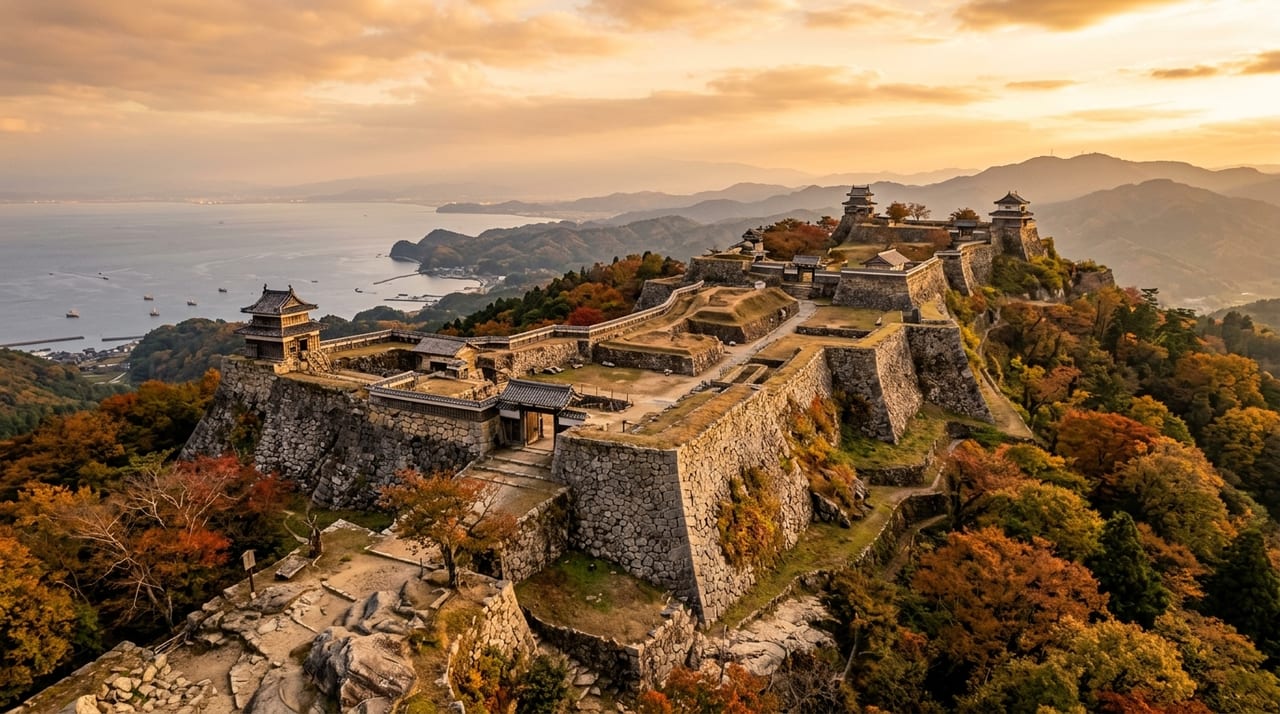
 * Image is for illustrative purposes only.
Nanao Castle
七尾城
Nanao Castle is a historic castle in the Chūbu region (Built around the early 15th century (roughly the Shōchō era)). Its lord was Hatakeyama Yoshifusa / Uesugi Kenshin (captor).
Overview
About the Castle
Nanao Castle is a mountain castle of Noto Province built on Mount Jōyama (about 300 m above sea level) in Nanao City, Ishikawa Prefecture. It is a famous castle with grand remains that rank among the most impressive medieval fortifications in Japan. It is said to have been built around the early 15th century (roughly the Shōchō era) by the Hatakeyama clan, shugo of Noto. For about 150 years afterward it served as the Hatakeyama family's seat and as the base from which they ruled the entire Noto Peninsula. The name “Nanao” (Seven Tails) is also said to derive from the castle having been built on seven ridges: Matsuo, Takeo, Umeo, Kikuo, Kameo, Torao, and Ryūo. Its site makes the fullest use of the sea and mountain terrain of the Noto Peninsula, and this gave it a reputation as an impregnable stronghold that gave Sengoku-period warlords considerable trouble.
Uesugi Kenshin's Siege
No account of Nanao Castle is complete without its connection to Uesugi Kenshin, the Tiger of Echigo. In 1576 (Tenshō 4), Kenshin began his invasion of Noto and surrounded Nanao Castle. Protected by natural defenses, the castle could not easily be taken even by Kenshin's besieging army. However, during the prolonged siege, an epidemic broke out inside the castle, and the young lord Hatakeyama Haruōmaru died of illness. Internal strife followed when Yusa Tsugumitsu, a member of the pro-Uesugi faction, secretly colluded with the enemy and attacked Chō Tsugutsura and other relatives in the pro-Oda faction. In the 9th month of Tenshō 5 (1577), Nanao Castle, weakened by the internal conflict, finally fell into Kenshin's hands. Kenshin is said to have composed his famous poem “Shimo mitsu gunei shūki kiyoshi” (“Kugatsu Jūsanya Jinchū no Saku,” Composed in Camp on the Thirteenth Night of the Ninth Month) in camp during this siege. The poem reads: “Frost fills the military camp, and the autumn air is clear; / A few rows of passing geese, the moon at the third watch; / Having taken together the mountains of Etsu and the scenery of Noto, / Let it be—I think of home, far away on this campaign.” The poem is widely known today, but some hold that it was not composed by Kenshin.
Scale and Structure
Nanao Castle is a complex mountain castle made up of many enclosures, including the Honmaru, Ninomaru, Sannomaru, and the Yusa residence, and its total area is considerable. Remains such as stone walls, dry moats (horikiri), and earthen ramparts survive in good condition, making the site an indispensable historic landmark for studying the form of medieval mountain castles. From the summit, the beautiful seascape of Nanao Bay and the Noto Peninsula can be seen in full, and on clear days the majestic panorama of the Noto mountain ranges unfolds.
Hatakeyama Culture and Crafts
The Noto Hatakeyama clan was a daimyō house distinguished for its martial prowess and also renowned as a patron of culture. Under Hatakeyama Yoshifusa in particular, Noto enjoyed such a cultural flourishing that it was called “Little Kyoto,” and courtly arts such as nō, the tea ceremony, and renga blossomed. Today the Nanao Castle site is protected as a national historic site, and a trail up Mount Jōyama has been maintained. At the foot of the mountain are the Nanao Castle History Museum and the Kaikokan, which display materials related to Nanao Castle.
Nanao's Culture and Present
Nanao has a history as a castle town called “Little Kyoto” during the Sengoku period, and its distinctive food culture (Noto oysters, Noto pufferfish, and more) and traditional crafts such as lacquerware and wa-rōsoku (Japanese wax candles) remain alive. A journey that combines the Nanao Castle ruins with the culture of the port town offers a luxurious course that condenses the rich history and culture of the Noto Peninsula. The 2024 (Reiwa 6) Noto Peninsula Earthquake caused severe damage to Nanao City, but local residents are working to pass on its history and culture as they advance the recovery.
Connection to Swords
The story of Nanao Castle and Uesugi Kenshin provides essential historical background for discussing the culture of Japanese swords and the spirit of the warlords of Echigo. Uesugi Kenshin is a Sengoku warlord praised by later generations as a “Warlord of Righteousness” and a “God of War.” The sword “Sanchōmō”, handed down as Kenshin's favorite blade, is unsigned but has been authenticated as a masterpiece of the Bizen Fukuoka Ichimonji school. Its beauty is said to feature a delicate hamon resembling bird feathers, which shows that Kenshin had a deep appreciation for the beauty of swords. Setouchi City in Okayama Prefecture purchased Sanchōmō for about 500 million yen, and the famous blade returned home in 2020 (Reiwa 2). The Hatakeyama clan, which ruled Nanao Castle, was a daimyō house with a strong cultural foundation. The Nanao Castle History Museum at the entrance to the castle trail exhibits the castle lord's treasured sword and letters handwritten by Hatakeyama Yoshifusa, among other items. Standing at the castle ruins overlooking Nanao Bay and gazing at the sea of Noto while recalling the poem Kenshin composed, one feels as if the spirit of “righteousness” that Sengoku warriors embodied with the sword in hand still lingers in the air.
Highlights
- Nanao Castle ruins — remains of a medieval mountain castle with many enclosure sites and stone walls, including the Honmaru, Ninomaru, and Sannomaru
- Views of Nanao Bay from the summit of Mount Jōyama — the sea and mountains of the Noto Peninsula in full view
- Site associated with Kenshin's “Kugatsu Jūsanya Jinchū no Saku” — relive the historic moment when the poem was composed
- Ishikawa Prefectural Nanao Art Museum — holds a special exhibition on the Nanao-born painter Hasegawa Tōhaku every year
- Noto Shokusai Market (Nanao Port) — rich seafood from the sea, including Noto oysters and Noto pufferfish
* Opening hours and admission fees are subject to change. Please check the official website before visiting.