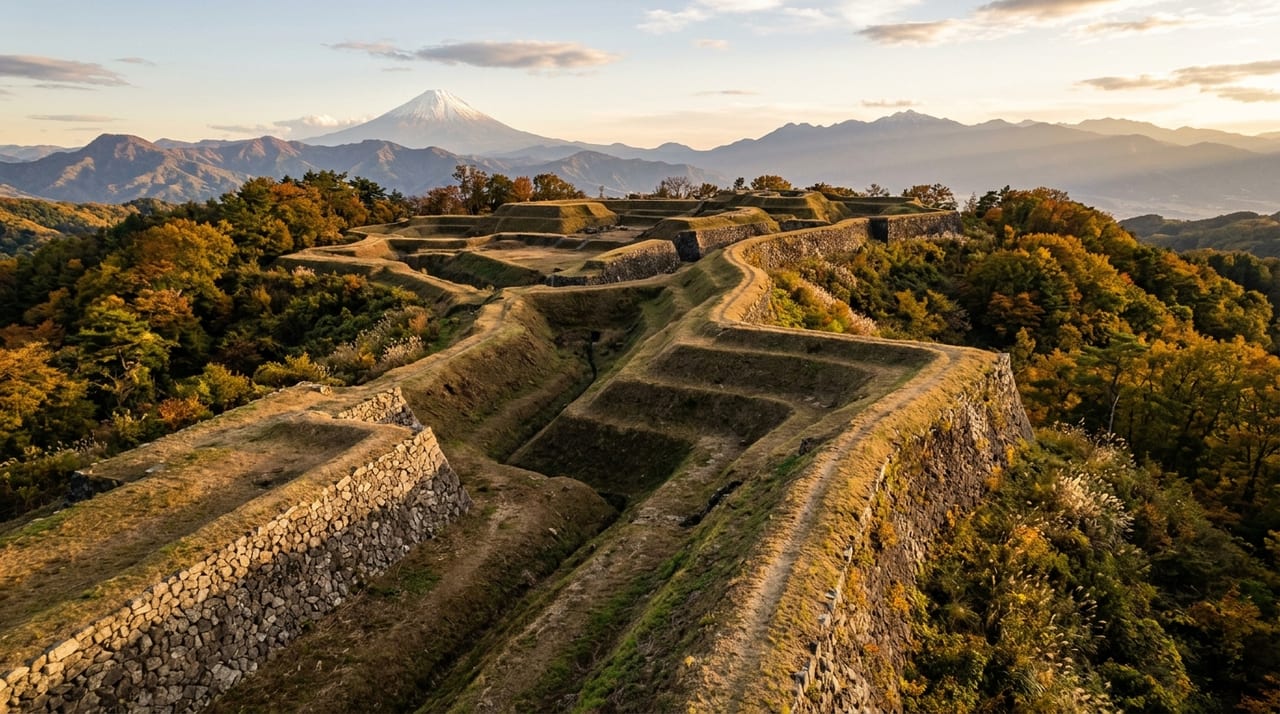
 * Image is for illustrative purposes only.
Shinpu Castle (Nirasaki Castle)
新府城(韮崎城)
Shinpu Castle (Nirasaki Castle) is a historic castle in the Chūbu region (Built 1581 (Tenshō 9); burned by Katsuyori himself in 1582 on the eve of the Takeda clan's destruction). Its lord was Takeda Katsuyori.
Overview
Shinpu Castle in Nirasaki, Yamanashi Prefecture, is one of Japanese history's most poignant fortresses — built in 1581 by Takeda Katsuyori as his clan's last stronghold, and burned by his own hand just months later as the Takeda fell to Oda Nobunaga's overwhelming invasion.
After the catastrophic defeat at Nagashino (1575), Katsuyori resolved to leave his father Shingen's Tsutsujigasaki Palace at Kōfu and build a genuinely fortified castle. Shinpu's layout on the Shichiri-iwa plateau, with its massive umadashi (cavalry sally ports), earthworks, and carefully planned defensive circuit, represents the pinnacle of Takeda military engineering. Yet betrayal and the relentless advance of Oda-Tokugawa forces gave Katsuyori no time to use it. He abandoned and burned the castle in the 3rd month of Tenshō 10 (1582), fled with a handful of retainers, and shortly afterwards took his own life at Tano while heading for Seiun-ji on Mount Tenmoku, ending the Takeda clan.
The site is now a National Historic Site. Excavations continue to reveal construction details and artifacts, and the castle's sophisticated earthwork design is increasingly appreciated by scholars. The site commands panoramic views of Mount Fuji, the Southern Alps, and the Yatsugatake range.
Connection to Swords
The bond between Shinpu Castle and Japanese swords is inseparable from the extinction of the Takeda clan—a pivotal turning point in sword history. Katsuyori Takeda's move to Shinpu Castle came after the Battle of Nagashino marked the end of the Takeda's "Age of the Blade," and the castle embodied the transition in Japanese weapon history from sword to firearm.
The treasure hall of Takeda Shrine in Kōfu (the site of Tsutsujigasaki Palace) houses the tachi "Yoshioka Ichimonji" (Important Cultural Property), donated by the Sanjō family through its connection to Lady Sanjō, Shingen's principal wife.
Highlights
- Umadashi sally port structures (original earthworks) — finest surviving example of Takeda castle engineering
- Earthworks and moats — well-preserved Sengoku-era defensive circuit, National Historic Site
- Main enclosure views — panorama of Mount Fuji, Southern Alps, and Yatsugatake
- Fujitake Inari Shrine — small shrine standing on the site of the main enclosure
- Site interpretation boards — detailed maps reflecting ongoing excavation findings
- Shichiri-iwa cliffs — natural precipice guarding the west side of the castle, with the Shio River to the east
* Opening hours and admission fees are subject to change. Please check the official website before visiting.