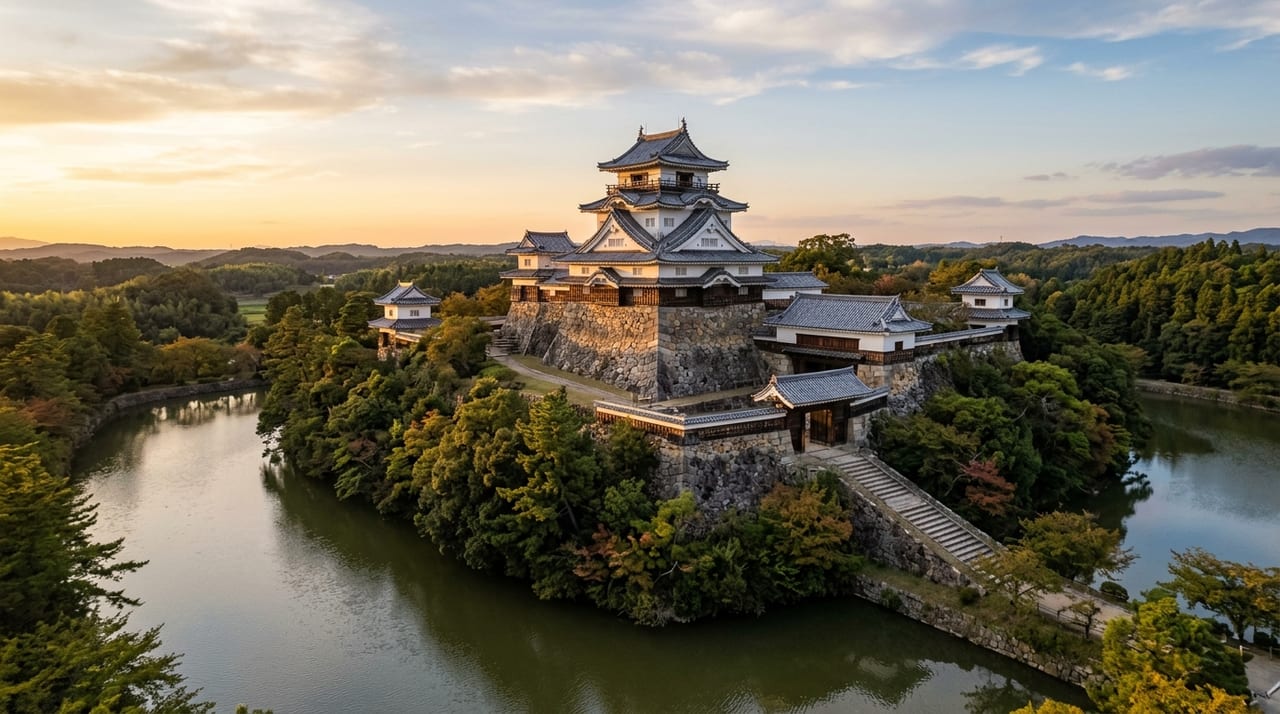
 * Image is for illustrative purposes only.
Kariya Castle (Kame Castle)
刈谷城(亀城)
Kariya Castle (Kame Castle) is a historic castle in the Chūbu region (Built by Mizuno Tadamasa in Tenmon 2 (1533). Known as the seat of the Mizuno clan, the natal family of Ōdai no kata, mother of Tokugawa Ieyasu. During the Edo period it continued as the domain office of Kariya Domain (23,000 koku)). Its lord was Mizuno Tadamasa (built Tenmon 2 (1533)) → Mizuno Nobumoto, Mizuno Tadashige, and Mizuno Katsunari → Fukamizo Matsudaira, Hisamatsu Matsudaira, Inagaki, Abe, Honda, and Miura clans → from Enkyō 4 (1747) onward, the Doi clan served as lords of Kariya Domain and held the castle until the Meiji Restoration.
Overview
Kariya Castle (Kame Castle) is a Sengoku- to Edo-period castle located in Shiromachi, Kariya, Aichi Prefecture. It was built in Tenmon 2 (1533) by Mizuno Tadamasa, a kokujin (local lord) who controlled the area near the border between Mikawa and Owari. Also called Kame Castle (Kijō), it is loved by citizens as a castle ruins park. Its greatest historical feature is that it was the main castle of the Mizuno clan, the natal family of Ōdai no kata, mother of Tokugawa Ieyasu, and it was valued throughout the Edo period as one of the roots of the Tokugawa Shōgun family.
The Mizuno clan was a kokujin with influence in the border area of Mikawa and Owari from the mid-Muromachi period, a local power that survived skillfully between the powerful daimyō to the east and west (the Imagawa, Oda, and Tokugawa). Kariya Castle is a hirajiro (flatland castle) built on a low plateau facing Kinugaura (now Kinuura Port), and it is characterized by a site that makes use of the natural defenses of the sea and marshland surrounding it. Kinugaura protects the western side of the castle, and moats were dug on the other three sides where there were no inlets. The name Kame Castle is also said to derive from the terrain, which resembles the shape of a turtle.
In Tenmon 10 (1541), Ōdai no kata, daughter of castle lord Mizuno Tadamasa, married Matsudaira Hirotada, and in the following year, in the 12th month of Tenmon 11 (1543), she gave birth to the future Tokugawa Ieyasu (childhood name Takechiyo). Two years later, however, in Tenmon 13 (1544), the Mizuno clan defected from the Imagawa to the Oda side, and Ieyasu was left behind at Okazaki Castle. (The Mizuno had to sever ties with the Matsudaira family, who were under Imagawa control, so Ōdai was separated from Takechiyo, the infant she had left at Okazaki Castle.) This event is famous as a historical fact symbolizing the trials of Ieyasu's childhood, and Kariya Castle is passed down as the stage of that tragedy.
During the Edo period, Kariya Castle continued as the domain office of Kariya Domain, and it was held by the lords of the Fukamizo Matsudaira, Hisamatsu Matsudaira, Inagaki, Abe, Honda, Miura, and Doi clans. With the abolition of the han system (1871), it lost its function as a castle and its buildings were demolished, but traces of the earthen walls and moats surrounding the honmaru remain, and part of the honmaru and obi-kuruwa has been developed as Kame Castle Park. It has become the center of Kariya City's history and tourism.
Connection to Swords
Kariya Castle is closely tied to the birth of Tokugawa Ieyasu and holds special significance as a junction of the Tokugawa Shōgun family and Japanese sword culture.
The most notable connection between the Mizuno clan, Kariya Castle, and swords is their link to famous blades associated with Tokugawa Ieyasu. Ieyasu is known for collecting and possessing many famous swords throughout his life, and Kariya Castle, the castle of his mother's natal family, forms an essential background for discussing his sword culture. It is said that Ieyasu possessed numerous famous blades, including those by Muramasa, Monoyoshi Sadamune, and Sōhayanotsurugi, and many of the swords he favored throughout his life are still preserved today at the Tokugawa Art Museum (Nagoya City) and the Kunōzan Tōshō-gū Museum (Shizuoka City).
The Mizuno clan itself, as a clan forming part of the samurai groups of Mikawa, also possessed and used many swords. Whether swordsmiths or smiths were permanently based in the castle town of Kariya Castle is not clearly documented, but as one of the centers of samurai culture in Mikawa, the clan is thought to have played an important role in the demand for and circulation of swords.
Also, Mizuno Nobumoto, the successor of Mizuno Tadamasa (Ieyasu's maternal grandfather and the first lord of Kariya Castle), is said to have been in an alliance with Oda Nobunaga even before the Battle of Okehazama (1560), and to have served as a go-between in forming the alliance between Nobunaga and Ieyasu. This Kiyosu Alliance (1562) is one of the most important political alliances in Japanese history.
Highlights
- Kame Castle Park (honmaru site): the core of Kariya Castle, a citizens' park where visitors can walk among the remnants of earthen ramparts and moats
- Places associated with Ōdai no kata: the castle of the natal family of Ieyasu's mother, with the Kariya City Historical Museum explaining the history of Ieyasu and the Mizuno clan
- Cherry blossoms at Kame Castle Park: a well-known spot for spring hanami at the castle ruins
- Kariya City Historical Museum: permanent exhibits of historical materials and reconstruction models on Kariya Castle, the Mizuno clan, and Kariya Domain
- Tokugawa Art Museum (Nagoya City): one of Japan's leading museums of samurai culture, housing famous swords, armor, and tea utensils associated with Ieyasu
- Kenkon-in temple (Higashiura Town): the family temple of the Mizuno clan, where Ōdai no kata is also memorialized
* Opening hours and admission fees are subject to change. Please check the official website before visiting.