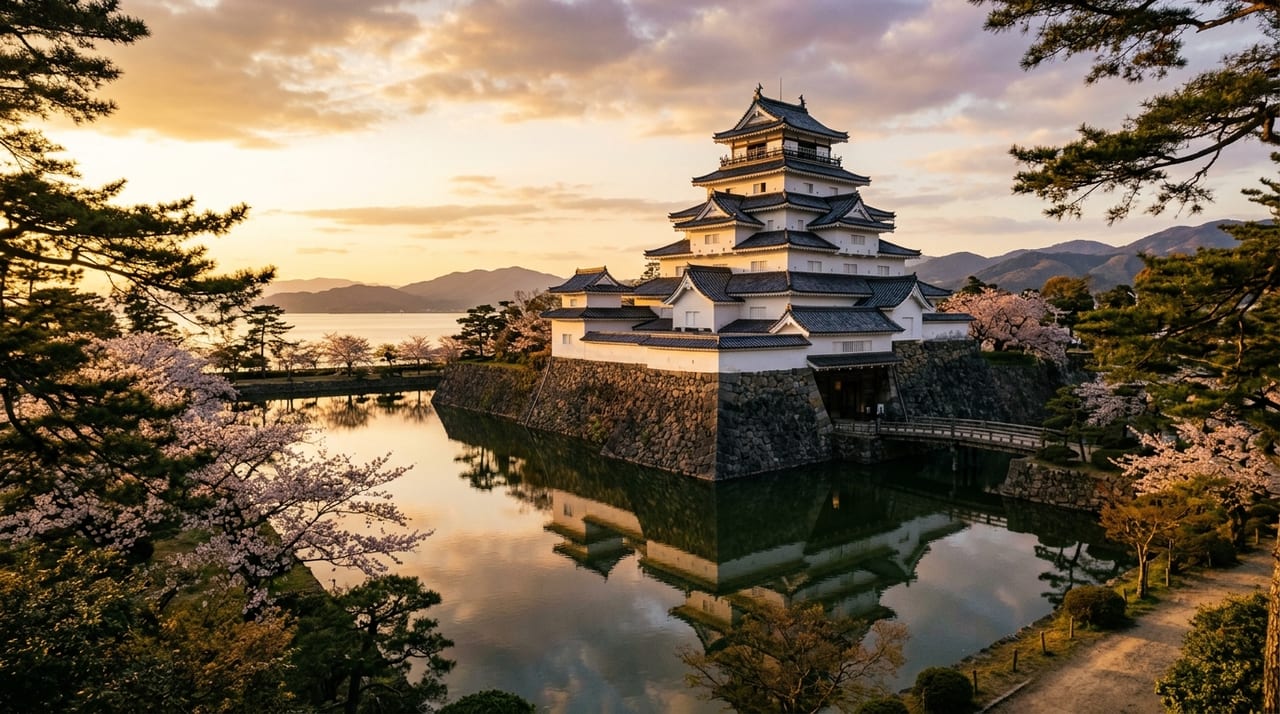
 * Image is for illustrative purposes only.
Tsuruga Castle
敦賀城
Tsuruga Castle is a historic castle in the Chūbu region (Hachiya Yoritaka began construction in Tenshō 11 (1583); Ōtani Yoshitsugu took over and developed the castle in Tenshō 17 (1589); abandoned under the Genna One-Castle-per-Province Edict). Its lord was Hachiya Yoritaka → Ōtani Yoshitsugu → administered by deputies (daikan) of the Fukui domain (Yūki Hideyasu).
Overview
Tsuruga Castle was a flatland castle in Tsuruga, Fukui Prefecture, built on a strategic point that controlled Tsuruga, long known as 'Tsuruga-tsu' and a key port for trade on the Sea of Japan. Tsuruga sits at the innermost part of Wakasa Bay and was also the starting point of the route to Kyoto via Lake Biwa and Ōmi. From the Muromachi through the Sengoku period, it was a key hub of logistics and transport, and various forces repeatedly fought over it.
The person most deeply involved in developing the castle was Ōtani Yoshitsugu, a trusted lieutenant of Toyotomi Hideyoshi. Yoshitsugu was appointed lord of Tsuruga in Tenshō 17 (1589) and advanced the development of the castle and its castle town. Yoshitsugu is said to have suffered from Hansen's disease (then known as gōbyō), yet as a warrior trusted by Hideyoshi, he promoted town planning and the cultivation of merchants in Tsuruga.
At the Battle of Sekigahara in Keichō 5 (1600), Ōtani Yoshitsugu initially set out from Tsuruga to join Tokugawa Ieyasu's campaign against Aizu, but after being persuaded by Ishida Mitsunari, he sided with the Western Army. Yoshitsugu established his camp at Fujikawa-dai in Yamanaka village, at the western end of the Sekigahara battlefield. Even as the army collapsed due to the betrayal of Kobayakawa Hideaki, he resisted to the very end and died by seppuku. The story of his loyalty and bravery was passed down through the Edo period, and Yoshitsugu is still highly regarded today as a 'righteous general' (gishō).
After Sekigahara, Tsuruga Castle came under Tokugawa control and was eventually abandoned. Today, almost nothing remains of the castle's former appearance at the site, but a marker stone stands beside the main gate of Tsuruga Nishi Elementary School, and the gate of Raigō-ji temple is said to have been relocated from the castle's central gate (chūmon). Kehi Shrine in Tsuruga, ranked as the Echizen Ichinomiya (chief shrine of Echizen), has been revered since ancient times, and it is said that Ōtani Yoshitsugu also worshipped there.
Connection to Swords
The relationship between Tsuruga Castle and Japanese swords can be discussed from two angles: the military career of its lord, Ōtani Yoshitsugu, and Tsuruga's role as a trading port.
Ōtani Yoshitsugu was a warlord deeply involved in the military administration of the Toyotomi regime. During the Bunroku and Keichō campaigns, he handled ship procurement and logistics for the invasion of Korea as a ship magistrate and military inspector. Direct records of the swords he wore are scarce, but as a tendency among the swords favored by Toyotomi administrators, many were imposing uchigatana by masters of Kyoto and the Kinai region (such as Horikawa Kunihiro), and Yoshitsugu is thought to have owned famous blades of that era.
Echizen (northern Fukui Prefecture) is widely known as a production center for swordsmiths, headed by Echizen Yasutsugu. Yasutsugu became official swordsmith to Tokugawa Ieyasu and his son Hidetada and received the honor of the grant of the Aoi crest. However, he originally honed his craft in Echizen and grew with the protection of the Tokugawa. Tsuruga lies on the border between Echizen and Wakasa, at the western edge of the sword-making sphere associated with Echizen Yasutsugu.
As a castle linked to the righteous general Ōtani Yoshitsugu, Tsuruga Castle also holds a place in the history of swords.
Highlights
- Tsuruga Castle ruins — a flatland castle ruin associated with Ōtani Yoshitsugu, with traces remaining in the marker stone beside Tsuruga Nishi Elementary School and the stone foundations at Shingan-ji temple
- Kehi Shrine (Echizen Ichinomiya) — a major shrine that has protected Tsuruga since ancient times, with a connection through Ōtani Yoshitsugu's veneration of it
- Kanegasaki Castle and Kanegasaki Shrine — the setting of Nobunaga's 'Retreat from Kanegasaki', a national historic site overlooking Tsuruga Bay
- Echizen sword sphere associated with Echizen Yasutsugu — the production region of Yasutsugu, official swordsmith to the Tokugawa, with Tsuruga forming its western edge
* Opening hours and admission fees are subject to change. Please check the official website before visiting.