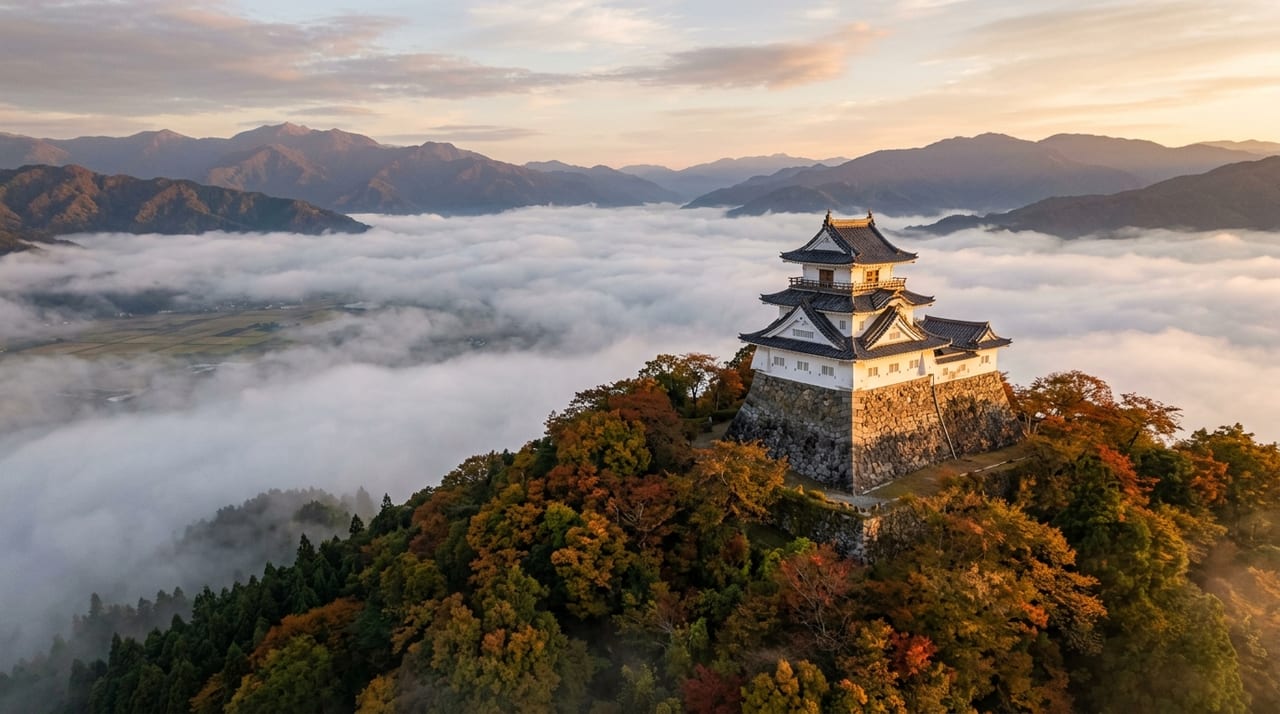
 * Image is for illustrative purposes only.
Echizen Ōno Castle
越前大野城
Echizen Ōno Castle is a historic castle in the Chūbu region (Founded Tensho 4 (1576)). Its lord was Kanamori Nagachika / Doi Toshikatsu lineage.
Overview
About the Castle
Echizen Ōno Castle is a mountain castle built on Kameyama (Shiroyama), a peak 249 meters above sea level in the central part of Ōno City, Fukui Prefecture. In Tenshō 4 (1576), Kanamori Nagachika, acting on the orders of Oda Nobunaga, pacified the Echizen Ikkō Ikki. As a reward for this achievement he was granted the Ōno district, and he built the castle over four years. The two-tier, three-story tenshu stands on a low mountain summit overlooking the Ōno Basin. It is not large in scale, but it has earned some of the highest praise in Japan for its scenic beauty, created by the harmony between the surrounding mountains and the rural landscape of the basin. Particularly from autumn to early winter, when weather conditions align, a sea of clouds spreads across the entire basin and only the tenshu rises above it. This "castle in the sky" is a fantastical sight that is famous nationwide, and it is known as a famous castle of the clouds alongside Takeda Castle (Hyōgo Prefecture).
Kanamori Nagachika and the Castle's History
Kanamori Nagachika was originally a samurai from Mino (a member of the Toki clan) who served as a senior retainer of Oda Nobunaga and devoted himself to the suppression of the Ikkō Ikki and the stabilization of Echizen. Nagachika was a rare warlord who served three successive lords of the realm: Nobunaga, Toyotomi Hideyoshi, and Tokugawa Ieyasu. His worldly wisdom and practical ability were indispensable to surviving the chaotic Sengoku era. Ōno Castle was fully developed by Nagachika as a full-scale early modern castle, and the castle town was also systematically laid out in a grid pattern. Even today, the castle town of Ōno retains the street layout from that time, and its graceful townscape, known as the "Little Kyoto of the Hokuriku," is preserved.
Echizen's Spirit and the Ikkō Ikki
Echizen is a region with many adherents of Jōdo Shinshū (the Ikkō sect). After the fall of the Asakura clan, the Ikkō Ikki controlled the province in Tenshō 2 (1574). The Echizen Campaign of Tenshō 3 (1575), in which Nobunaga annihilated the Echizen Ikkō Ikki, is recorded as one of the most severe religious persecutions in Sengoku history. The historical background of Ōno Castle being built the following year conveys to the present the memory of Echizen, a land where military force and faith clashed. Built on land of the Ikkō Ikki, Ōno Castle continued to function as the center of Echizen's samurai culture, and lords of the domain included the Doi and Matsudaira families.
Castle in the Sky and Seasonal Beauty
Beyond the autumn sea of clouds, Echizen Ōno Castle shows a different face in each season: cherry blossoms in spring, fresh greenery in summer, and snowy scenes in winter. Its presence gives an impression that far exceeds its scale. The tenshu was rebuilt in reinforced concrete in Showa 43 (1968), estimated on the basis of old drawings and other materials from the period, and it is not a restoration faithful to the historical facts. In Ōno City, the Shichiken Morning Market, a traditional morning market with a history of over 400 years, opens every morning, and local agricultural products and food culture still brighten the everyday life of the castle town.
Echizen's Sword Culture
Echizen has long been a region with a flourishing cutlery industry known as Echizen Uchihamono (Echizen forged blades). The blacksmithing tradition of knife-making, said to have begun in the Northern and Southern Courts period, has been passed down to today's Echizen Uchihamono.
Connection to Swords
Essential to any discussion of Echizen Ōno Castle's sword culture is the blade-smithing tradition deeply rooted in the land of Echizen itself. The history of Echizen Uchihamono is said to date back to the Northern and Southern Courts period (Engen 2, 1337). There is a legend that the swordsmith Chiyozuru Kuniyasu of Kyoto settled in Echizen Fuchu (present-day Echizen City) in search of a suitable place to make swords, and while doing so made sickles for the farmers of the surrounding area, which became the origin of blade-smithing in Echizen. Since then, Echizen's blade craftsmen have made a wide range of blades, from swords to farm tools and kitchen knives, and have developed into the largest blade-industry region in Hokuriku. Kanamori Nagachika, lord of Ōno Castle, was a warrior who pacified the Echizen Ikkō Ikki on Nobunaga's orders. In Echizen City (formerly Takefu), workshops for Echizen Uchihamono are still concentrated today, and facilities where visitors can experience and observe blade-making using traditional techniques, such as Takefu Knife Village, have been set up. Echizen Uchihamono's forging techniques are recognized as a nationally designated traditional craft. The existence of Echizen blade craftsmen, who pass down both Japanese sword-making techniques and the production techniques of farm and kitchen tools, symbolizes the diversity of Japan's smithing culture. The view of the basin from the tenshu of Echizen Ōno Castle makes one realize that this place has long been where people's lives and samurai rule intersected. The fantastical figure of the tenshu floating on a sea of clouds and the solid, plain, and sturdy character of the long-established blade industry brilliantly embody the dual nature of the land of Echizen Ōno.
Highlights
- Tenshu floating on the sea of clouds — From autumn to early winter, the spectacular castle in the sky appears when conditions align
- View of the Ōno Basin from Kameyama — Harmony of the castle with the rural scenery of each season
- Echizen Ōno Castle tenshu — Tenshu rebuilt in Showa 43 (1968); the interior is a local history museum
- Shichiken Morning Market — Traditional morning market that has continued for over 400 years, with local seasonal produce on display
- Little Kyoto of the Hokuriku, Ōno's castle town — Edo-period grid-pattern street layout remains
* Opening hours and admission fees are subject to change. Please check the official website before visiting.