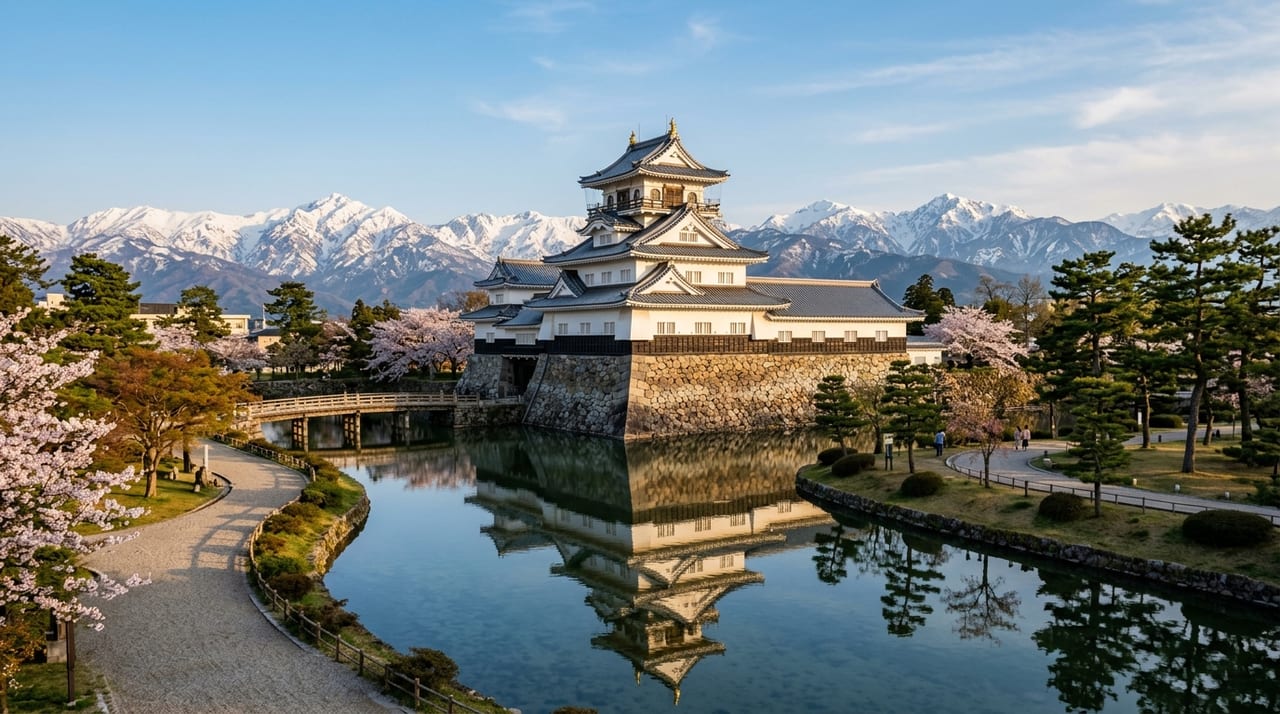
 * Image is for illustrative purposes only.
Toyama Castle
富山城
Toyama Castle is a historic castle in the Chūbu region (Built around Tenbun 12 (1543)). Its lord was Jinbō Nagamoto / Maeda Toshitsugu (first lord of the Toyama Domain).
Overview
About the Castle
Toyama Castle was a flatland castle at Toyama in Niikawa District, Etchū Province (present-day Marunouchi, Toyama City). Its moats drew water from the Jinzū River, and it was also called the "Floating Castle". Before the straightening works of 1903 (Meiji 36), the Jinzū River flowed east in a great bend just north of the castle; its remnant is today's Matsukawa River. It has been selected as one of the Continued Top 100 Japanese Castles.
Toyama Castle in the Sengoku Period
The prevailing view is that Toyama Castle was built around Tenbun 12 (1543) by Jinbō Nagamoto, deputy governor of Etchū (theories on the date range from Eishō 16 to about Eiroku 3). In Eiroku 3 (1560), Nagamoto was attacked by Uesugi Kenshin and fled to Masuyama Castle, and the castle then changed hands repeatedly among the Uesugi side, the Shiina, the Jinbō and the Ikkō-ikki. After Kenshin's death in Tenshō 6 (1578), Jinbō Nagazumi, who had taken refuge with Oda Nobunaga, entered Toyama Castle, and from Tenshō 9 (1581) Sassa Narimasa, sent by Nobunaga, ruled Etchū from here. In Tenshō 13 (1585), surrounded by Hashiba Hideyoshi's great army, Narimasa surrendered without fighting, and Hideyoshi ordered the castle dismantled (the Toyama Campaign).
A Castle of the Maeda
In Keichō 10 (1605), the retired Maeda Toshinaga made Toyama Castle his residence and began improving the castle and town, but the castle burned in the great fire of Keichō 14 (1609), and Toshinaga moved to Takaoka. When the Toyama Domain was later split off from the Kaga Domain, its first lord, Maeda Toshitsugu, entered Toyama Castle provisionally in Kan'ei 17 (1640), and in Kanbun 1 (1661), with the shogunate's permission, made it the seat of the Toyama Domain. From then until the end of the Edo period it remained the castle of the Maeda of Toyama. Only the gate areas of the castle were faced with stone walls; elsewhere it was defended by earthen ramparts and moats.
Was There a Keep?
The present keep is a replica built for the Toyama Industrial Exposition of 1954 (Shōwa 29) and is not a reconstruction of an Edo-period keep. The shogunate's permission of 1661 (the building permit dated Manji 4) also covered the construction of a keep, and the Toyama Domain raised the earthen rampart at the southeast corner of the main bailey as a foundation for the keep base, but the stone base and the keep itself are thought never to have been built because of the domain's finances. The replica keep houses the Toyama Municipal Folk Museum and was registered as a national tangible cultural property in 2004 (Heisei 16).
Connection to Swords
The area around Toyama Castle is also linked to master swordsmiths of the late Kamakura period. Norishige lived in Nei District, Etchū Province, in what is now Gofuku, Toyama City; he has long been counted among the Ten Disciples of Masamune, and a tantō signed Norishige (named "Nihon-ichi") is a National Treasure, while eight of his tachi, katana and tantō are Important Cultural Properties. Gō Yoshihiro (Gō no Yoshihiro), said to have lived at Matsukura-gō in Niikawa District, Etchū Province (present-day Uozu), is counted with Masamune and Awataguchi Yoshimitsu as one of the "three great makers" of meibutsu, and the "Tomita-gō", handed down in the Maeda family, is a National Treasure. No signed work by Gō Yoshihiro is known; his blades are known only through the attributions of the Hon'ami family.
Highlights
- Toyama Castle keep (replica) — Built for the Toyama Industrial Exposition of 1954. It houses the Toyama Municipal Folk Museum, which presents the history of the castle from the Sengoku period to the present
- Chitose Gate — Built in 1849 (Kaei 2) as the main gate of the Chitose Palace, the retirement residence of Maeda Toshiyasu, 10th lord of the Toyama Domain. Returned to the castle park from the site it had been moved to, it is a Toyama City-designated cultural property
- Stone walls and moats — In the Edo period only the gate areas of Toyama Castle were faced with stone; elsewhere the castle was defended by earthen ramparts and moats. Stone walls and moats remain in the castle park
- Gofuku (home of Norishige) — The village in Nei District, Etchū Province, where the late Kamakura swordsmith Norishige lived corresponds to present-day Gofuku, Toyama City
* Opening hours and admission fees are subject to change. Please check the official website before visiting.