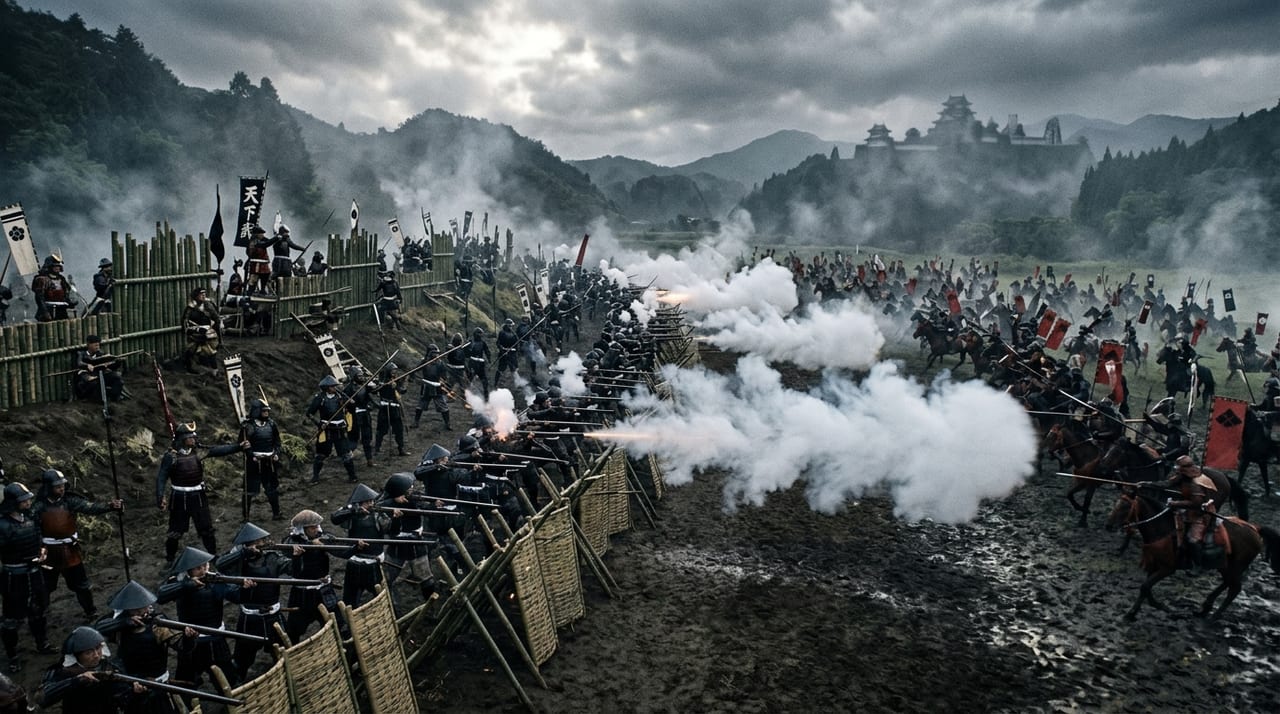
Sassa Narimasa's Hokuriku Conquest and Siege of Toyama Castle
1581-1585
Etchū Province
- Date
- 1581-1585
- Location
- Etchū Province
- Result
- Completion of Hokuriku unification under Sassa Narimasa. Fall of Uozu Castle, reconstruction of Toyama Castle. Conclusion of large-scale warfare in the musket age. Subsequently, Narimasa ceded Hokuriku control to Toyotomi Hideyoshi.
About 5 min read
Sassa Narimasa (1536-1588) was a pivotal military commander under Oda Nobunaga who achieved the unification and control of Etchū Province between 1575 and 1585. Rising from humble provincial origins, Narimasa demonstrated exceptional military acumen in service to Nobunaga's campaigns. The period from 1581 to 1585 marked the Hokuriku region's final great wars of unification, with the siege of Toyama Castle at its center exemplifying the evolution of siege warfare in the musket age.
Narimasa's advance into Etchū followed the power vacuum left by Uesugi Kenshin's death in 1578. In February 1581, Narimasa formally obtained half of Etchū and initiated massive reconstructions of Toyama Castle as his regional headquarters, introducing advanced fortification designs then unavailable in the northern provinces. Concurrent with this, Narimasa prosecuted an intense three-month siege of Uozu Castle, Uesugi's final foothold in the province. By the time of the Honnō-ji Incident in June 1582, the Uozu campaign had reached its final phase, securing Narimasa's decisive victory in pacifying Etchū.
Narimasa's military strategy combined concentrated volley fire from massed musket units with multi-layered assault tactics incorporating close-quarters sword work. Unlike Uesugi Kenshin's reliance on individual spearmen and sword-wielders, Narimasa centralized his forces on collective firearm deployment and advanced fortification engineering. The reconstruction of Toyama Castle incorporated cutting-edge trace italienne (稜堡式) bastioned fortress design—evidence of Oda's modernization penetrating the Hokuriku region. Strategically positioned artillery bastions enabled overlapping fields of fire, rendering traditional siege approaches obsolete and establishing new standards for Edo-period castle construction.
However, in the 1584 Battle of Komaki and Nagakute, Narimasa allied with Tokugawa Ieyasu against Toyotomi Hideyoshi and suffered defeat. This reversal precipitated his rapid decline. In 1585, following Hideyoshi's dispatch of a Hokuriku expeditionary force, Narimasa completed his Toyama siege but was forced to surrender the castle to Hideyoshi. Though initially spared, Narimasa was subsequently ordered to commit seppuku in 1588 following administrative irregularities in his Higo Province appointment.
Narimasa's Hokuriku conquest war represents a transitional phase in Japan's nationwide unification, while simultaneously documenting the explosive evolution in weaponry and tactics as the Sengoku age yielded to the Edo. His military dominance in Etchū symbolized the historical shift from individual sword-based combat toward massed musket-centered warfare. The fortification innovations pioneered at Toyama Castle became prototypes for subsequent Edo-period construction, establishing architectural principles that persisted for centuries.