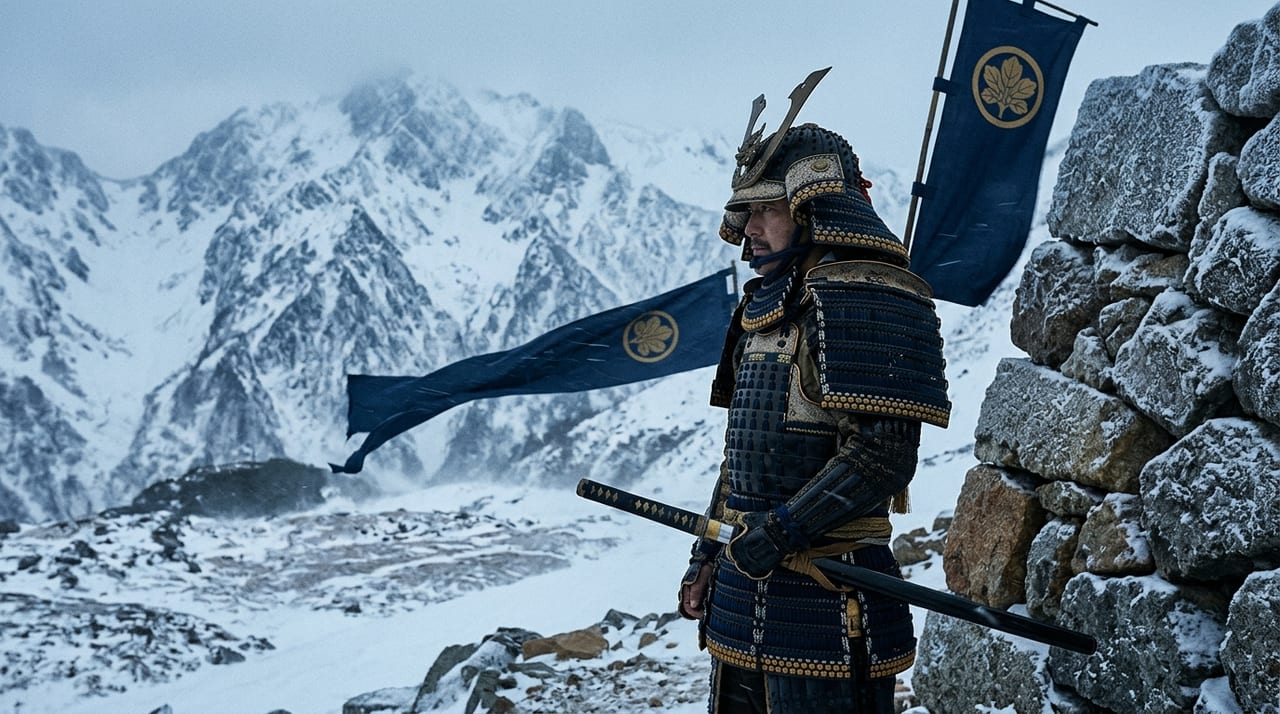
 * Image is for illustrative purposes only.
Sassa Narimasa
佐々成政
Fierce General of Etchū, Hero of the Sarasara-goe
- Era
- Late Sengoku Period
- Lifespan
- 1536-1588
Description
Sassa Narimasa (1536-1588) was a warrior who rose from a yoriki (attached commander) of Shibata Katsuie to become a daimyō ruling Etchū Province (present-day Toyama Prefecture). His name is remembered for the extraordinary feat of crossing the Northern Alps in the depths of winter, known as the Sarasara-goe. In the struggle for supremacy after Oda Nobunaga's death, he allied with Tokugawa Ieyasu to oppose Toyotomi Hideyoshi, but was ultimately forced to submit, making him a tragic warrior.
Narimasa served Oda Nobunaga as an umamawari (mounted guard) and became the head of the Kuro-horo-shū (Black Horo Corps), distinguishing himself in numerous battles, including the Battle of Moribe and the Battle of Nagashino. Having earned Nobunaga's trust, Narimasa was assigned as a yoriki of Shibata Katsuie to the Hokuriku Area Army, where he played an important role in the conquest of Kaga and Etchū. He entered Toyama Castle in 1581, and the following year became the daimyō governing the whole of Etchū Province.
After the Honnō-ji Incident (1582), Narimasa sided with Shibata Katsuie. However, at the Battle of Shizugatake he did not take the field himself, as he had to guard against the Uesugi, and only sent reinforcements. After Katsuie's defeat he briefly submitted to Hideyoshi, but in 1584, at the Battle of Komaki and Nagakute, he sided with Tokugawa Ieyasu and fought against Maeda Toshiie, who was on Hideyoshi's side. When Hideyoshi and Ieyasu made a truce, Narimasa crossed the Northern Alps (the Tateyama mountain range) in the deep winter of 1584 and went to Ieyasu at Hamamatsu, appealing for a joint front against Hideyoshi. He failed to persuade Ieyasu, but this Sarasara-goe has been passed down as a heroic mountain crossing in deep winter (there are various theories regarding the route).
In relation to swords, Etchū Province, which Narimasa governed, is known as the home of Norishige (Etchū Norishige), a swordsmith of the Kamakura period.
However, in 1585, when Hideyoshi sent a large army into Etchū, Narimasa surrendered (the Toyama Campaign) and was stripped of his domains, except for Niikawa District in eastern Etchū. After the Kyūshū Campaign of 1587, he was granted the entire province of Higo (Kumamoto), but he was held responsible for the uprising of the provincial warriors in Higo and in 1588 was ordered to commit seppuku. Befitting the end of a turbulent life, Narimasa is said to have resolutely taken his own life.