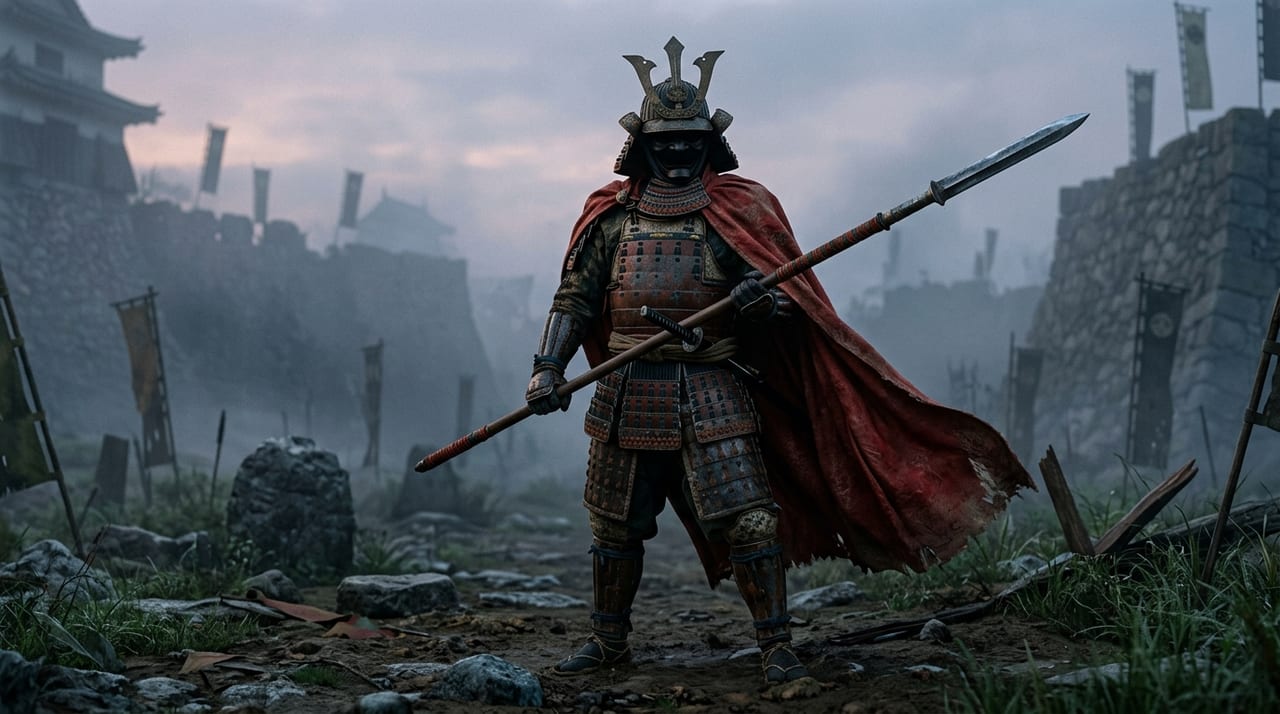
 * Image is for illustrative purposes only.
Maeda Toshiie
前田利家
Mataza of the Spear
Description
The Birth of Mataza of the Spear
Maeda Toshiie, born in Tenbun 7 (1539) at Arako Castle in Owari Province, earned a martial reputation in the warring states era under the nickname 'Yari no Mataza' (Mataza of the Spear). He later laid the foundations of Kaga Hyakumangoku and was both a fierce warrior and a man of culture. As one of Oda Nobunaga's Akahoro-shū (Red Hooded Guards, an elite personal guard unit), he built up military distinction in many battles from his youth, and in spear technique he was said to be unrivaled under heaven.
Nobunaga's Akahoro-shū
Toshiie's martial talent was precocious. At the age of fourteen he began serving Nobunaga, and in his first battle, the Battle of Kayazu, he showed his prowess by taking one enemy head. Nobunaga's Akahoro-shū were an elite unit that carried large red back banners on the battlefield and took pride in fighting at the front line, and Toshiie, as their foremost member, led the vanguard in numerous battles. He took part in Nobunaga's major battles, including the Battle of Okehazama (fought without permission while under a suspension of service), the Battle of Moribe, and the Battle of Anegawa, where he wielded his spear to win distinction.
The Transition to the Hideyoshi Era
Toshiie's spear skill resounded throughout the realm, but he also had deep knowledge of swords. The most famous of the swords handed down in the Maeda family is Ōdenta Mitsuyo. Counted among the Tenka Goken (Five Great Swords under Heaven), this tachi was made by Miike Denta Mitsuyo, a smith of Miike in Chikugo Province, and as a masterpiece of Miike Denta it is a sword ranked at the summit of Japanese sword history. Ōdenta Mitsuyo is distinctive for its broad, weighty form and its ō-itame forging pattern with a hoso-suguha temper line, and it preserves today the expansive style of the late Heian period. Handed down carefully through generations as a treasure of the Maeda family, it has been designated a National Treasure.
The Path to Kaga Hyakumangoku
There are various theories about how this Ōdenta Mitsuyo came into the Maeda family, but the most widely held is that Toyotomi Hideyoshi bestowed it on Toshiie. According to the Kyōhō Meibutsu-chō, it was given by Hideyoshi to cure the illness of Toshiie's daughter, Gōhime, and after it came into Toshiie's hands, it is said to have been placed in a karabitsu chest and encircled with a shimenawa sacred rope.
A Discerning Eye for Swords
Toshiie became one of the Five Elders in the Toyotomi regime, and after Hideyoshi's death he served as guardian of the Toyotomi house, supporting the young Toyotomi Hideyori. Toshiie's presence was the greatest check on the expansion of Tokugawa Ieyasu's power, and it is said that as long as Toshiie lived, Ieyasu could not move against the Toyotomi house. However, in the intercalary 3rd month of Keichō 4 (1599), only eight months after Hideyoshi's death, Toshiie also died. Toshiie's death hastened the collapse of the Toyotomi regime, leading to the Battle of Sekigahara the following year.
Aspects as a Man of Culture
Throughout the Edo period, the Kaga Domain prospered as a great domain of one million koku and boasted one of Japan's finest sword collections. The Maeda family's swords are known for their high quality, led by the Tenka Goken Ōdenta Mitsuyo. The Kaga Domain was also enthusiastic about cultural undertakings, and the culture of preserving and appreciating swords was promoted by the domain as a whole. The tradition of martial prowess and culture that Toshiie built has been passed down to later generations along with the splendor of Kaga Hyakumangoku.
Foundations of Kaga
For Toshiie, the spear was the greatest weapon on the battlefield, while the sword was a symbol of the dignity and cultural refinement befitting a leader of the warrior class. He defeated enemies with the spear and expressed his own dignity through the sword. That image was the very ideal of a warring-states commander who combined martial valor with learning.
Notable Swords
- Ōdenta Mitsuyo (one of the Tenka Goken, National Treasure; a work of the swordsmith Denta Mitsuyo of Miike in Chikugo Province. Characterized by a broad, massive form, an ō-itame forging pattern and a narrow straight temper line (hoso-suguha); a treasure that conveys the generous style of the late Heian period)
- Swords handed down in the Maeda family (many high-quality masterpieces reflecting the prestige of Kaga's million koku)