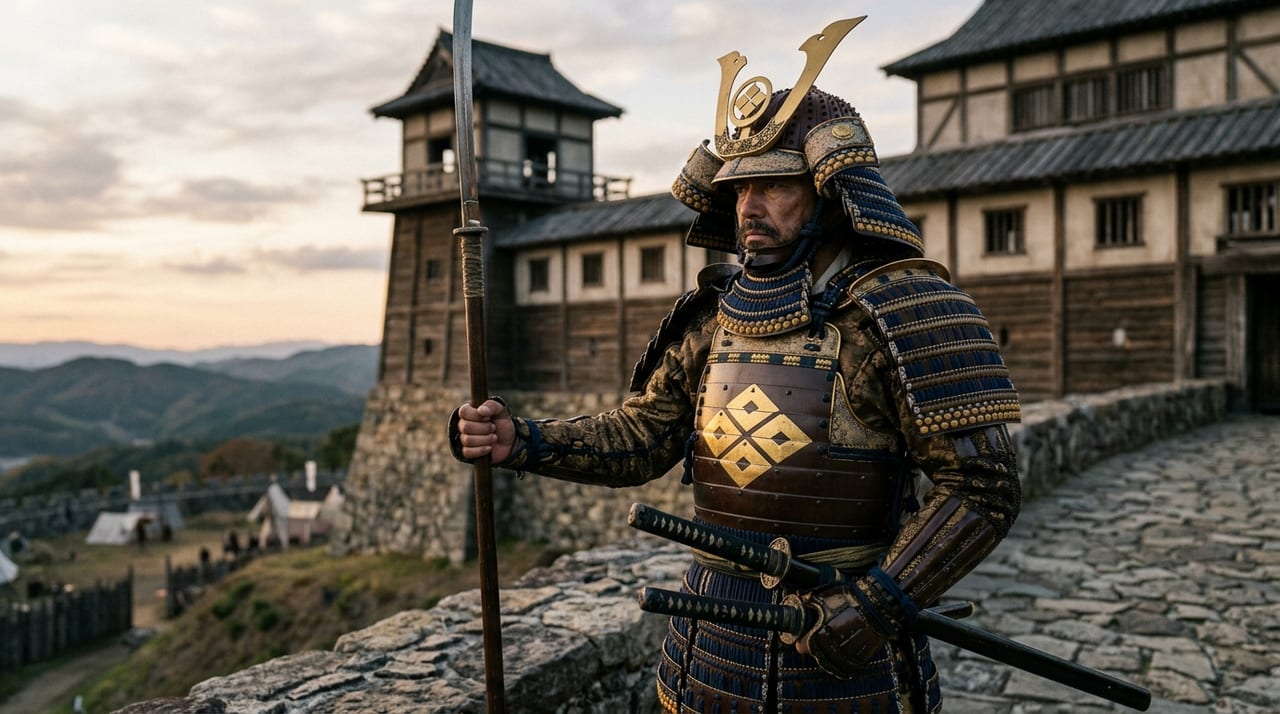
 * Image is for illustrative purposes only.
Araki Murashige
荒木村重
Rebel Lord and Tea Master
Description
From Nobunaga's Vassal to Rebel
Araki Murashige, born around Tenbun 4 (1535) in Settsu Province (present-day Osaka Prefecture), belonged to the Ikeda clan and then the Miyoshi clan before becoming a vassal of Oda Nobunaga. He was a capable warrior entrusted with governing Settsu Province. Nobunaga placed great trust in him: Murashige was given the whole of Settsu Province and made Itami Castle (Arioka Castle) his main castle. However, in Tenshō 6 (1578), Murashige suddenly rebelled against Nobunaga. There are various theories about the reason for the rebellion. It is said to have been a personal grudge against Nobunaga, or cooperation with Ishiyama Hongan-ji, but the true story remains a mystery to this day.
Siege and Escape from Arioka Castle
Arioka Castle, surrounded by Nobunaga's large army, held out in a siege of about one year until Tenshō 7 (1579). During this siege, Murashige took a shocking action. Leaving his wife, children, retainers, and soldiers behind in Arioka Castle, Murashige escaped the castle and moved first to Amagasaki Castle and later to Hanakuma Castle. The wife, children, and retainers left in the castle were captured by Nobunaga, and many people, beginning with Murashige's wife, Dashi, were executed. This 'flight abandoning his wife and children' is recorded in history as Murashige's greatest stain, and it continues to be debated in later times as an act that has given rise to many mysteries and criticisms.
The Age of Swords and Warriors
Before Murashige rebelled, during the period when he was active as a vassal of Nobunaga, he was known as an excellent warrior. Murashige distinguished himself in battle by fighting in various places, including the Ishiyama War and the Kishū campaign. The Ehon Taikōki (an illustrated Edo-period chronicle) depicts an anecdote in which Nobunaga held out a manjū (bun) speared on the tip of a dagger, and Murashige ate it in one bite. Nobunaga praised his courage and entrusted Settsu to him. Nobunaga also highly valued Murashige's military strength and administrative ability.
Turning to the Tea Ceremony and Dōkun
Pursued by Nobunaga's forces at Amagasaki and Hanakuma as well, Murashige relied on the Mōri clan and fled to Onomichi. After Nobunaga's death in 1582, he moved to Sakai. Here Murashige underwent a remarkable transformation. Abandoning the life of a warrior, he took the tea name Dōkun and, associating with Sen no Rikyū, Imai Sōkyū, and others, was reborn as a tea master. It is also said that he first went by the name 'Dōfun,' and this strange name is interpreted as self-deprecation about his past.
The Spirit of Tea and the Sword
Having entered the world of the tea ceremony, Murashige is thought to have deeply grasped the commonalities between the sword and tea. The spirit of 'ichi-go ichi-e,' taught by Sen no Rikyū, meaning this encounter will never happen again, resonates with the 'single flash' of the sword. In later times, Murashige is sometimes counted among the Seven Disciples of Rikyū (Rikyū Shichitetsu).
A Mysterious End
In Tenshō 14 (1586), Murashige died at the age of 52. Murashige's life, rebelling as a warrior, fleeing and abandoning his wife and children, and finally ending his life peacefully as a tea master, traced an extremely unusual path even among the warriors of the Sengoku period. Murashige's contradiction-filled life, lived between the sword and the tea bowl, poses to later generations a question that continues to ask what a samurai is and what a sword is.