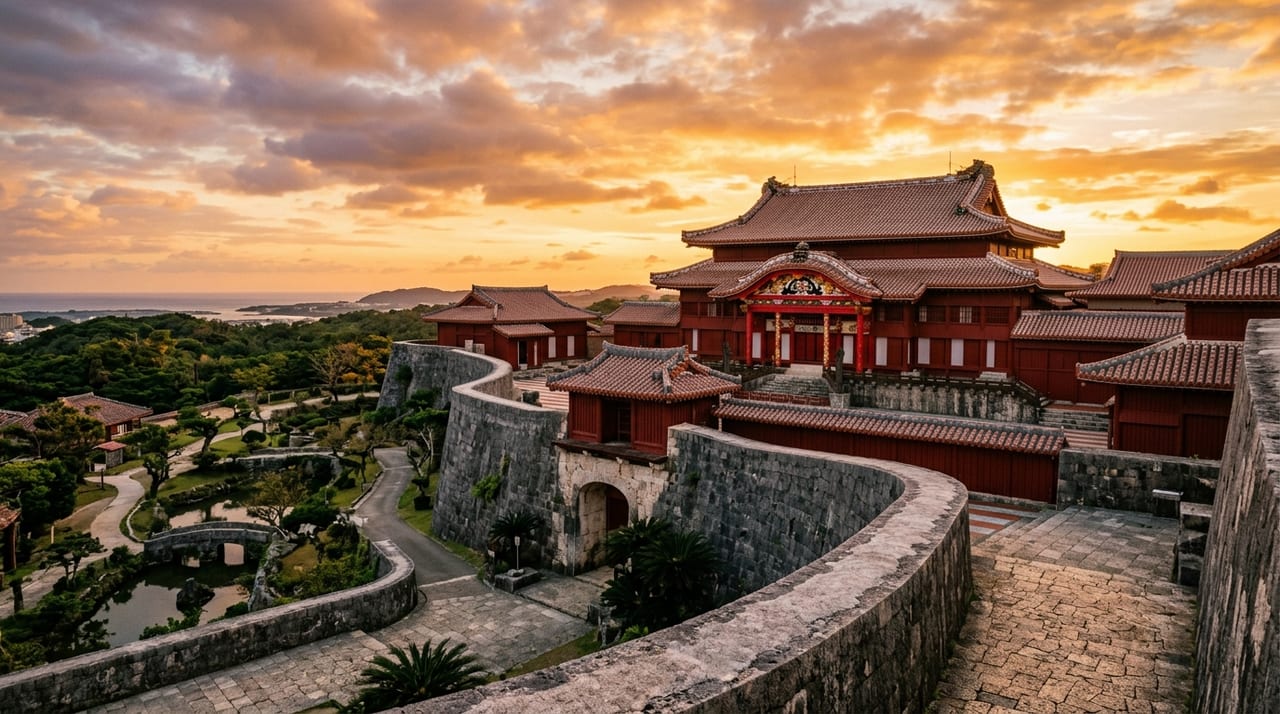
 * Image is for illustrative purposes only.
Arioka Castle (Itami Castle)
有岡城(伊丹城)
Arioka Castle (Itami Castle) is a historic castle in the Kansai region (Founded in the Nanboku-chō period; rebuilt and renamed by Araki Murashige in 1574; fell in 1579). Its lord was Itami clan (later Araki Murashige).
Overview
Overview
Arioka Castle stood in present-day Itami, Hyogo Prefecture, and traces its origins to Itami Castle, held by the local Itami clan from the Nanboku-chō through the Sengoku period. In the 11th month of Tenshō 2 (1574), Araki Murashige, a general under Oda Nobunaga, took the castle from the Itami and renamed it Arioka, carrying out a major reconstruction.
A Sōgamae Fortress
Murashige's rebuilding adopted a sōgamae layout, enclosing not just the castle itself but the surrounding samurai and merchant quarters within a single system of moats and earthworks — an advanced design for the Kinai region at the time.
Murashige's Revolt and the Fall of the Castle
In 1578, Murashige suddenly rebelled against Nobunaga and holed up in Arioka Castle. Kuroda Yoshitaka (Kanbei), a strategist on the Oda side, went to the castle to try to talk him down but was captured; tradition holds that he was imprisoned within the castle for about a year. In the 9th month of Tenshō 7 (1579), Murashige himself slipped out of the castle and relocated to Amagasaki Castle, leaving Arioka in the hands of his retainer Araki Kyūzaemon. After a continued siege by Oda forces, the castle finally surrendered and fell on the 19th day of the 11th month of that year. In the 12th month, the women of the household were executed at Nanamatsu near Amagasaki, while thirty-six members of the Araki clan were beheaded at Rokujō-ga-hara in Kyoto.
Present State
Recognized for its value as a sōgamae fortress, the site was designated a National Historic Site in December 1979, with an additional designation in May 1988. Today, portions of its stone walls, earthworks, and a well are preserved and open to the public as a park in front of JR Itami Station.
Connection to Swords
The sword most closely associated with Kuroda Yoshitaka (Kanbei), who was imprisoned at Arioka Castle, is the celebrated blade "Heshikiri Hasebe" — a National Treasure made by the Nanboku-chō swordsmith Hasebe Kunishige. Several traditions explain how it came into the Kuroda family's hands: one holds that Kanbei received it directly from Nobunaga as a reward for proposing the strategy for the Chūgoku campaign; another that it was later bestowed on his son, Kuroda Nagamasa, by way of Toyotomi Hideyoshi. During Murashige's revolt, Nobunaga is said to have ordered the execution of Kanbei's hostage son, Shōjumaru (later Kuroda Nagamasa), though the boy was reportedly saved through the quick thinking of Takenaka Hanbei. "Heshikiri Hasebe" is now held at the Fukuoka City Museum and designated a National Treasure.
Highlights
- Sōgamae layout — an advanced Sengoku-period design enclosing both the castle and its castle town
- Site of Kuroda Kanbei's imprisonment — the setting for the traditional account of Araki Murashige's revolt
- Preserved grounds in front of JR Itami Station — stone walls, earthworks, and a well maintained as a park
- National Historic Site — designated in 1979 for its value as a sōgamae fortress
* Opening hours and admission fees are subject to change. Please check the official website before visiting.