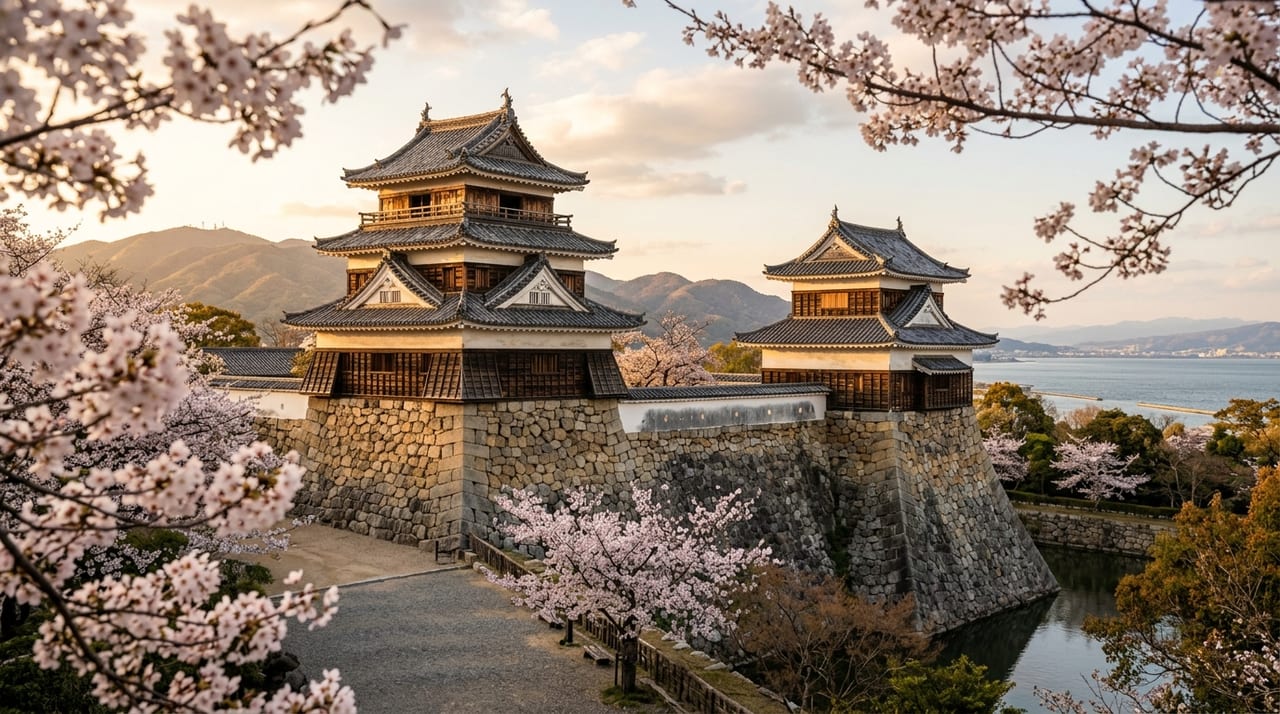
 * Image is for illustrative purposes only.
Akashi Castle (Kishun Castle / Kinkō Castle)
明石城(喜春城・錦江城)
Akashi Castle (Kishun Castle / Kinkō Castle) is a historic castle in the Kansai region (Built in 1619 (Genna 5)). Its lord was Ogasawara Tadazane / Matsudaira clan.
Overview
About the Castle
Akashi Castle was built in the 5th year of Genna (1619) by Ogasawara Tadazane, the first lord of the domain, under orders from the Tokugawa shogunate. It was constructed as a castle to monitor and deter the daimyō of western Japan after the Osaka campaigns (1615). The land of Akashi, facing Harima-nada, was a key point on the Sanyōdō linking Kyoto and Osaka with western Japan, and it was strategically important to the shogunate. Tokugawa Hidetada, the second shogun, advanced a policy of placing shinpan (collateral) and fudai (hereditary vassal) daimyō across the country to firmly establish control of western Japan after the Osaka campaigns, and Akashi Castle was built as part of this policy. The castle's position, watching over the Sanyōdō from the west, functioned to observe the movements of remnants of the Toyotomi, to track the sankin-kōtai routes of western daimyō, and to display shogunal authority at a key point. The background to choosing Akashi lay in its geographic advantage as a transport hub where sea access to Harima-nada crossed the overland Sanyōdō.
Architectural Features
The most distinctive feature of Akashi Castle is the two corner turrets that still survive, Tatsumi-yagura and Hitsujisaru-yagura. Four three-story turrets were once built at the four corners of the honmaru, but Ushitora-yagura in the northeast and Inui-yagura in the northwest were dismantled in the Meiji period. Two remain today and are designated Important Cultural Properties of the nation. These two turrets are valuable remains that convey the imposing appearance of the castle of the past, and their form against the Harima mountains and the Akashi sky has a distinctive beauty. A tenshu was planned but was never built, and only the stone walls of the tenshu base remain. The two surviving corner turrets have a three-story structure, and there is also a theory that Hitsujisaru-yagura was relocated from the remains of Fushimi Castle. Architecturally, they embody the historical continuity from the Toyotomi period to the Tokugawa period.
The Historical Significance of Akashi
The name and place of Akashi hold a unique significance in Japanese cultural history. The 'Akashi' chapter of The Tale of Genji tells of Hikaru Genji's exile to Akashi Bay, and in Japanese literature Akashi occupies a singular place as a site where 'light and shadow,' 'capital and provinces,' and 'elegance and melancholy' intersect. Akashi is also known as the place through which the Japan Standard Time meridian (135° East) passes, and its clock tower serves as a symbol of the city. In the Edo period, the Akashi Domain prospered as a post town on the sankin-kōtai route and as a key point on the Sanyōdō, where daimyō of western Japan passed through. The Akashi Strait has long been known as a difficult passage for navigation because of its fast currents, and Akashi Castle, built overlooking this strait, also played a military role in controlling a key point of maritime traffic. In modern times, the opening of the Akashi Kaikyō Bridge connected Honshu and Awaji Island, and Akashi's geographic importance has continued unchanged from ancient times to the present.
The Matsudaira Family and Domain Governance
After Ogasawara Tadazane was transferred to Kokura in the 9th year of Kan'ei (1632), castle lords changed in rapid succession. From the 2nd year of Tenna (1682), when Matsudaira Naoakira of the Echizen Matsudaira house took over, the Matsudaira family governed the domain until the end of the Edo period. The Matsudaira family was a distinguished house related by family ties to the Tokugawa shogunal family, and domain governance in Akashi operated under a system that faithfully followed the wishes of the shogunate. In the late Edo period, the domain fought on the shogunate's side in the Battle of Toba–Fushimi, but later submitted to the Meiji government. Today Akashi Park is maintained as a place for citizens to relax and is also famous as a cherry blossom spot in spring. The contrast between the two corner turrets and the cherry blossoms has become a symbol of spring in Akashi.
The World of Castles and Swords
The Ogasawara family was a distinguished house excelling in archery, horsemanship, and courtly etiquette, and this tradition is deeply rooted in the martial culture of the Akashi Domain. Ogasawara-ryū etiquette spread widely as the standard of courtesy in samurai society, and the manners for handling, wearing, and appreciating swords were also incorporated into the norms of Ogasawara-ryū. The two surviving corner turrets of Akashi Park embody the techniques and aesthetic sense of early Edo castle architecture and are valuable cultural properties. In cherry blossom season, the contrast between the white blossoms and the golden-brown, aged wood creates a distinctive atmosphere. The martial culture of Akashi, where Ogasawara-ryū etiquette took root, fostered an attitude that sought courtesy and aesthetic sense in all aspects of handling swords, deportment, and appreciation, and this tradition continues today as a foundation of modern martial arts and etiquette. A visit to the Akashi Castle ruins is an invitation to a rare historical space where the shogunate's intent to watch over western Japan coexists with the spirit of Ogasawara etiquette, and it is one of the best places to deeply understand the social background of sword culture.
Connection to Swords
At the core of the sword culture of Akashi Castle is the 'Ogasawara-ryū etiquette' transmitted by the first lord, Ogasawara Tadazane, and the Ogasawara family. Ogasawara-ryū originated in the archery and horsemanship etiquette established by Ogasawara Nagakiyo under Minamoto no Yoritomo in the Kamakura period, and from the Muromachi period onward it spread widely as the standard of courtesy across samurai society. The manners for handling, wearing, and appreciating swords were all based on the norms of Ogasawara-ryū, and the 'learning of etiquette,' including how to handle a sword, was at the root of samurai education. Ogasawara Tadazane himself was a commander who fought in the Osaka summer campaign (the 20th year of Keichō, 1615). The Matsudaira family, which later became lords of the Akashi Domain, was a distinguished house related by family ties to the Tokugawa shogunal family. Akashi City has the Akashi City Cultural Museum, which exhibits historical, archaeological, and folk materials of Akashi. As a castle associated with Ogasawara-ryū etiquette, Akashi Castle is a special place where one can experience the history of Japan's samurai etiquette.
Highlights
- Two surviving corner turrets (Tatsumi-yagura and Hitsujisaru-yagura) (Important Cultural Properties) — a renowned Harima structure that conveys early Edo-period castle-building techniques to the present day
- Stone walls of the tenshu base — the tenshu that was never built; the massive stone walls convey the scale of the castle in its day
- Cherry blossoms of Akashi Park — a showcase of the two corner turrets and cherry blossoms, one of the '100 Famous Cherry Blossom Spots in Japan'
- Akashi City Cultural Museum — holds historical, archaeological, and folk materials of Akashi
- Akashi Astronomical Science Museum — a symbol of 'Akashi, the City of Time,' through which the Japan Standard Time meridian (135° East) passes
- Uo no Tana shopping arcade — offers Harima-nada seafood such as Akashi octopus, Akashi sea bream, and nishin-zuke (herring pickles)
* Opening hours and admission fees are subject to change. Please check the official website before visiting.