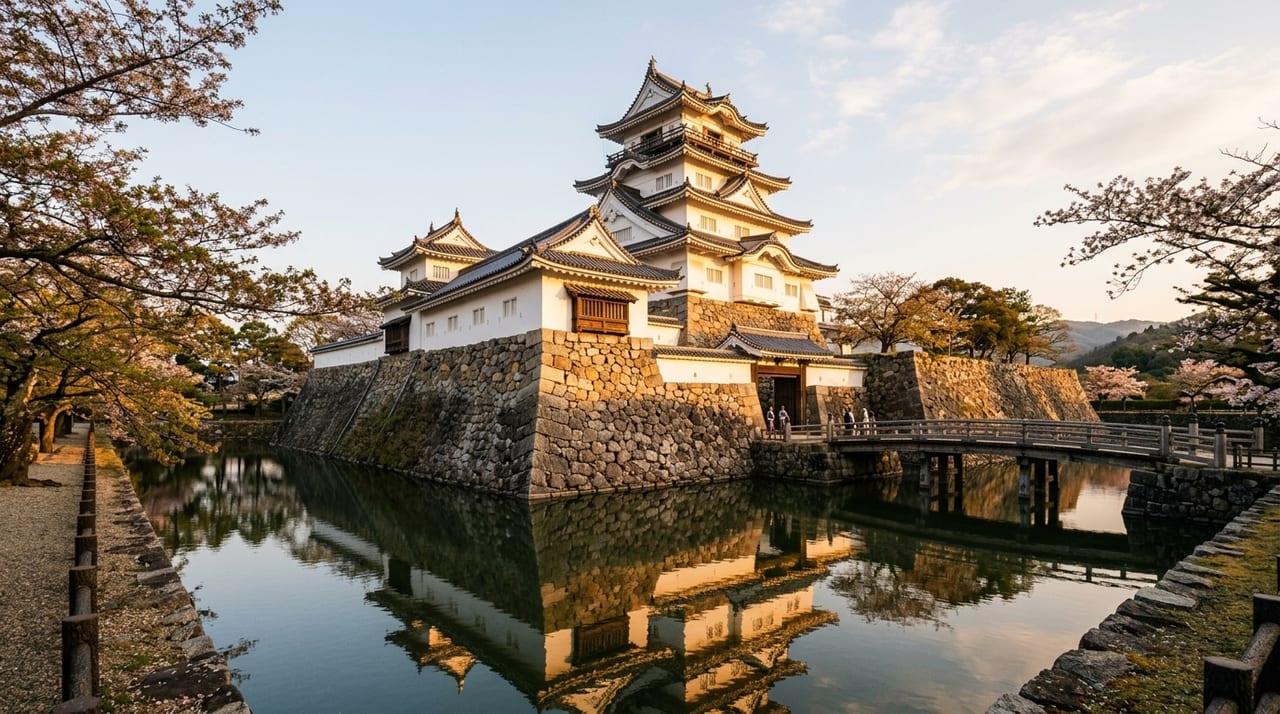
 * Image is for illustrative purposes only.
Tamba-Kameyama Castle
丹波亀山城(亀山城)
Tamba-Kameyama Castle is a historic castle in the Kansai region (Around Tenshō 6 (1578), Akechi Mitsuhide built the castle as a base for the conquest of Tamba, and it was developed as a base for Oda Nobunaga's rule of Tamba). Its lord was Akechi Mitsuhide → Hashiba Hidekatsu → Maeda Geni → Okabe Nagamori → Matsudaira (Katagahara) clan.
Overview
Tamba-Kameyama Castle is a castle site located in Uchimaru, Arazuka-machi, Kameoka, Kyoto Prefecture. It is directly connected to one of the most dramatic events in Japanese history, as it was the castle where Akechi Mitsuhide based himself immediately before the Honnō-ji Incident of 1582. It is often called "Tamba-Kameyama Castle" to distinguish it from "Ise-Kameyama Castle" in Kameyama, Mie Prefecture.
Akechi Mitsuhide completed the pacification of Tamba under Oda Nobunaga's orders in Tenshō 7 (1579), and he developed Tamba-Kameyama Castle as his base. The pacification of Tamba was extremely difficult for Mitsuhide (it took five years, counted inclusively, starting from Tenshō 3 (1575)), but his rule after completion is said to have been admired by the local people as exemplary good governance. Mitsuhide played an "administrator"-like role in Nobunaga's rule of Kyoto and is known as a warlord of culture, well versed in the tea ceremony, renga poetry, and the arts.
On the 1st day of the 6th month of Tenshō 10 (1582), Akechi Mitsuhide set out from Tamba-Kameyama Castle with an army of about 13,000 and, in the early hours of the 2nd day of the 6th month, made a surprise attack on Oda Nobunaga, who was staying at Honnō-ji Temple in Kyoto (the Honnō-ji Incident). Mitsuhide's rebellion, which forced Nobunaga to take his own life, fundamentally changed the course of Japanese history. However, Mitsuhide was defeated eleven days later by Hashiba (Toyotomi) Hideyoshi at the Battle of Yamazaki, and was killed by hunters of fleeing warriors while on the run (after the Battle of Tennōzan).
Afterward, the castle passed through Maeda Geni and others, and in the Edo period its lords changed among the Okabe and Matsudaira clans, and it functioned as the seat of the Tamba-Kameyama Domain. Following the castle's abandonment, much of the castle site became religious grounds (the sacred garden of Ōmoto), and only a limited part is open to the public. However, part of the stone walls and the moat survive and convey the scale of the castle as it was in its time.
Connection to Swords
The connection between Tamba-Kameyama Castle and Japanese swords is rooted in the castle's lord, Akechi Mitsuhide himself, and in the historical event of the Honnō-ji Incident.
Akechi Mitsuhide was a cultured man well versed in the tea ceremony, renga poetry, and the Chinese classics, and he was also a fierce warrior who carried out Oda Nobunaga's military operations. Direct records of swords associated with Mitsuhide are few. Also, the scene when Mitsuhide gave the order during the Honnō-ji Incident, with armored officers and soldiers wearing swords and standing in formation, is one of the most vivid appearances of swords in Japan's historical imagination.
After the Honnō-ji Incident, Hashiba (Toyotomi) Hideyoshi, who defeated Mitsuhide, seized Mitsuhide's possessions and the contents of the castle's storehouses during the postwar arrangements. It is presumed that famous swords and armor that Mitsuhide had stored were among them, but no detailed records remain. Anecdotes about swords connected to Mitsuhide's death (such as the theory that he took his own life with a short sword while fleeing as a fallen warrior) contain much later fiction. Nevertheless, Tamba-Kameyama Castle occupies a special place in the history of swords as the place where the theme of "Japanese swords and the death of the warrior" intersects most densely throughout the Honnō-ji Incident as a historical event.
Highlights
- Stone walls and inner moat remains of Tamba-Kameyama Castle: the stone walls, built in a nationwide construction project (tenka-bushin) and restored by Ōmoto, and the remains of the inner moat survive within Ōmoto's grounds (visits by application at the reception desk)
- Departure point of the Honnō-ji Incident: the castle from which Mitsuhide set out with his army on the 1st day of the 6th month of Tenshō 10 (1582)
- Historic sites related to Akechi Mitsuhide: shrines and temples in Kameoka City associated with Mitsuhide, and the latest excavation information
- Hozu River boat descent: a rapids descent on the Hozu River (Katsura River), which flows past the castle town, from Kameoka to Arashiyama, a distance of about 16 km
- Kameoka Misty Town: the misty autumn scenery created by the mist unique to the Tamba Basin. The castle also has the alternate name Kasumi Castle
* Opening hours and admission fees are subject to change. Please check the official website before visiting.