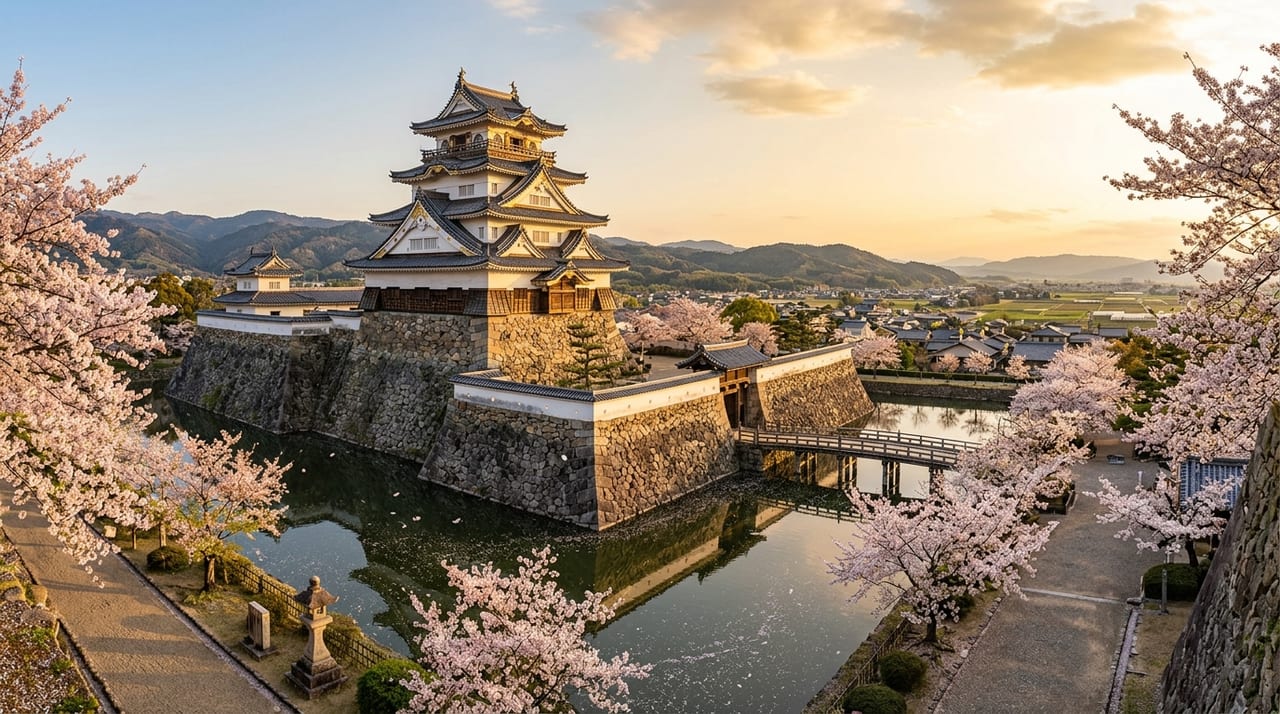
 * Image is for illustrative purposes only.
Yamato-Kōriyama Castle
大和郡山城
Yamato-Kōriyama Castle is a historic castle in the Kansai region (Built by Tsutsui Junkei from 1580 (Tenshō 8) on the site of an earlier medieval stronghold). Its lord was Tsutsui Junkei / Toyotomi Hidenaga / Yanagisawa Yoshisato.
Overview
About the Castle
Yamato-Kōriyama Castle is a flatland castle (hirajiro) built in Kōriyama, Yamato Province, in the central part of the Nara Basin. It carries the record of a turbulent history from the Sengoku period through the Edo period as a key stronghold for controlling Yamato. Its origins are traced to a castle of a medieval local lord. In 1580 (Tenshō 8), Yamato local lord Tsutsui Junkei renovated it as his base. It became a full-scale early modern castle only after Hashiba Hidenaga (later Toyotomi Hidenaga), the younger brother of Toyotomi Hideyoshi, was enfeoffed here in 1585 (Tenshō 13) as a great daimyō with a domain of one million koku across Yamato, Kii and Izumi. Hidenaga was Hideyoshi's ally and supported him in both politics and military affairs. He greatly expanded Yamato-Kōriyama Castle, developed the castle town, and made it the base for governing Yamato. Hidenaga enjoyed Hideyoshi's deep trust and was known for his gentle character and excellent administrative skill.
Toyotomi Glory and Change of Fortunes
When Hidenaga died in 1591 (Tenshō 19), his adopted heir Toyotomi Hideyasu succeeded him, but Hideyasu died young in 1595 (Bunroku 4). Mashita Nagamori, one of the Five Magistrates, then became lord of the castle. After the Battle of Sekigahara, Mizuno Katsunari, Matsudaira Tadaakira and Honda Masakatsu succeeded one another as domain lords. In 1724 (Kyōho 9), Yanagisawa Yoshisato came from Kōfu with a domain of about 150,000 koku. Yoshisato's father, Yanagisawa Yoshiyasu, wielded great power as chamberlain to the fifth shōgun, Tokugawa Tsunayoshi. He also had a cultured side, known for Rikugien, the garden he built in Edo.
Architecture and Features of the Castle
The most famous feature of Yamato-Kōriyama Castle is the sakasa-jizō (upside-down jizō). When Toyotomi Hidenaga expanded the castle, stone was in short supply, so jizō statues, stone Buddhas and gravestones from the surrounding area were reused. It has been confirmed that among them were jizō statues stacked upside down. The upside-down jizō can still be seen today as part of the stone wall of the tenshu-dai (main keep base), and it has become a sightseeing attraction as a rare remnant that conveys to the present the reality of stone procurement in the age of warfare. The Ōte-mon (gate, Shōwa 58) and the Ōte-mukai-yagura (turret, Shōwa 62) were restored through citizen volunteer activity, and they evoke the appearance of castle architecture of the past. The castle ruins are now developed as Kōriyama Castle Ruins Park. In spring, about 600 cherry trees bloom there, making it one of Nara's leading hanami spots.
Yamato Province and Sword Culture
Yamato Province flourished from ancient times as a center of Buddhism and Shintō, and its religious soil gave rise to its own sword culture, the Yamato-den. The Yamato-den is one of the five traditions of Japanese swords (Yamato, Yamashiro, Bizen, Sōshū and Mino), and it is said to have the oldest lineage of the five. Sword-smith groups known as the Yamato Goha (Yamato Five Schools) were active: Senjuin, Taima, Tegai, Shikkake and Hōshō. They produced high-quality swords based at the temples and shrines of Nara. Kōriyama Castle was built in Yamato Province, the land that nurtured this sword culture.
Goldfish and the Castle Town
Kōriyama is also renowned as one of Japan's leading goldfish-producing areas and is loved as the Village of Goldfish. Goldfish farming, said to have begun under the Yanagisawa rule in the Edo period, developed into an important industry of the castle town. Kōriyama is still known nationwide as a leading goldfish-producing region. Yamato-Kōriyama, where the layered history of Nara as an ancient capital meets the crossroads of the two great forces of Toyotomi and Tokugawa, offers a profound charm, like a miniature view of Japanese history.
Connection to Swords
Yamato Province, where Yamato-Kōriyama Castle is located, is a sacred place of the most fundamental significance in the history of Japanese swords. The Yamato-den is said to have the oldest lineage of the five traditions, and its practitioners were the sword-smith groups of the Yamato Five Schools, who were active based at the shrines and temples of Nara. The five schools are Senjuin, Taima, Tegai, Shikkake and Hōshō, and each produced high-quality swords in association with a famous temple or shrine of Nara. The Taima school is said to have set up its workshops near Taima-dera, and the Tegai school near the Tegai-mon (Tegai Gate) of Tōdai-ji. The style of Yamato swords is built on straight hamon (suguha). It is known for works of dignified quality with restrained changes in the hamon but substantial jigane (ground steel). In contrast to the elegance of the Bizen-den and the boldness of the Sōshū-den, the world of Yamato swords might be called the beauty of stillness. It expresses the essence of Yamato as a land where Buddhist spirituality and the way of the warrior intersect. The Yanagisawa Bunko, located in the Bishamon-kuruwa of the Kōriyama Castle ruins, holds books and paintings handwritten by successive lords of the Yanagisawa family, who ruled the Kōriyama domain. Yamato-den swords are still studied by contemporary swordsmiths as models of technique and as the origin of the Japanese sword. Visiting the Kōriyama Castle ruins and standing in the land of Yamato while feeling the deep ties between the temples and shrines of Nara and sword culture, one touches the root of the history of the Japanese sword with an emotion matched by nothing else.
Highlights
- The upside-down jizō on the tenshu-dai — jizō stone statues stacked upside down in the stone wall, proof of stone procurement in the Sengoku age
- Ōte-mukai-yagura and Ōte-mon — castle turret and gate restored through citizen volunteer activity in the Shōwa era
- Cherry blossoms of Kōriyama Castle Ruins Park — about 600 cherry trees lining the moat, a hanami spot in Japan's Top 100 Cherry Blossom Spots
- Goldfish farming in Yamato-Kōriyama — one of Japan's leading goldfish-producing areas, with a goldfish museum (Kingyo Shiryōkan) that can also be visited
- Kasuga Taisha and Tōdai-ji (Nara City) — ancient temples and shrines of Nara that were bases of Yamato sword-smith activity
* Opening hours and admission fees are subject to change. Please check the official website before visiting.