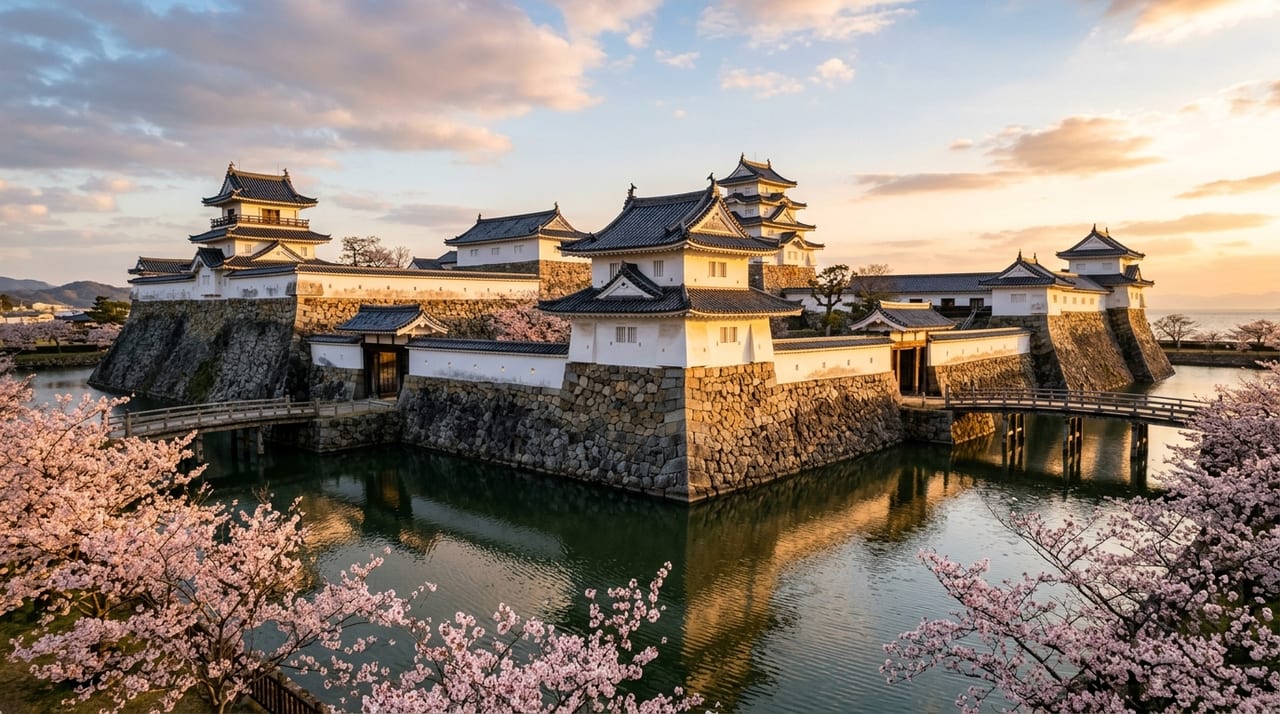
 * Image is for illustrative purposes only.
Ako Castle (Kariya Castle)
赤穂城(加里屋城)
Ako Castle (Kariya Castle) is a historic castle in the Kansai region (Construction began under Asano Naganao in Keian 1 (1648), and the castle was completed in Kanbun 1 (1661). After the sword attack incident involving Asano Takumi no Kami in Genroku 14 (1701), the domain was abolished, and the following year the vendetta by the Forty-Seven Retainers took place). Its lord was Asano Naganao → Asano Naganori (Takumi no Kami) → Nagai Naohiro → Mori clan.
Overview
Akō Castle is an early modern castle located in Akō City, Hyōgo Prefecture. As the castle associated with Chūshingura, the Genroku Akō Incident and the vendetta of the Forty-Seven Retainers, it is one of the castle ruins most widely cherished in Japanese history.
Construction of the castle began in Keian 1 (1648) under Asano Naganao, the first lord of the Akō Asano family. Kondō Masazumi, a military scholar of the Kōshū-ryū school, laid out the castle grounds (nawabari), and the castle was completed in Kanbun 1 (1661) with advice from the military scholar Yamaga Sokō. Yamaga Sokō is said to have advised on the layout around the Ninomaru masugata during construction in Jōō 2 (1653). He was later exiled to the same place from Kanbun 6 (1666) to Enpō 3 (1675). Sokō is known as the foremost authority on Japanese military science, and it is said that his military learning is reflected in the castle's layout. The castle was built as a flatland castle (sea castle) on low ground by the coast. It has a modified concentric (rinkaku-style) layout made up of the Honmaru, Ninomaru and Sannomaru, and it has a unique structure even among the early modern castles of its time.
In the 3rd month of Genroku 14 (1701), Asano Takumi no Kami Naganori, the lord of the domain, drew a blade on Kira Kōzuke no Suke Yoshihisa, chief master of ceremonies (kōke kimoiri), inside Edo Castle. He was ordered to commit seppuku the same day, and the Akō domain was abolished. The Genroku Akō Incident is the vendetta in which 47 former Akō retainers led by Ōishi Kuranosuke Yoshio stormed the Kira residence in Honjo, Edo, on the 14th day of the 12th month of Genroku 15 (30 January 1703), and avenged their lord. Throughout the Edo period it was dramatized as a model of samurai virtue in kabuki and jōruri plays such as Kanadehon Chūshingura, and it became the incident most widely retold in Japanese culture.
The castle ruins are now maintained as a national historic site, and the stone walls, moats and gates of the Honmaru and Ninomaru are preserved in good condition. Within the castle ruin park stands Ōishi Shrine, which enshrines the Forty-Seven Retainers, with Ōishi Kuranosuke at their head, as its deities. Every year on December 14, the Gishi-sai (Festival of the Loyal Retainers) is held, and many worshippers visit from across the country.
Connection to Swords
Akō Castle's connection to Japanese swords is directly tied to the essence of the Chūshingura incident, namely the actions of samurai who wore swords to take revenge for their lord. It is a castle ruin that embodies one of the most symbolic scenes in Japanese sword culture.
The scene in which Asano Takumi no Kami drew a blade on Kira Kōzuke no Suke is the act of drawing a sword within the castle (Edo Castle). The wakizashi itself that Takumi no Kami used in this attack has not been confirmed to survive, and there is no reliable record of it being held in any particular museum. However, the incident caused by this "sword of the attack" is among the most told and filmed scenes in Japanese history, and it vividly symbolizes the dramatic quality that Japanese swords possess.
The Forty-Seven Retainers carried swords, spears and other weapons during the raid. Various swords said to be the "swords of the loyal retainers" remain at temples and shrines across the country. The pair of long and short swords (daishō) said to have been owned by Ōishi Kuranosuke are attributed to the smiths Kiyomitsu and Yasumitsu of Bizen Osafune. Together with the command baton used during the raid, they have been transmitted to the Gishi Treasure Hall at Ōishi Shrine in Akō, and materials connected to the loyal retainers are also preserved at Sengakuji in Tokyo.
Yamaga Sokō, who is said to have been involved in designing Akō Castle, was a military scholar representative of the early Edo period who wrote works including the Bukyō Zensho and the Yamaga Gorui. Sokō's theory of bushidō asks how a warrior should live and how he should die. The historical flow in which the Forty-Seven Retainers presented an "answer" from that castle (Akō Castle) places castle, sword and bushidō in the history of Japanese sword culture as a rare case in which they form a single whole.
Highlights
- Ōishi Shrine — guardian shrine of the castle ruin, enshrining the Forty-Seven Retainers, with an attached treasure hall related to Ōishi Kuranosuke
- Honmaru stone walls and inner moat — core of the national historic site, with the stone walls and water moat that show the layout of an early modern sea castle surviving
- Akō City Museum of History — exhibits historical materials on Chūshingura and the Genroku Akō Incident
- Gishi-sai (December 14) — festival held on the anniversary of the raid
- Kagakuji (family temple of the Asano clan) — graves of successive generations of the Asano family and a hair-relic stupa of the Forty-Seven Retainers
- Salt fields of Akō, the "Country of Salt" — remains of the salt fields and the history and culture of Akō salt, which supported the domain's finances
* Opening hours and admission fees are subject to change. Please check the official website before visiting.