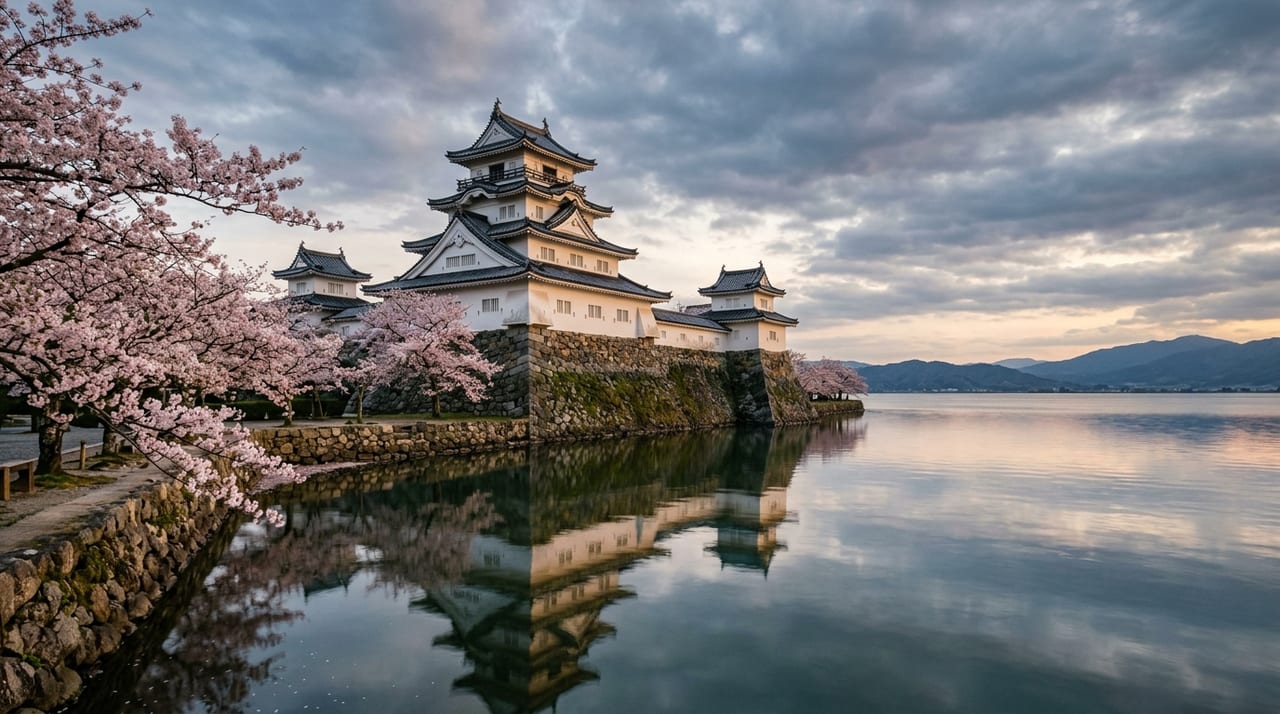
 * Image is for illustrative purposes only.
Nagahama Castle
長浜城
Nagahama Castle is a historic castle in the Kansai region (Built after receiving North Ōmi as a fief in Tenshō 1 (1573); completed around Tenshō 3 (1575)). Its lord was Hashiba Hideyoshi (later Toyotomi Hideyoshi).
Overview
Hideyoshi's first castle
Nagahama Castle is a flatland (water) castle on the eastern shore of Lake Biwa in Nagahama City, Shiga Prefecture. It is recorded in history as the first castle personally built by Hashiba Hideyoshi (later Toyotomi Hideyoshi). In Tenshō 1 (1573), in recognition of Oda Nobunaga's destruction of Azai Nagamasa, Hideyoshi was granted the former Azai domain of North Ōmi (around present-day Nagahama). He renamed the place name 'Imahama' to 'Nagahama' and began building a new castle town. Using this area as a foothold, Hideyoshi actively invited merchants and craftsmen, continued the rakuichi rakuza (free markets) policy, and developed Nagahama into a prosperous commercial city.
Lake Biwa and the strategic significance of the castle
The main reason Nagahama Castle was built on the shore of Lake Biwa was to control the lake's water transport. Lake Biwa is Japan's largest lake, with an area of about 670 square kilometers, and its water transport was a main artery supporting logistics in the Kinki region throughout the medieval and early modern periods. Nagahama Castle directly faced the lakeshore, and it is said that the castle's stone walls met the lake surface, a design that made the fullest use of its function as a 'water castle.' Hideyoshi used this water transport network to organize supply lines and made Nagahama Castle function as a key traffic hub linking Hokuriku, Mino, and the Kinai region.
Yamauchi Kazutoyo and Nagahama Castle
After Hideyoshi left Nagahama, many warlords succeeded one another as lords of Nagahama Castle. Among them, the best known is Yamauchi Kazutoyo. The anecdote of how, in his youth, he bought a fine horse in Nagahama's castle town thanks to his wife Chiyo's naijo no kō (a wife's behind-the-scenes support) is famous as a representative example of the naijo no kō. It is said that Chiyo, to help her husband advance his career, did not hesitate to spend precious money on the fine horse. This episode is said to have caught Nobunaga's attention at his cavalry parade (umazoroe) in Tenshō 9 (1581), raising Kazutoyo's evaluation. Nagahama still passes down this couple's story today, and historic sites associated with Yamauchi Kazutoyo and Chiyo remain around the castle.
Present-day Nagahama Castle
The present Nagahama Castle is a reconstruction, rebuilt in Shōwa 58 (1983) as the Nagahama Castle Historical Museum. The interior of the castle keep displays materials on the history of Nagahama and North Ōmi in the Toyotomi period. Hōkō Park extends around the castle and is loved by local residents as a famous spot for spring cherry blossoms and winter snowscapes. The Nagahama urban area also has many sightseeing spots, including Kurokabe Square (a glass-craft town that makes use of old townscapes). Together with Nagahama Castle, these spots convey today the charm of a castle town where visitors can enjoy sightseeing for a full day.
Connection to Swords
Hideyoshi and his passion for swords
Toyotomi Hideyoshi is known for collecting famous swords. Influenced by Nobunaga's tea policy (the 'politics of tea'), Hideyoshi actively collected famous (meibutsu) swords, and during the process of unifying the country he acquired many fine swords. As lord of Nagahama Castle, Hideyoshi built up his wealth by making use of North Ōmi's agricultural and commercial base and Lake Biwa's water transport.
The Ōmi sword-producing region
The Ōmi Province around Nagahama had a tradition of sword making since the medieval period. Crossing Lake Biwa from Nagahama also brings one close to Kyoto (Yamashiro), and Nagahama Castle was located close to the sword-producing regions of Yamashiro and Mino.
Hideyoshi's sword policy and Nagahama
The Sword Hunt edict (katanagari) issued after Hideyoshi achieved national unification, in Tenshō 16 (1588), was a policy of confiscating swords from peasants and monopolizing swords as the mark of samurai status.
Highlights
- Hideyoshi's first castle — the historic site that became the starting point of a 'ruler of the realm'
- Nagahama Castle Historical Museum — exhibits historical materials on North Ōmi and Nagahama from the Toyotomi period
- Cherry blossoms at Hōkō Park — spring scenery with Lake Biwa in the background
- Kurokabe Square — a sightseeing area representing Nagahama, lined with glass-craft shops that make use of old townscapes
- Sites associated with Yamauchi Kazutoyo and Chiyo — Yamauchi Kazutoyo, known for the anecdote of 'naijo no kō,' also served as lord of Nagahama Castle
* Opening hours and admission fees are subject to change. Please check the official website before visiting.