New Arrivals — Browse our catalog for the latest authentic Japanese sword arrivals. Browse →
June 11, 1583 (Tenshō 11/4/21)
Shizugatake, Ika District, Ōmi Province (present-day Kinomoto-chō, Nagahama, Shiga Prefecture)
Forces
Hashiba Hideyoshi Forces
Shibata Katsuie Forces
About 13 min read
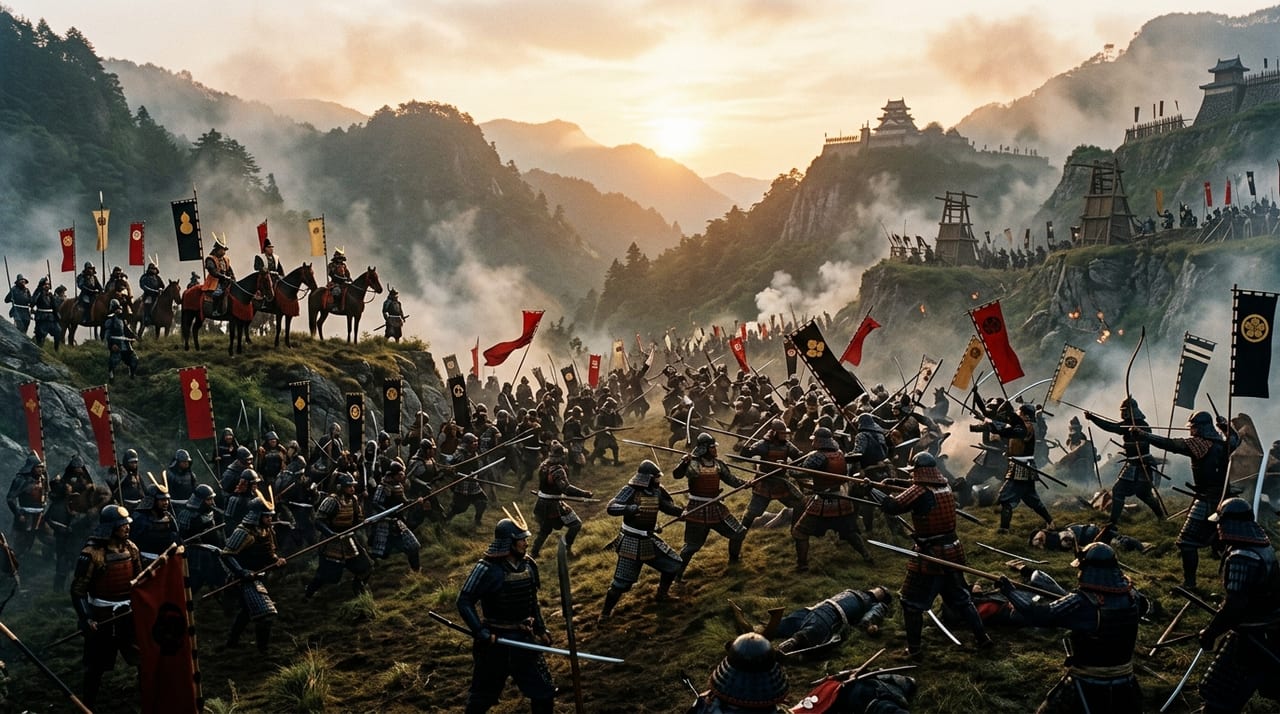
In the 6th month of Tenshō 10 (1582), when Oda Nobunaga met a violent death in the Honnō-ji Incident, a great power vacuum opened across the realm. Oda family senior retainers deliberated over who would succeed Nobunaga at the Kiyosu Conference (the 6th month of Tenshō 10), but a true resolution could only be reached by force of arms. The final outcome of this power struggle was the Battle of Shizugatake in the 4th month of Tenshō 11 (1583).
The conflict took the form of Hashiba Hideyoshi versus Shibata Katsuie. Immediately after the Honnō-ji Incident, Hideyoshi turned back from Bitchū Takamatsu in a hyper-fast march known as the "Chūgoku Ōgaeshi" (the great return from the Chūgoku region). He defeated Akechi Mitsuhide at the Battle of Yamazaki, avenged Nobunaga, and thereby established his position as the "first successor." Katsuie, on the other hand, was the most senior and most powerful of Nobunaga's generals, a great daimyō who ruled Echizen, Kaga, and Etchū. At the Kiyosu Conference he had been in fierce conflict with Hideyoshi.
Katsuie led northern commanders, including Sakuma Morimasa, Maeda Toshiie, Kanamori Nagachika, and Fuwa Katsumitsu, southward and entered Ōmi. Hideyoshi's side was supported by many commanders, including Niwa Nagahide, Katō Kiyomasa, Fukushima Masanori, and Katagiri Katsumoto.
What decided the course of the battle was the independent action of Sakuma Morimasa, a fierce general of Katsuie's army who was known by the nickname "Oni Genba" (Demon Genba). On the night of the 19th day of the 4th month of Tenshō 11, Morimasa launched a surprise attack on the forces of Nakagawa Kiyohide, who guarded Hideyoshi's key stronghold at Ōiwayama, and succeeded in killing Kiyohide. Pleased with this great victory, Morimasa ignored Katsuie's order to withdraw and remained in his camp.
Meanwhile, Hideyoshi, who received this urgent report, was then encamped at Ōgaki Castle in Mino. He arrived at Shizugatake through a hyper-fast march, said to have covered about 50 kilometers in five hours, which could be called a reenactment of the great return. There he committed his entire army and launched an all-out assault on Katsuie's forces. Katsuie's army, which had been unable to complete either its withdrawal or its formation, collapsed in an instant, and Sakuma Morimasa was taken prisoner.
The greatest legend that has kept the Battle of Shizugatake alive to this day is the "Seven Spears of Shizugatake" (Shichi-hon-yari). Seven young warriors who won especially remarkable military distinction in this battle, namely Fukushima Masanori, Katō Kiyomasa, Katō Yoshiaki, Katagiri Katsumoto, Hirano Nagayasu, Kasuya Takenori, and Wakisaka Yasuharu, were praised by later generations as the "Seven Spears."
The word "spear" (yari) in "Seven Spears" clearly reflects the importance of the spear in battles of the time. In actual combat during the Sengoku period, the sword was a last-resort weapon, and thrusting combat with spears was the principal means of close fighting. The commanders of the Seven Spears are said to have shown outstanding valor in this spear skill.
In later years, Katō Kiyomasa became a daimyō ruling Higo Kumamoto, and he is still fondly revered by the people of Kumamoto City as "Seishōkō." Kiyomasa is also known for having retained the Dōtanuki, a group of swordsmiths from Higo, as his own craftsmen. Fukushima Masanori was given a spear named Nihongō, one of the Three Great Spears of the Realm, by Hideyoshi. He is known, however, for the anecdote that he later lost it in a drinking contest to Mori Tomonobu, a retainer of the Kuroda house.
The most dramatic political event of the Battle of Shizugatake was the defection of Maeda Toshiie (on Katsuie's side). Toshiie was a close ally of Katsuie and a powerful Hokuriku commander who ruled Noto. Sensing the inferiority of his position, he decided on his own during the fighting to withdraw, and he retreated to his home domain. With this defection, the rear of Katsuie's army collapsed, and the retreat turned into a rout.
Toshiie later made peace with Hideyoshi and held considerable weight within the Toyotomi regime as one of the Five Elders. His decision at Shizugatake is criticized as "contrary to principle," but it could also be called "a realistic decision that read the larger situation."
Shibata Katsuie fled to his home base in Echizen, Kitanoshō Castle (present-day Fukui city, Fukui Prefecture), but Hideyoshi's army did not slacken its pursuit, and before long Kitanoshō Castle was surrounded. Katsuie set fire to the castle together with Oichi no Kata, said to be Nobunaga's younger sister and a woman of unrivaled beauty, and then took his own life. The final moments of Oichi no Kata and Katsuie continue to be passed down to later generations as a tragedy of the Sengoku period, and they remain subjects of kabuki, novels, and film and television works.
The Battle of Shizugatake became the practical starting point of Toyotomi Hideyoshi's policy of unifying the realm. After this victory, in Tenshō 16 (1588) Hideyoshi promulgated the Sword Hunt edict (katanagari).
Hideyoshi also made efforts to collect famous swords. The famous swords owned by the Toyotomi house are recorded in the Toyotomi-ke Okoshimono-chō (the Toyotomi register of swords), divided from the "first box" (Ichi no hako) through the "seventh box" (Shichi no hako). The tachi "Ichigo Hitofuri," which Awataguchi Yoshimitsu is said to have forged as the only blade of its kind in his lifetime, also came into Hideyoshi's possession. In the same register it is listed in the foremost box, the "first box" (Ichi no hako).
The essence of the Battle of Shizugatake lies not in a mere military clash but in a "shift of power structures, old and new." What Shibata Katsuie embodied was a power structure based on the achievements and loyalty of an old senior retainer from Nobunaga's era. What Hashiba Hideyoshi embodied was a modern style of politics built on mobility, information warfare, and the construction of alliances.
It was the overwhelming mobility seen in Hideyoshi's "great movement from Ōgaki to Shizugatake" (Mino Ōgaeshi) that brought him his decisive advantage at Shizugatake.
Through this victory, Hideyoshi established his position as the de facto successor of the Oda house. He went on to become Kanpaku (Imperial Regent) in Tenshō 13 (1585), and advanced toward the Odawara Campaign and the unification of the realm in Tenshō 18 (1590).
The young warriors of the Seven Spears of Shizugatake went on to serve Hideyoshi and Toyotomi Hideyori, and they followed their own destinies in the Korean invasions (the Bunroku and Keichō campaigns) and at the Battle of Sekigahara. The history carved by their swords and spears embodies the great transformation from the Sengoku period to the Edo period. Viewed through the medium of swords, Shizugatake was not merely a contest among warlords but a battle that asked what Japan's bushidō and the very nature of power truly were.
Toyotomi Hideyoshi
Hashiba Hideyoshi — secured his path to unification with victory at Shizugatake
Shibata Katsuie
Shibata Katsuie — Nobunaga's most senior general, defeated and died at Kitanoshō Castle
Katō Kiyomasa
One of the Seven Spears of Shizugatake, later daimyo of Higo (Kumamoto)
Fukushima Masanori
Often named first among the Seven Spears of Shizugatake
Maeda Toshiie
Defected from Katsuie's side during the battle; later became one of the five Toyotomi Tairō