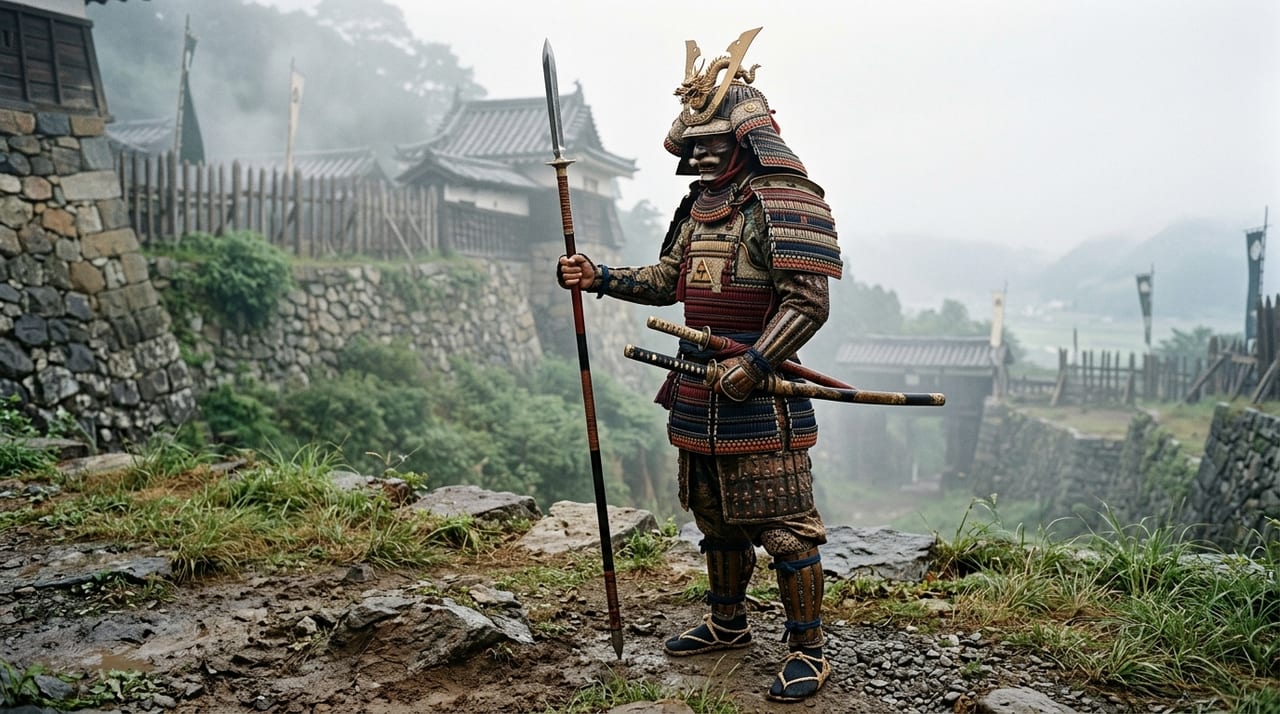
 * Image is for illustrative purposes only.
Katō Kiyomasa
加藤清正
The Tiger Slayer
Description
Kiyomasa's Birth
Born in Nakamura, Owari Province, in 1562 (Eiroku 5), Katō Kiyomasa is regarded as a leading figure of the martial faction, a fierce general raised by Toyotomi Hideyoshi from childhood. As a maternal relative of Hideyoshi, he served him from an early age and displayed unmatched valor in numerous battles. Kiyomasa's martial renown extended beyond Japan, and he is also widely known for the tale of tiger slaying during the Korean campaigns.
Seven Spears of Shizugatake
In the Battle of Shizugatake in 1583 (Tenshō 11), Kiyomasa was counted among the Seven Spears of Shizugatake. In this battle, Kiyomasa earned distinction by taking the life of enemy commander Yamaji Masakuni. The weapon most associated with Kiyomasa is the katakama-yari. The katakama-yari is a special spear with a sickle-shaped branch blade on one side of the spearhead, allowing it to thrust, hook, and slash, making it a versatile weapon. Kiyomasa favored this katakama-yari throughout his life, and it became his emblem.
Valor in the Korean Campaigns
Kiyomasa's exploits in the Bunroku and Keichō campaigns (1592 to 1598) are legendary. Crossing over to the Korean Peninsula, Kiyomasa advanced as far as Hamgyong Province and achieved a great victory by capturing two Korean princes. The legend of his slaying a tiger during this expedition is widely known as an episode symbolizing his martial prowess. Encountering a huge tiger in the mountains of Korea, Kiyomasa is said to have confronted it with a katakama-yari (according to one account, a jūmonji-yari) and killed it skillfully. This scene of tiger slaying has been depicted repeatedly in nishiki-e woodblock prints and sculptures, and it became synonymous with Kiyomasa.
Patronage of the Dōtanuki
When Kiyomasa became lord of Higo Province, Kumamoto, he took under his patronage a swordsmith group that arose in Kikuchi, Higo, known as the Dōtanuki. Including Dōtanuki Masakuni, who is said to have received one character of his name from Kiyomasa, the Dōtanuki swordsmiths forged sturdy blades designed for actual combat, and these swords were reportedly kept as the standard swords of Kumamoto Castle.
Characteristics of the Dōtanuki Blades
Dōtanuki swords pursued sturdiness and cutting ability that function reliably in actual combat, rather than ornate decoration or fine hamon patterns. Thick-backed and shallow in curvature, the construction of the Dōtanuki embodies a design philosophy aimed at reliably felling an enemy with a single stroke. The Dōtanuki are remembered by later generations as the byword for combat swords, and they often appear in period novels and jidaigeki.
Kumamoto Castle
Kiyomasa was also known as a master of castle construction, and Kumamoto Castle is an impregnable famous castle built by his hand. The distinctive curve of the Kiyomasa-style stone walls is called mushagaeshi.
The Great Figure of the Martial Faction
In 1611 (Keichō 16), Kiyomasa died in Kumamoto at the age of fifty. For Kiyomasa, a general who fought his entire life as a retainer of Hideyoshi, the sword was the most trustworthy tool for protecting his life on the battlefield. Kiyomasa's achievement of spreading the name of the Dōtanuki across the land established the value of the combat sword in Japanese swordsmithing culture, embodying the spirit of the warrior's way that prizes practicality over splendor.
Notable Swords
- A sword by Dōtanuki Masakuni (a work of a representative swordsmith of the Higo Dōtanuki school. Masakuni is said to have received one character of his name from Kiyomasa. Thick-backed and shallow in curvature, with a sturdy construction, it is the byword for combat swords)
- katakama-yari (a special spear with a sickle-shaped branch blade on one side of the spearhead. Capable of both thrusting and hooking. Said to have been used in Kiyomasa's tiger slaying in Korea, as his emblematic weapon)