Yari Smithing Techniques: Manufacturing Processes for Jūmonji-yari, Su-yari, and Katagama-yari, and a Comparison of Methods with the Japanese Sword
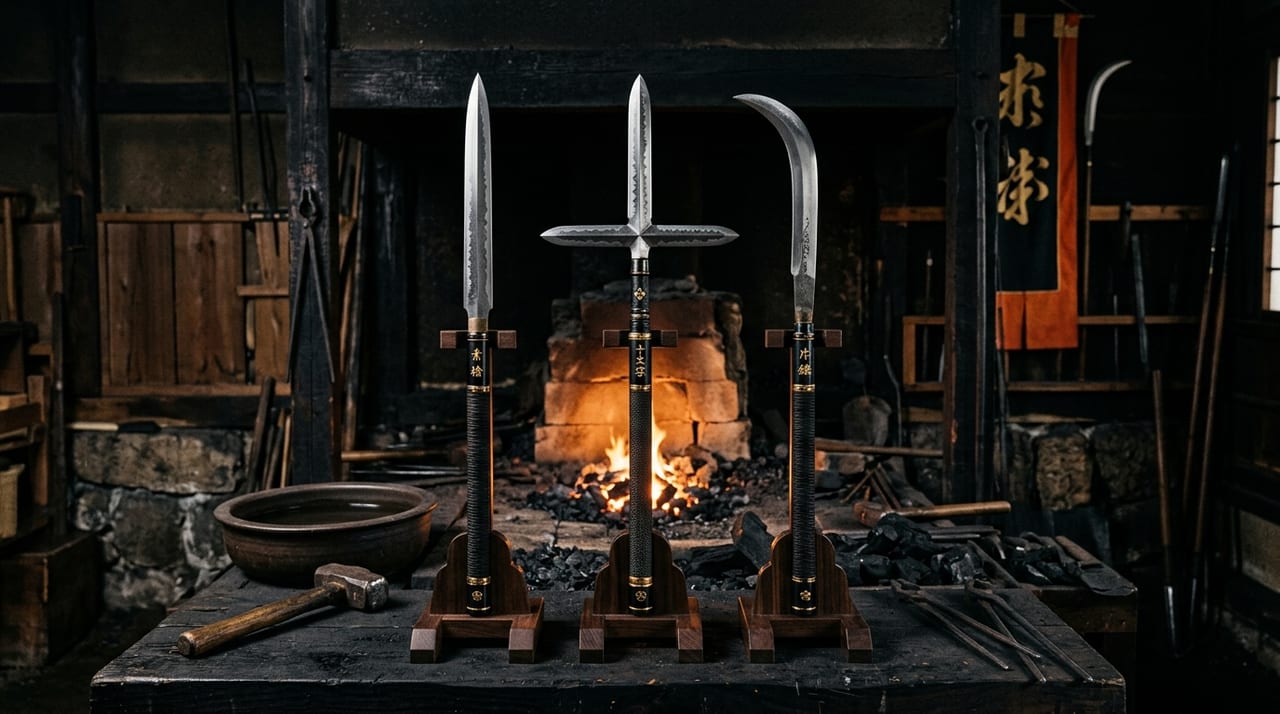 * Image is for illustrative purposes only.
Table of Contents
Yari Smiths: Their Relationship with Japanese Sword Tōshō and the History of the Division of Labor
Yari (spears) are one of Japan's representative categories of bladed weapons, classified as art swords subject to the Act for Controlling the Possession of Firearms or Swords and Other Such Weapons (Jūtōhō), just like Japanese swords (tachi and uchigatana). Their production is in principle carried out by tōshō (art-sword tōkō) certified by the Agency for Cultural Affairs.
Historically, demand for yari increased explosively from the late Muromachi period through the Sengoku period, and some historical records indicate that specialist yari-shi (spear smiths) existed; however, in the modern era, tōshō who specialize exclusively in yari are rare, and it is common for smiths to work primarily on Japanese swords (uchigatana and tantō) while also producing yari.
The first technical challenge a tōshō faces when making yari is "selecting the blade-tip shape and designing the forging process to suit that shape." Yari blade-tip shapes fall broadly into three types — su-yari (straight spear), jūmonji-yari (cross-shaped spear), and katagama-yari (single-sickle spear) — each requiring a different forging approach.
Su-yari Manufacturing Process: Precision Requirements Within Simplicity
Su-yari are spears with a simple, straight blade-tip form that appears to be the most straightforward in design, yet the precision required in production is high.
The basic production process shares much in common with Japanese sword-making. Tamahagane is selected as the material, and the jigane (steel of the blade surface) is homogenized through orikaeshi tanren (folding). However, since the length of the yari blade is shorter than the blade of a uchigatana, the total quantity of steel used is smaller, yet distinctive techniques are required in the process of precisely controlling the shape along the longitudinal direction.
The cross-sectional shape of the su-yari blade tip is fundamentally shinogi-zukuri, with a shinogi (ridge line) running along both faces of the blade, achieving a balance between blade angle and strength. While similar to the shinogi-zukuri of a sword, since the yari's primary purpose is thrusting, penetrating performance and resistance to breaking are prioritized over cutting sharpness. For this reason, the blade angle tends to be set thicker than a sword's, and the mune (back of the blade) side also tends to be designed with greater material thickness (nikuoki).
In the yaki-ire (quenching) process, yakiba-tsuchi (clay coating) is applied through tsuchioki (applying the clay coating) just as with swords, and the piece is heated in the furnace before water-cooling. However, because the yari blade's shape is long and narrow, controlling the angle and speed at which it enters the water during quenching is more difficult than with swords. When the thickness differential between the thin tip and the base (moto) is large, localized temperature differences arise, increasing the risk of quench cracking (yakiware). Skilled tōshō reduce this risk by varying the thickness of the tsuchioki in a gradual gradient from the tip toward the base.
Jūmonji-yari Forging: Welding Techniques for the Lateral Projections
Jūmonji-yari are spears with bilaterally symmetrical lateral projections (kama, or transverse blades) attached to a straight blade tip — practical battle weapons widely used by ashigaru (foot soldiers) in Sengoku-period battles. The kaji (smiths) of Settsu Province (present-day Osaka Prefecture) are known as representative producers.
The greatest technical challenge in making jūmonji-yari is "joining the lateral projections." Modern production methods are broadly divided into two types.
- Integral forging: A method in which the body and the lateral projections are carved out as a single unit from a lump of steel. While possible with modern techniques that can make use of gas or electric furnaces, this method is rarely used in modern traditional production when only tamahagane from tatara (traditional smelting) is used, as securing a large integrated steel billet is difficult.
- Forge-welding (tansetsu): The body (blade-tip section) and the lateral projections are forged separately and then joined by tansetsu — a smithing welding technique in which the pieces are hammered together at high temperature to bond them. This is the common method in traditional Japanese yari production. Securing the strength of the tansetsu joint is the most critical challenge; if the intermixing of the jigane at the joint is uneven, there is a risk of breakage in actual use. Pine resin and straw ash are used as intermediary materials (flux) in tansetsu, and controlling the joining temperature is crucial.
In designing the shape of the lateral projections, the balance between the width and thickness at the root (base) of the projection is important; if the root is too narrow, the projection becomes prone to breaking when lateral force is applied during thrusting. The blade angle of the projections also varies by maker, with the design changing depending on whether cutting performance or withdrawal performance after thrusting is prioritized.
Katagama-yari: The Forging Difficulties Brought by Asymmetrical Shape
Katagama-yari are spears with an asymmetrical form, carrying a sickle-shaped transverse blade on only one side of the blade tip. The katagama jūmonji-yari (katagama-yari) said to have been favored by Katō Kiyomasa is a well-known example.
The distinctive difficulty in making katagama-yari is controlling the sori (curvature) during yaki-ire due to the asymmetrical form. In sword-making, producing sori through heat treatment is incorporated into the design and achieving the prescribed degree of sori is one measure of skill; in katagama-yari, however, having a lateral projection on only one side makes it easy for shrinkage during heat treatment to become left-right asymmetrical.
To control this, the thickness of the tsuchioki is varied between the katagama side and the straight section to adjust the rate of heat absorption and release. In addition, in the tame (shape adjustment) process before yaki-ire, a technique called "pre-correction" is required — predicting the amount of deformation that will occur after yaki-ire and intentionally bending the piece in the opposite direction before proceeding with quenching. This is in principle the same as sori control in sword-making, but the calculations and execution are more complex for an asymmetrical yari.
Nakago and Handle (E) Design: The Long-Shaft Structure Unique to Yari
The part of the yari blade that is inserted into the handle (e) is called the nakago (tang). Like the nakago of a Japanese sword, it is where the maker's mei (signature) is cut and is an important section that determines how the blade is fixed to the handle.
The nakago of a Japanese sword is relatively short (around 20 cm) and designed to fit completely inside the tsuka (hilt), but the nakago of a yari varies greatly depending on the material, length, and purpose of the handle. For yari intended for actual combat, the nakago is often designed longer to increase the contact area, taking into account the overall strength of the shaft.
In the production of modern art yari, the handle uses wood such as ho (Japanese bigleaf magnolia) or kashi (oak); unlike the tsukagi of a sword, the yari handle can reach an overall length of 1 to 3 meters, so the straightness of the grain and the absence of knots directly affect shaft strength. Cases in which the tōshō makes the handle himself are rare, and collaboration with a handle specialist is sometimes necessary.
Togi (Polishing) and Finishing: Features of the Process That Differ from Swords
The completed yari blade tip is finished through a polishing process by a togishi (polisher), just as with swords. However, because the shape of the yari blade tip differs, the togi (polishing) process also differs from that of swords.
Su-yari can be handled with a process close to sword togi, but for jūmonji-yari and katagama-yari, specific whetstone application techniques are required to polish the curved surfaces of the lateral projections, as well as polishing of the underside of the projections (inner curved surface). The inner side of the lateral projections of jūmonji-yari in particular is difficult for a whetstone to reach, requiring ingenuity such as using narrow whetstones or whetstones with specially shaped tips.
The hamon (temper line) of yari blades — on su-yari in particular — is often suguha or ko-midare (small irregular), reflecting a tradition in which practical uniformity has been valued over artistic evaluation. However, among modern art yari, examples exist in which highly ornamental gunome-midare or chōji-midare hamon are produced.
Conclusion: What Yari Smithing Techniques Demand of the Tōshō
Yari production is built on a foundation of Japanese sword-smithing techniques, yet requires the acquisition of distinct skills due to the particular characteristics of yari in terms of shape, purpose, and structure. Whether a tōshō can apply the yaki-ire control, tansetsu techniques, and togi sensibility cultivated through sword-making to the different shapes, dimensions, and requirements of yari is one measure of the technical skill of a tōshō who takes on yari work.
The number of surviving art yari is far smaller than that of Japanese swords, and naturally opportunities for production are also limited. Yet the historical and martial significance that yari hold within sword culture is high, and the passing on of yari-making techniques to the next generation of tōshō is a meaningful challenge for preserving the full picture of Japan's sword-smithing tradition.
Those with an interest in swords are welcome to browse the swords currently listed in TOUKENZA's online catalog.