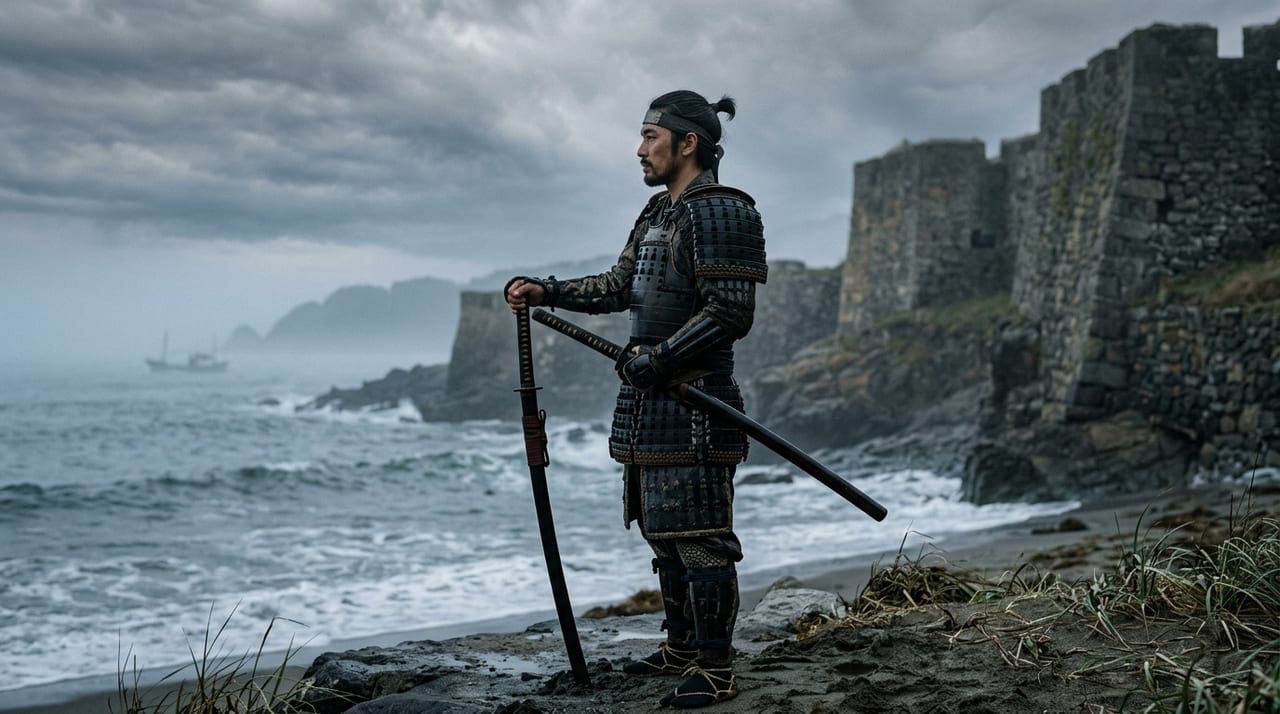
 * Image is for illustrative purposes only.
Sasaki Kojirō
佐々木小次郎
Ganryū — The Legendary Swordsman Who Made His Name Resound Across the Land with the Three-shaku Long Sword 'Monohoshizao' ('the Drying Pole') and the Secret Technique 'Tsubame-gaeshi' ('Swallow Reversal')
Description
An Origin Shrouded in Mystery
Sasaki Kojirō is a legendary swordsman who faced Miyamoto Musashi in the duel at Ganryūjima and shines with an eternal glow in the legends of Japanese swordsmanship. His life is wrapped in even more mystery than Musashi's. From his birthplace and year of birth to his real name, many theories proliferate, yet the splendor of his swordsmanship and his tragic end continue to stir people's imagination.
Training in Chūjō-ryū
Regarding Kojirō's origins, the theory that he came from Echizen Province (present-day Fukui Prefecture), recorded in the Nitenki, is well known, but there is also a theory that he came from Buzen Province. He is said to have studied the swordsmanship of Chūjō-ryū (or Toda-ryū), after which he is said to have pursued his own refinement and founded "Ganryū." Chūjō-ryū is a swordsmanship school founded by Chūjō Nagahide in the Muromachi period, known for its precise techniques that excel with the kodachi (short sword). The fact that Kojirō, starting from this kodachi school, later established his own swordsmanship style wielding a long sword of three shaku speaks to his rare talent.
The Long Blade and the School
Kojirō's signature is the long sword known as 'Monohoshizao' ('the Drying Pole'). This blade, also said to be the work of Bizen Osafune Nagamitsu, has a cutting length of over three shaku (about one meter), far longer than an ordinary sword, and it earned the nickname 'Monohoshizao' from its length. Normally, it is extremely difficult to freely wield such a long blade in combat, yet Kojirō swung this long sword with effortless, unrestrained grace, making its wide reach his greatest weapon. Bizen Osafune Nagamitsu was a master smith of the late Kamakura period, known for his splendid chōji-midare hamon and elegant form. If the Monohoshizao was truly Nagamitsu's work, it was a rare blade that combined the value of a famous sword with a practical length.
The Road to Ganryūjima
The secret killing technique 'Tsubame-gaeshi' ('Swallow Reversal') that Kojirō devised is one of the most famous techniques in the history of Japanese swordsmanship. True to its name, it is a lightning-fast reversal technique said to cut down even a swallow in flight. It is said to have accomplished, in a single motion, a two-stage strike that is impossible for ordinary people: swinging the sword down from an overhead position and instantly reversing it to cut upward. What made this technique possible was the fusion of the Monohoshizao's length with Kojirō's superhuman skill. After swinging the long blade downward, he instantly reversed its edge to cut upward. This technique is a mechanically sound method that uses centrifugal force and gravity as allies, showing that Kojirō's swordsmanship was backed not only by intuitive genius but also by rational thought.
Duel with Musashi
Kojirō made a name for himself mainly in the western provinces. He is also said to have been invited as a guest retainer to the Hosokawa family and to have served as sword instructor for the Kokura Domain. During this period, Kojirō attracted many disciples with his splendid swordsmanship, and Ganryū flourished enough to form a school of its own.
Legend and History
On 13 May 1612 (Keichō 17/4/13), the duel with Miyamoto Musashi on Ganryūjima (the small island of Funashima in the Kanmon Strait) is passed down forever as the most famous one-on-one duel in Japanese history. Musashi is said to have arrived well past the appointed time, and some say this was a stratagem to throw Kojirō's mind into disarray (the Kokura Monument inscription (Kokura Hibun), erected by Musashi's adopted son Miyamoto Iori, makes no mention of his lateness). Musashi is said to have carried a wooden sword carved from an oar of a boat, and its length is said to have exceeded that of the Monohoshizao. Kojirō, having lost his advantage in reach, is said to have fallen after receiving Musashi's blow.
Eternal Radiance
Regarding Kojirō's end, there are various accounts, including the theory that he died instantly from a blow of Musashi's wooden sword, and the theory that he got up once but was finished off by one of Musashi's disciples. In any case, even with the Monohoshizao and Tsubame-gaeshi, he did not match Musashi. Yet the splendor of Kojirō's swordsmanship and his tragic end are engraved in people's hearts with a brilliance no less than that of the victor, Musashi. The sympathy that the Japanese feel toward Kojirō, in the spirit of hōgan-biiki (sympathy for the tragic loser), remains deeply rooted even today.
Notable Swords
- Monohoshizao ('the Drying Pole'): a long sword said to be the work of Bizen Osafune Nagamitsu, with a blade length of over three shaku (about one meter). Its length, far exceeding that of an ordinary sword, earned it the nickname 'Monohoshizao'. Kojirō wielded this long sword with effortless grace and made its wide reach his greatest weapon