Japanese Swords in Literature: A Guide to Kengō Fiction and Period Novels
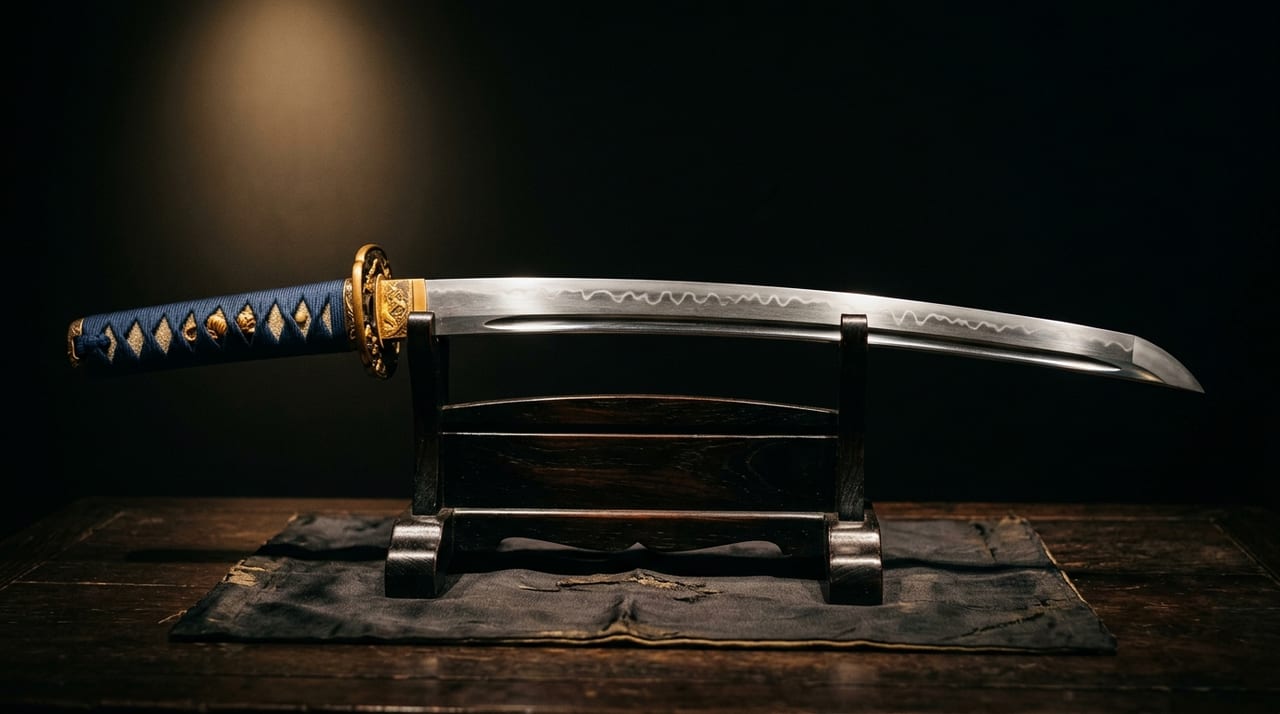 * Image is for illustrative purposes only.
Table of Contents
Japanese Swords and Literature: Points of Intersection
Japanese swords are weapons and crafts, and at the same time they have functioned as important symbols throughout a long literary history. The genre known as sword-fighting novels (kengo shosetsu) originated in the reading books (yomihon) of the Edo period and developed through the Meiji, Taisho, and Showa periods into a genre representing Japanese popular literature. The scenes of protagonists with swords heading toward fateful confrontations, or human dramas surrounding the provenance of famous swords, possess a universal appeal that never bores readers.
The depiction of swords in literature is not merely an introduction of tools. The beauty of the hamon, the grain of the jihada, the balance of weight and curve—by weaving such sword-specific vocabulary into the narrative, readers are drawn into the story world while sensing the aroma of historical truth. In this article, I will provide a bird's-eye view of Japanese swords in literature, taking up representative works and authors.
When organizing representative authors and works and the characteristics of their sword descriptions, the following emerges.
| Author | Representative Work | Characteristics of Sword Description |
|---|---|---|
| Yoshikawa Eiji | Miyamoto Musashi | Depicts the sword as a "symbol of self-discipline" |
| Shibata Renzaburo | Nemuri Kyōshirō Burai Hikae | Depicts the sword as a mirror reflecting the protagonist's inner world |
| Ikenami Shotaro | The Onihei Detective Chronicles | Depicts the sword as a tool of duty, prioritizing wisdom and experience over famous sword legends |
| Yamamoto Shūgorō | Momi no Ki wa Nokotta | Depicts the sword as both a "symbol of power" and a "burden" |
Yoshikawa Eiji and "Miyamoto Musashi"
The pinnacle of sword-fighting novels known to many readers is Yoshikawa Eiji's (1892-1962) "Miyamoto Musashi" (serialized 1935-1939). The story of Musashi, born of farming stock, growing as a martial artist through training and battles, was groundbreaking in depicting the sword as a "symbol of self-discipline."
Particularly noteworthy in the sword descriptions within the work is the psychological process by which Musashi arrives at two-sword style. Yoshikawa repeatedly depicts through Musashi's soliloquies a paradoxical recognition that "the sword is a tool, and something that transcends tools." In the famous duel scene on Ganryu Island, the contrast between the wooden sword (the style of Musashi, who primarily used wooden swords) and Sasaki Kojirō's "Monohoshizao" ("clothes-drying pole," said to be the long sword "Bizen Osafune Nagamitsu") becomes a device that accentuates the difference between technique and spirit.
Shibata Renzaburo and the Diversification of Swordsmen
A major influence on post-war sword-fighting novels was Shibata Renzaburo (1917-1978). In his representative work "Nemuri Kyōshirō Burai Hikae" (serialization began in 1956), the protagonist Nemuri Kyōshirō employs the "Engetsu Sappō" (full-moon killing technique), an imaginary swordsmanship in which the sword is rotated in an arc to read the opponent's spirit, but its depiction is infused with the samurai's perspective on death and feelings of nihilism.
In Shibata's works, swords that appear in the narratives most often function as mirrors reflecting the protagonist's inner world. The sword used by Kyōshirō is often depicted as an "unnamed masterpiece" that does not specify a model number or school, which echoes the protagonist's character as a "swordsman unbound by provenance." While this perspective differs from sword appraisal viewpoints, this approach of assigning literary meaning to both named and unnamed swords had profound influence on subsequent writers.
Ikenami Shotaro and "The Onihei Detective Chronicles"
The body of works by Ikenami Shotaro (1923-1990) has earned high acclaim as historical fiction precisely depicting Edo-period life and culture. Among these, "The Onihei Detective Chronicles" (1967-1989) is a masterpiece featuring Hasegawa Heizō, head of the arson and robbery police (Hitsuke Tōzoku Aratame), as protagonist, vividly depicting the customs, food, and martial arts of Edo town.
Ikenami's sword descriptions distinguish themselves from the "boasting of sword strength" typical of sword-fighting novels. The swords carried by Heizō and his subordinate swordsmen are purely tools of their profession, and rather than famous sword legends, the foreground is given to "wisdom and experience" of how to resolve situations without drawing the sword. Yet naturally occurring within the work are specific sword names such as these, conveying the atmosphere of Edo sword culture:
- A tanto modeled after Bizen Saburo Kunimune
- A wakizashi by Hizen Tadayoshi
Yamamoto Shūgorō and "Sabu" and "Momi no Ki wa Nokotta"
Yamamoto Shūgorō (1903-1967) is known as a writer who carefully depicted samurai life and human kindness. In "Momi no Ki wa Nokotta" (serialized 1954-1956, published as a single volume in 1958), Harada Kai, a retainer of the Date clan, appears as the protagonist, and while the sword is at his side in schemes for the continuity of the clan, emphasis is placed on depicting human psychology and moral obligation rather than sword-fighting scenes.
In Yamamoto's novels, the sword functions as both a "symbol of power" and a "burden." What is unique to Yamamoto Shūgorō is the literary exploration of what it means for a samurai to wear a sword—social status and the resolve to face death.
The Development of Contemporary Sword Literature
In recent years, literature and novels with Japanese swords as motifs have become increasingly diverse. Two representative currents are as follows:
- A group of novels stemming from the sword personification game "Touken Ranbu" (2015-), which attracts readers of younger generations as a new form of sword narrative, one that personifies the "spirits" of historically famous swords.
- Sengoku battle novels written by historical novelists like Ito Jun based on precise historical research, in which descriptions related to swords—steel production, sword-forging, and costume—are increasingly incorporated at a level approaching scholarly standards.
The delight of sword literature lies in the intersection of the material appeal of famous swords (curve, hamon, weight, length) with the human will, history, and spirituality embodied in the sword. Recalling passages from these literary works while standing before an actual Japanese sword enriches the appreciation experience. I recommend taking up sword-fighting novels and historical fiction as an entry point to Japanese swords, or as a guide to more deeply enjoying your collection.
Connecting the Vocabulary of Novels to the Appreciation of Actual Works
When you observe an actual Japanese sword after reading sword-fighting or historical fiction, the vocabulary in the work begins to take on concrete form. For example, after recalling a sword described in the work as a "plain straight-blade sword," you might look for fine details such as ko-nie and kinsuji on the actual blade edge of a straight hamon. When you encounter a passage describing a "sword with deep curve," you might compare the difference in how the curve is applied between tachi and uchigatana (such as curve at the base versus mid-blade curve), using actual swords or images. As your focus shifts from literature into the three elements of appreciation—shape, jihada, and hamon—a cycle of mutual enrichment between reading and appreciation emerges.
Conversely, when you return to novels after acquiring basic knowledge of swords, you can see how far the author has ventured into historical research and from where they leap into creative invention. Savoring the distance between historical fact and fiction is also a unique pleasure of sword literature. If you pay attention to the type of sword that appeared in a work you're curious about—whether it is a tachi, an uchigatana, a wakizashi, or a tanto—while looking at images of actual pieces in an online catalog, the scenes of the narrative should come alive in three dimensions.