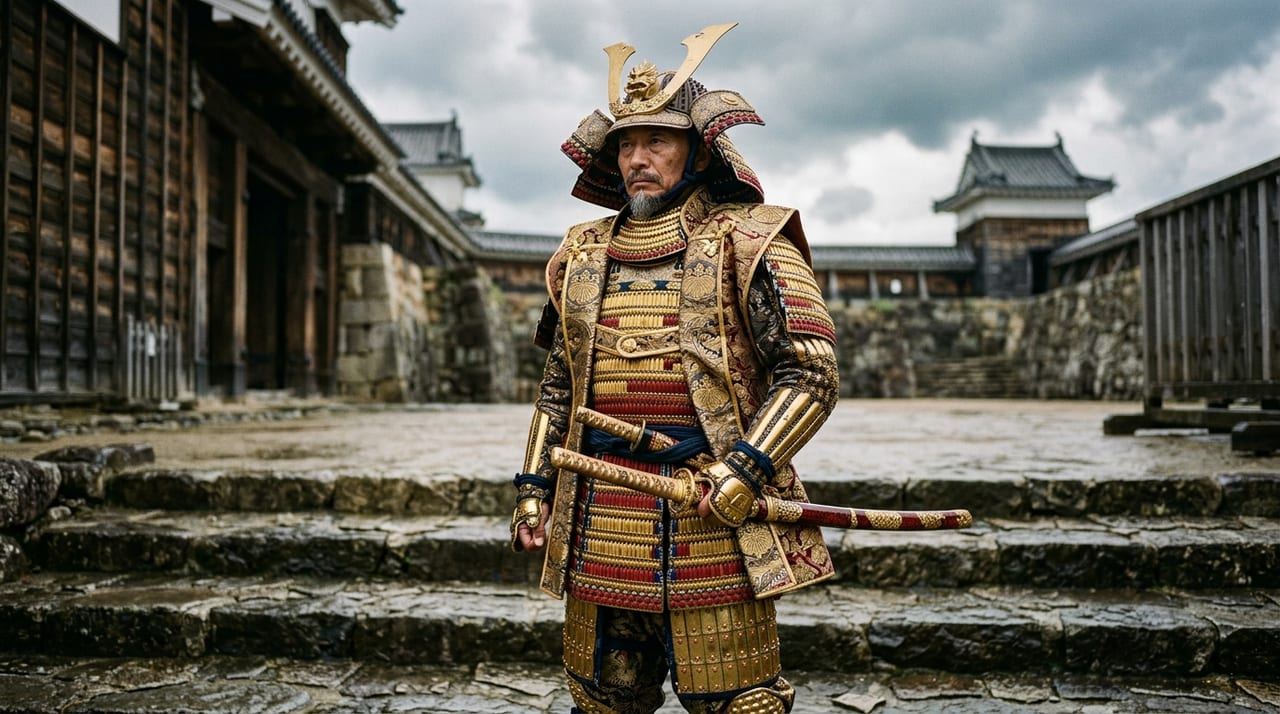
 * Image is for illustrative purposes only.
Toyotomi Hideyoshi
豊臣秀吉
The Taikō
Description
A Story of Rising from Humble Origins
In 1537 (Tenbun 6), Toyotomi Hideyoshi was born in Nakamura in Owari Province, the son of a farmer. He rose from sandal-bearer to kampaku daijō daijin (chancellor and great minister of state), and he embodies the most dramatic rise to success in Japanese history. After Oda Nobunaga's death, he defeated Akechi Mitsuhide at the Battle of Yamazaki, defeated Shibata Katsuie at the Battle of Shizugatake, destroyed the Hōjō clan at the Siege of Odawara, and finally achieved the unification of the realm. Throughout this process, Hideyoshi devoted extraordinary passion to collecting swords as symbols of power, and became the greatest sword collector in Japanese history.
Ichigo Hitofuri
The crown jewel of Hideyoshi's sword collection is the Ichigo Hitofuri. It is a work of Awataguchi Yoshimitsu, and it takes its name from the fact that it is the only tachi Yoshimitsu forged in his lifetime. Yoshimitsu is counted among the Three Great Smiths as a master of tanto, but examples of his tachi are extremely rare, and this Ichigo Hitofuri, believed to be his only tachi, is supremely precious. The jigane is ko-itame hada, and the hamon is a dignified suguha mixed with komidare and gunome, concentrating the peak of Yoshimitsu's craft. The blade was burned in the Summer Siege of Osaka, but it was later re-tempered by Echizen Yasutsugu under the order of the Tokugawa family, and it is still transmitted today as Imperial Household property.
Aspects as a Sword Collector
Honebami Tōshirō is also a work of Yoshimitsu, and its name derives from its astonishing sharpness, which led people to fear that it could devour even bone. It was originally made as a naginata, but it was later shortened and reworked into a wakizashi (naginata-naoshi). Although there are various theories about its history, it is among the finest works in Yoshimitsu's oeuvre.
Favorite Blade and Anecdotes
Nihongō is a large-bladed spear counted among the Three Famous Spears of Japan. It is known for the colorful anecdote that Hideyoshi bestowed it on Fukushima Masanori, and that Mori Tahei won it in a drinking contest. Its spearhead, roughly 80 centimeters long, has a commanding presence fitting a symbol of Hideyoshi's power.
Taikō's Power and Aesthetics
In 1588 (Tenshō 16), Hideyoshi issued the Sword Hunt edict, confiscating weapons from farmers. The stated reason was that the confiscated metal would be used for nails and clamps for the construction of the Great Buddha Hall at Hōkō-ji, but the real aims were to prevent uprisings and establish the separation of warriors and farmers. This policy decisively fixed Japan's social class system and brought about a clear separation between samurai and farmers. Ironically, Hideyoshi himself, who took weapons from the farmers, was building an unprecedented sword collection.
The Hon'ami Family and Origami
Hideyoshi protected the Hon'ami family as the supreme authority on sword appraisal. He ordered Hon'ami Kōtoku to establish a system for appraising famous swords and issuing origami (certificates of appraisal), creating a mechanism for objectively evaluating the value of swords. This system was carried on throughout the Edo period and forms the foundation of modern Japanese sword appraisal.
Final Years and Legacy
The sword collection Hideyoshi built at Osaka Castle is said to have been unprecedented in both quantity and quality. Its treasury, where famous swords from ancient and recent times gathered in one place, was like a hall of swords, including masterpieces by the Three Great Smiths (Masamune, Yoshimitsu, Gō Yoshihiro). However, when Osaka Castle burned in the Summer Siege of Osaka in 1615 (Keichō 20), an enormous number of famous swords were burned or scattered, and this is one of the greatest tragedies in the history of Japanese swords. One cannot help but be left speechless at the magnitude of the loss of the famous blades that vanished along with Hideyoshi's dream.
Notable Swords
- Ichigo Hitofuri (made by Awataguchi Yoshimitsu. The only tachi Yoshimitsu forged in his lifetime. Dignified suguha-style hamon on ko-itame hada. Imperial Household property)
- Honebami Tōshirō (made by Yoshimitsu. Named for a sharpness that seemed to devour bone. A wakizashi reworked from a naginata)
- Nihongō (one of the Three Famous Spears of Japan. Spearhead of about 80 cm. Renowned for the anecdote of Mori Tahei's drinking contest)