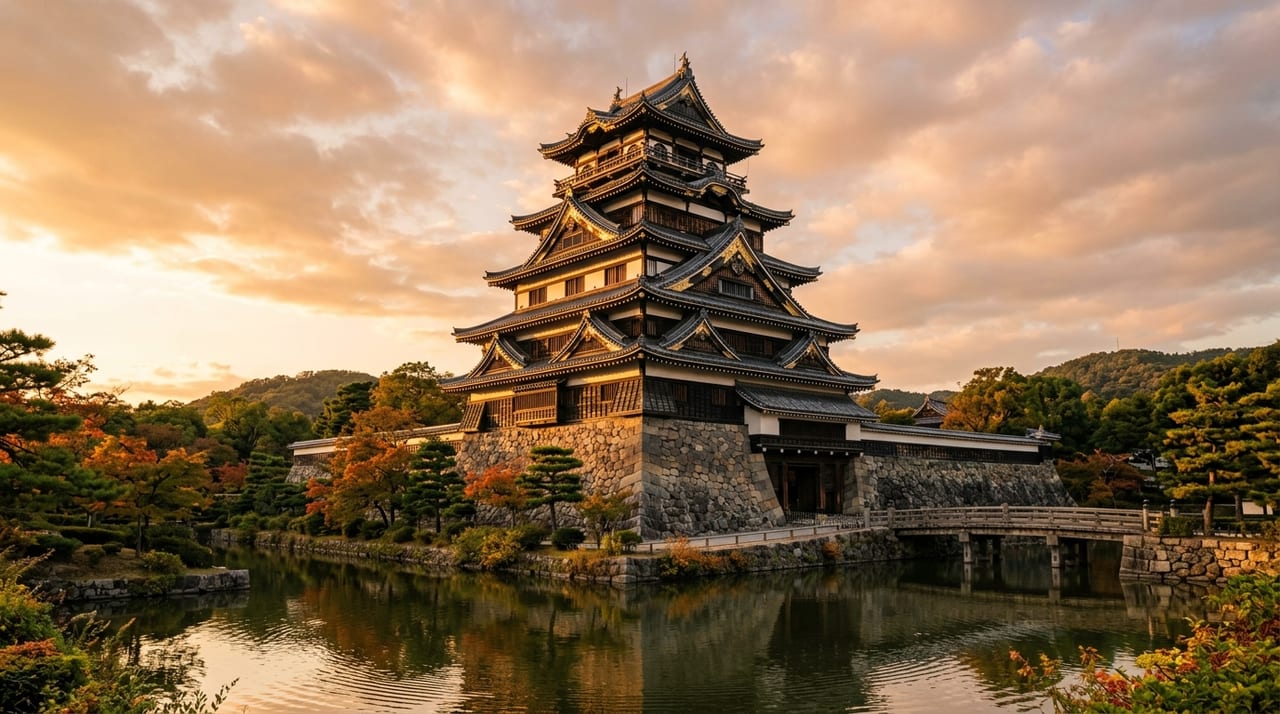
 * Image is for illustrative purposes only.
Fushimi Castle (Momoyama Castle)
伏見城(桃山城)
Fushimi Castle (Momoyama Castle) is a historic castle in the Kansai region (Built in 1594 (Bunroku 3)). Its lord was Toyotomi Hideyoshi / Tokugawa Ieyasu.
Overview
About the Castle
Fushimi Castle was a magnificent residence built by Toyotomi Hideyoshi in his later years, and it is a renowned castle that symbolizes an era of Japanese castle architecture history known as the “Momoyama culture.” In Bunroku 3 (1594), Hideyoshi began construction on the hill of Fushimi, south of Kyoto and close to the Yodo River. Initially conceived as a retirement villa for rest after he withdrew from active rule, it was rapidly expanded as a place to receive Ming envoys and as a political symbol of the prestige of the ruler of the realm. At its height, Fushimi Castle was a castle town centered on a splendid tenshu (main keep), with countless yagura (turrets) and vast goten (palace halls), and its gorgeous appearance symbolized the flowering of the “Momoyama culture.” Inside the castle, gilded wall and screen paintings by painters of the Kanō school covered every wall, and rare treasures brought from China and the Nanban traders were displayed. It is believed that Hideyoshi staged the castle thoroughly as a stage on which to show the daimyo who visited it the peak of his power and wealth.
Historical Events
The castle collapsed once in the Keichō Fushimi earthquake of Keichō 1 (1596) and was later rebuilt. In Keichō 3 (1598), Hideyoshi ended his eventful life in this castle. He died at the age of 62, having achieved the unification of the realm, yet while still worrying about the future of his young heir, Hideyori. Tokugawa Ieyasu subsequently used Fushimi Castle as a base opposing Ōsaka Castle, and on the eve of the Battle of Sekigahara in Keichō 5 (1600), the Battle of Fushimi Castle broke out. Against the western army of 40,000 led by Ishida Mitsunari, only 1,800 men of the eastern garrison led by Torii Mototada waged a fierce siege. Mototada had received a strict order from Ieyasu to “defend Fushimi,” and it is said that he had resolved to fall in battle at the castle. After a siege of a little more than ten days, Mototada was killed and the castle fell, but his loyal fight greatly boosted the morale of the Tokugawa side at Sekigahara. This “Battle of Fushimi Castle” was an important prelude that opened the road to the Battle of Sekigahara, and it has been handed down to later generations as a model of samurai loyalty.
Architecture and Remains
After the Battle of Sekigahara, Ieyasu repaired Fushimi Castle and made it the venue for his investiture as shogun. Even after being appointed Seii Taishōgun (shogun) in Keichō 8 (1603), he continued to use Fushimi as the center of politics. Hidetada, the second shogun, also received his shogunal investiture here, and Fushimi Castle functioned as the place where the authority of the Tokugawa shogunate was established. In Genna 5 (1619), it was decided to abandon the castle, and its buildings were moved to Nijō Castle, Yodo Castle, Fukuyama Castle and other castles, as well as to temples and shrines across the country. The most famous are the chi-tenjō (“blood ceilings”): floorboards from a corridor said to bear bloodstains of warriors who took their own lives in the Battle of Fushimi Castle are preserved to this day as ceilings in temples including Genkō-an, Yōgen-in, Kōshō-ji and Hōsen-in. Handprint-like and footprint-like marks can be seen on these ceiling boards, and as silent witnesses to history that tell the story of the fierce fighting on the eve of Sekigahara, they deeply move many visitors. Standing before a blood ceiling, visitors naturally feel as though they have been drawn back across time into the battlefield of the late Sengoku period.
The Pinnacle of Momoyama Culture
The “Momoyama culture” that flowered on the stage of Fushimi Castle broke free from the mysterious aesthetics of the medieval period and established a new style of Japanese art characterized by grandeur, splendor and realism. Gold-leaf wall and screen paintings in vivid colors, the dazzling designs of warriors’ armor and sword fittings, and the fusion with exotic crafts brought by the Nanban trade all came together under the vast stage setting of Fushimi Castle. Although it overlapped with the era when Sen no Rikyū embodied the spirit of wabi-cha, the aesthetic of Fushimi Castle put forward a bold and powerful grandeur that stood at the opposite pole from Rikyū’s wabi. The feud between Hideyoshi and Rikyū ultimately ended in the tragic outcome of Rikyū’s seppuku, but afterward, Fushimi’s cultural soil continued to serve as a seedbed for all the arts, including tea, calligraphy, painting and ceramics.
Fushimi’s Sake and Culture
Fushimi is also renowned as a famous sake-brewing region. Numerous breweries, including Gekkeikan and Kizakura, line its streets, and they use the abundant groundwater of Fushimi, the Gokōsui spring water, as brewing water. Fushimi sake is known for its light and refined flavor, and together with the sake of Nada (Kobe), it has long maintained its reputation as one of Japan’s two great sake-producing regions. Throughout the Edo period, Fushimi sake was shipped by boat to Ōsaka and Edo, quenching the thirst of sake lovers across the country. Today, the city of Fushimi, home to the thousand torii gates of Fushimi Inari Taisha, draws several million visitors from Japan and abroad every year as a sightseeing destination where the remains of the castle and the culture of sake breweries blend beautifully. The former castle town still retains picturesque canals and willow-lined banks around Kiyamachi and Chūshojima, evoking nostalgia for the world of Momoyama that Hideyoshi loved. Visiting Fushimi is a journey to feel the breath of the people who lived through the most dramatic turning point in Japanese history.
Fushimi Castle and the World of Swords
Fushimi Castle was the stage of the greatest transfer of power in Japanese history, from the Toyotomi to the Tokugawa, and the swords carried by the warriors gathered there witnessed that turning point of the age. In the Battle of Fushimi Castle, known as the prelude to the Battle of Sekigahara, Torii Mototada, a retainer of Tokugawa Ieyasu, defended the castle to the death and met a heroic end. His spirit of loyalty is handed down as a model for samurai. The floorboards said to bear bloodstains of Mototada and the castle garrison are preserved to this day as chi-tenjō (“blood ceilings”) in several temples in Kyoto City, and they welcome visitors as precious evidence that conveys to the present the weight of samurai resolve and the culture of the sword. At Nishi Hongan-ji and the Karamon gate of Nijō Castle, which are said to have received relocated parts of Fushimi Castle, visitors can see the magnificent beauty of Momoyama culture of that time, and can truly feel that the high level of Japanese crafts and art reached in Hideyoshi’s era resonates with the world of sword fittings.
Connection to Swords
The connection between Fushimi Castle and Japanese swords begins with Toyotomi Hideyoshi, the ruler of the realm, and with a sword culture that served as a symbol of his discerning taste and power. Hideyoshi burned with an unusual, almost obsessive passion for collecting swords. While the sword hunt edict of Tenshō 16 (1588) confiscated weapons from commoners, he himself plotted to gather the realm’s famous swords into his own hands. Hideyoshi’s collection included famous swords of the Bizen Osafune school, the Sōshū-den and the Yamato-den, and in both quality and quantity it stood far above the sengoku daimyo. In particular, the famous sword Honebami Tōshirō (made by Awataguchi Yoshimitsu), which Hideyoshi received as an offering from the Ōtomo clan, is now held by Toyokuni Shrine (Kyoto). When Hideyoshi died at Fushimi Castle in Keichō 3 (1598), the realm’s famous swords were scattered among the various daimyo amid the struggle for succession. The swords carried by Torii Mototada and the warriors of the eastern forces who fell in the Battle of Fushimi Castle are deeply engraved in history as evidence of their loyalty. With the establishment of the Edo shogunate, swords were institutionally established as the status symbol of the samurai, but their origin lies in the political and symbolic sword culture that Hideyoshi and Ieyasu competed over at Fushimi Castle.
Highlights
- Chi-tenjō (Genkō-an, Yōgen-in, Kōshō-ji) — ceiling boards said to bear bloodstains from warriors who took their own lives in the Battle of Fushimi Castle
- The thousand torii gates of Fushimi Inari Taisha — one of Japan’s most famous shrines, located in the same Fushimi Ward
- Fushimi’s sake brewery district — Gekkeikan Ōkura Sake Museum and Kizakura Kappa Country, the Gokōsui spring water and sake culture
- Toyokuni Shrine (Kyoto) — a shrine enshrining Hideyoshi, which holds the sword Honebami Tōshirō
- Replica tenshu (within Fushimi Momoyama Castle Sports Park) — a concrete replica main keep built in 1964
- Canals around Chūshojima and Fushimi Port — waterway hubs developed by Hideyoshi, where willow-lined banks and boathouses preserve the atmosphere of the past
* Opening hours and admission fees are subject to change. Please check the official website before visiting.