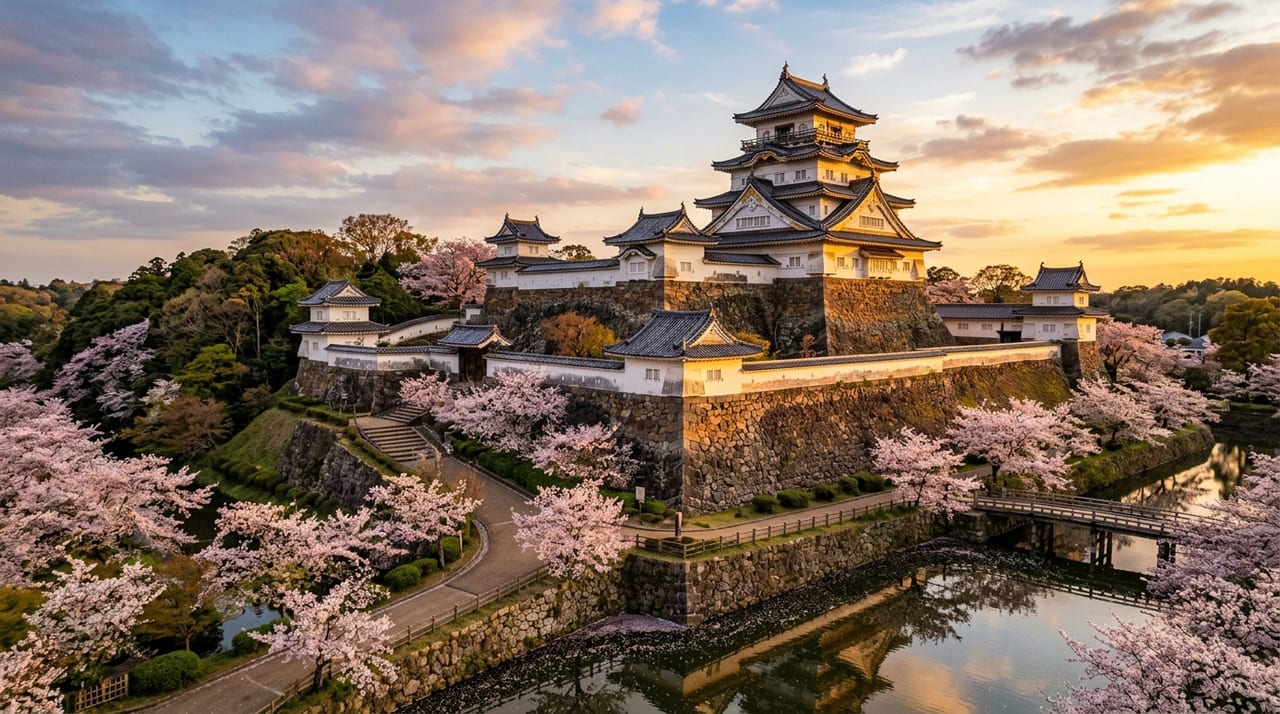
 * Image is for illustrative purposes only.
Akagi Castle
赤木城
Akagi Castle is a historic castle in the Kansai region (Azuchi-Momoyama period to early Edo period (founded in Tenshō 17, 1589)). Its lord was Tōdō Takatori (founder), Kishu Domain.
Overview
Akagi Castle is a hirayama-jō (a castle on a low hill) located in the mountainous Kiwa district of Kumano City, Mie Prefecture. Around Tenshō 17 (1589), the renowned general Tōdō Takatora built it to suppress the Kitayama Ikki uprising and strengthen control over the Kii Mountains. Its layout (nawabari), which skillfully uses the ridges of the hills, and its nozura-zumi (rough-stone masonry) stone walls are its defining features. The surviving stone walls are highly refined in technique and are said to demonstrate the essence of Takatora's castle-building skill. The Kitayama area has been known since ancient times for forestry, charcoal making, and copper mines, and uprising forces were deeply rooted there. With the completion of Akagi Castle, however, the Tōdō clan subdued the area. After the Battle of Sekigahara, it came under the Kii Domain of the Asano clan, and it was abolished under the One-Castle-per-Province Edict in Genna 1 (1615). It is now preserved as a national Historic Site, and the stone walls and enclosures (kuruwa) from its heyday survive in good condition. Because the castle ruins appear to float in morning mist, the site is also called the "Castle in the Sky" (Tenkū no Shiro), and its main enclosure (honmaru) is also known as a cherry blossom spot. A legend persists that a blacksmith's residence (Kajiya-yashiki) once stood near the castle entrance.
Connection to Swords
Smiths in the southern Kii Peninsula have long specialized in manufacturing forestry and agricultural blades, and such struck edged tool techniques formed the foundation of mountain community life.
Highlights
- A masterpiece of Tōdō Takatora's castle-building skill
- A nationally designated Historic Site with well-preserved stone walls
- Spectacular scenery where terraced rice fields and the castle ruins come together
- Historical stage of the suppression of the Kitayama Ikki uprising
* Opening hours and admission fees are subject to change. Please check the official website before visiting.