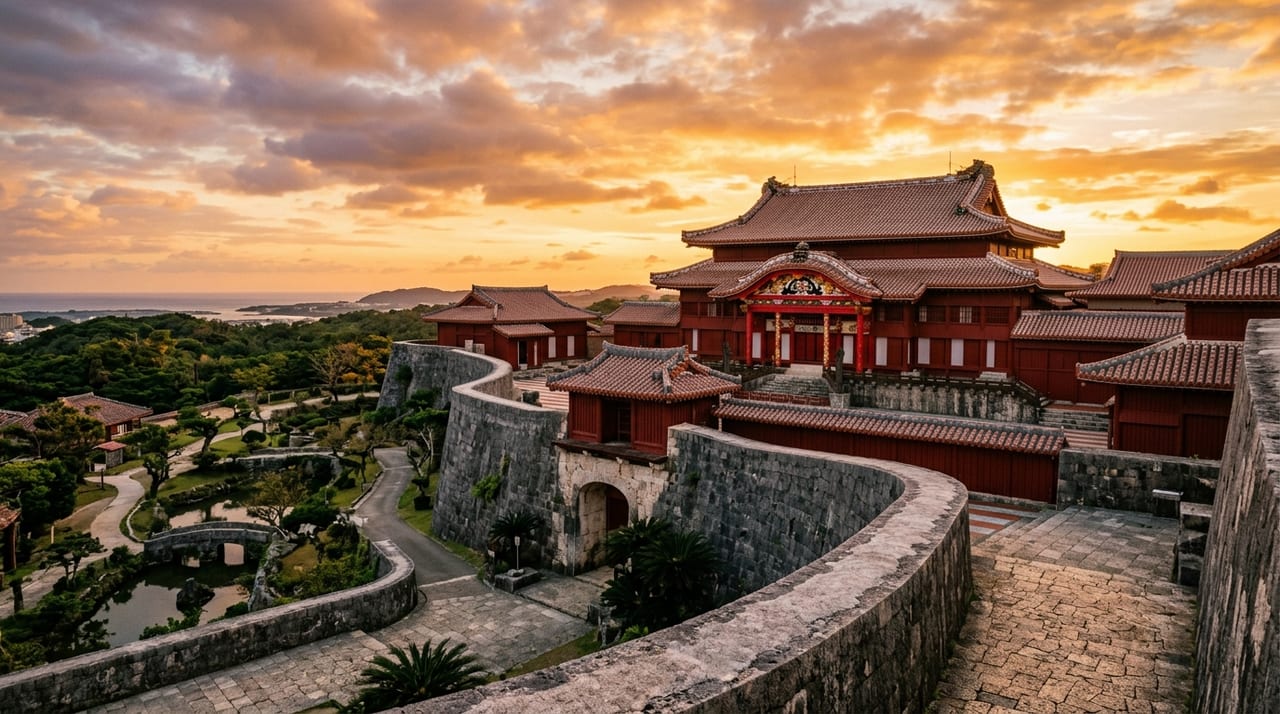
 * Image is for illustrative purposes only.
Akutagawasan Castle
芥川山城
Akutagawasan Castle is a historic castle in the Kansai region (Before 1516 (Eishō 13) to approximately 1573 (Tenshō 1), when it was abandoned). Its lord was Hosokawa Takakuni, Miyoshi Nagayoshi, Miyoshi Yoshioki, Wada Koremasa.
Overview
Overview and Location
Akutagawasan Castle (Akutagawa-sanjō, or Akutagawa Castle) is a Sengoku-period mountain castle located on Mt. Miyoshi (182 meters above sea level) in Takatsuki City, Osaka Prefecture. It is known as the largest castle remains in Settsu Province. The castle area extends approximately 500 meters east–west and 400 meters north–south, and it is a composite mountain castle made up of three blocks: the eastern enclosure group, the central enclosure group, and the western enclosure group. Situated on a natural stronghold enclosed on three sides by the deep gorge of the Akutagawa River, it functioned as a military and political base used as the residence of the ruler of Settsu Province. It was selected for the Zoku Nihon 100 Castles list (No. 159) in 2017, and in November 2022 it was designated a national historic site.
Construction and the Hosokawa Era
Akutagawasan Castle is said to have been built by Hosokawa Takakuni, shugo of Settsu Province, and is thought to have been completed before Eishō 13 (1516). It is said that "300 to 500 people were mobilized day and night" for its construction, suggesting that it was a hastily built castle that required a large investment of labor. Hosokawa Takakuni was a powerful figure who led the shogunate as kanrei, and Akutagawasan Castle was developed as a residence embodying that political power.
Afterward, Hosokawa Takakuni lost his struggle with Hosokawa Harumoto. In Tenbun 18 (1549), Miyoshi Nagayoshi, a retainer of Harumoto, defeated Harumoto's forces at the Battle of Eguchi and drove them out of the capital, and control of Settsu then shifted to the Miyoshi family.
The Era of Miyoshi Nagayoshi (1553–1560)
The most famous lord in the history of Akutagawasan Castle is Miyoshi Nagayoshi (1522–1564), the dominant figure of the Sengoku period. In Tenbun 22 (1553), Nagayoshi rose from a senior retainer of the Hosokawa family to the most powerful figure in Settsu. He made Akutagawasan Castle his base and ruled the Kinai region from here for about seven years.
Miyoshi Nagayoshi governed a vast domain that included Yamashiro, Kawachi, Settsu, and Izumi. Because his power even surpassed that of the Ashikaga shogunal house, recent research has also rated him as "Japan's first tenka-hito." Akutagawasan Castle functioned as the center of his political and military power. Remains of a building on foundation stones have been discovered in the summit main enclosure, showing its character as a residence with palace-like facilities on the summit.
In Eiroku 3 (1560), Nagayoshi moved his base to Iimoriyama Castle (Daitō and Shijōnawate, Osaka Prefecture), and his son Miyoshi Yoshioki entered Akutagawasan Castle. Yoshioki died suddenly at the age of 22 in Eiroku 6 (1563), and his father Nagayoshi also died in Eiroku 7 (1564).
Ashikaga Yoshiaki and Oda Nobunaga's Entry, and Luís Fróis's Visit
In Eiroku 11 (1568), when Oda Nobunaga marched to the capital in support of Ashikaga Yoshiaki, Miyoshi Nagayasu and others who were defending the castle abandoned it and fled. Ashikaga Yoshiaki entered Akutagawasan Castle and stayed there for 14 days. Afterward, Wada Koremasa became lord of the castle, and his retainer Takayama Hida-no-kami (father of Takayama Ukon) was entrusted with the castle. The Society of Jesus (Jesuit) missionary Luís Fróis was invited by Hida-no-kami on his way to the capital the following year, Eiroku 12 (1569), and received hospitality at the castle.
Koremasa moved to Takatsuki Castle the following year and was killed in the Battle of Shiraigawara in Genki 2 (1571). It is thought that the castle was abandoned in the early Tenshō years (around 1573).
Structure and Remains
The greatest feature of Akutagawasan Castle is the combination of advanced castle-building techniques of the late Sengoku period with a high level of cultural refinement. The major remains confirmed through archaeological investigation are as follows.
Remains of a building on foundation stones have been confirmed in the main enclosure. Regarding stone walls, stone wall remains, which are unusual for a mountain castle, have been confirmed at the main entrance (ōte koguchi) of the central enclosure group, and debate continues over whether they date from the era of Miyoshi Nagayoshi or from the time of later lords. Excavations have revealed, in addition to earthen ramparts and dry moat cuts (horikiri), an unusual layout in which the summit was developed as living and residential space. Its character as a device of political authority stands out more than its character as a simple military base.
The eastern, central, and western enclosure groups are arranged in terraces along the ridge, and the blocks are linked by dry moat cuts and earthen ramparts.
Current State and Highlights
The Akutagawasan Castle site is not a developed historic park. Much of the castle site is privately owned, and the remains survive in mountain woodland overgrown with trees. Earthen ramparts, dry moat cuts, and other remains survive in good condition, and the scale of the remains gives a tangible sense of the grandeur of the castle in the era of Miyoshi Nagayoshi. The Takatsuki City Shiroato History Museum holds a permanent exhibition on the results of the excavations and on Miyoshi Nagayoshi.
Since the national historic site designation in November 2022, development and surveys by Takatsuki City have accelerated, and the discovery of new remains is expected in the future. Access: from Takatsuki Station on the JR Tōkaidō Main Line, take the Takatsuki City Bus and get off at "Tsukawaki," then about a 30-minute walk.
Connection to Swords
The largest mountain castle in Settsu, which Miyoshi Nagayoshi ("Japan's first tenka-hito") used as his base for seven years.
Highlights
- National historic site (2022) · Zoku Nihon 100 Castles No. 159
- Base of Miyoshi Nagayoshi, the first tenka-hito of the Sengoku period (1553–1560)
- Largest castle remains in Settsu Province (500 m east–west, 400 m north–south)
- Stone wall remains at the ōte koguchi and foundation-stone building remains in the summit main enclosure
- Visit by Luís Fróis (1569) —— received hospitality from Takayama Hida-no-kami, who was in charge of the castle
* Opening hours and admission fees are subject to change. Please check the official website before visiting.