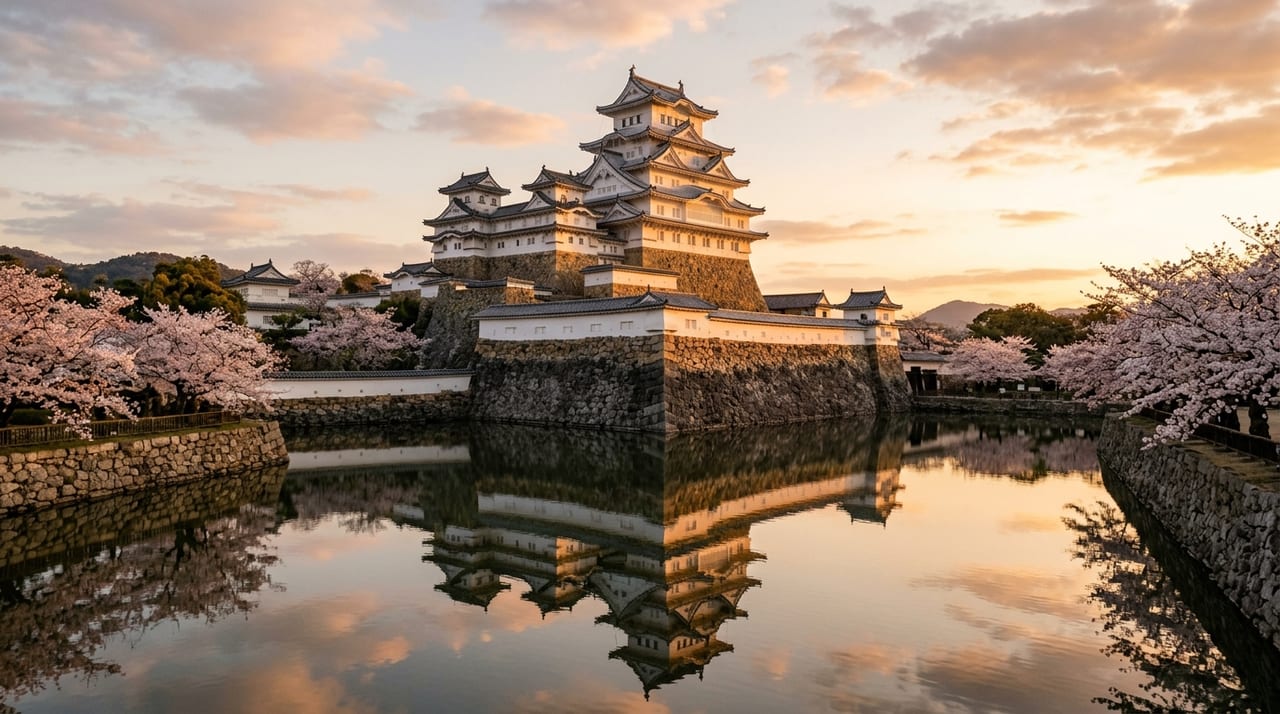
 * Image is for illustrative purposes only.
Shōryūji Castle
勝龍寺城
Shōryūji Castle is a historic castle in the Kansai region (First documented in 1457 (Kōshō 3); renovated by Hosokawa Fujitaka from 1568 (Eiroku 11)). Its lord was Hosokawa Fujitaka (Yūsai) / Akechi Mitsuhide.
Overview
The Castle
Shōryūji Castle is a flatland castle located in Nagaokakyō, Kyoto Prefecture. Built along the Saikoku Kaidō (former San'yō Road) in the southwestern part of Kyoto, it is a castle at a key transportation hub. It first appears in historical records from 1457 (Kōshō 3), but it was not fully developed as an early modern castle until 1568 (Eiroku 11), when Oda Nobunaga, escorting Ashikaga Yoshiaki on his entry into Kyoto, ordered Hosokawa Fujitaka (later known as Yūsai) to renovate the castle. Fujitaka served three generations, Nobunaga, Hideyoshi, and Ieyasu, and lived out his life as a rare figure who balanced the roles of warrior and cultivated man. As a successor of the Kokin-denju transmission, he left a major legacy in the protection of waka poetry and classical literature.
The Castle of Gracia
Shōryūji Castle is most widely known in Japanese history as the castle associated with Hosokawa Gracia (Tama). In 1578 (Tenshō 6), Hosokawa Tadaoki, the eldest son of Fujitaka, wed Tama, the daughter of Akechi Mitsuhide, and Tama spent the first few years of her married life in this castle. Gracia was known as a beautiful and intelligent woman; she later embraced Christianity and received the baptismal name Gracia (meaning "grace"). On the eve of the Battle of Sekigahara in 1600 (Keichō 5), when Western Army commander Ishida Mitsunari tried to take Gracia hostage, targeting the period when Tadaoki was away, Gracia ordered a retainer to kill her, and she took her own life with a fiery resolve. Her death is passed down in Japan's Christian history as a saintlike martyrdom, and even today it continues to be a subject of many works of art, literature, and theater.
Connection to the Battle of Yamazaki
Shōryūji Castle is also deeply linked to the Battle of Yamazaki (the Battle of Tennōzan) of 1582 (Tenshō 10). Akechi Mitsuhide, who had defeated Oda Nobunaga in the Honnōji Incident, was defeated at the Battle of Yamazaki within the same sixth month, due to Hashiba Hideyoshi's lightning-fast "Chūgoku Ōkaeshi" (return march from the Chūgoku region). The defeated Mitsuhide retreated to Shōryūji Castle, but that same night he escaped through the castle's north gate and died on the way to Sakamoto Castle. The historical fact that this castle became Mitsuhide's last stronghold gives Shōryūji Castle a special significance, directly connecting it to the Honnōji Incident, the greatest mystery in Japanese history. Furthermore, the 1578 (Tenshō 6) wedding of Hosokawa Tadaoki and Gracia was held in this very castle, and Shōryūji Castle captures the hearts of Japanese history enthusiasts as a castle where the greatest romance of the Sengoku period and its greatest mystery coexist.
Remains and Reconstruction of the Castle
The present-day Shōryūji Castle was developed in 1992 (Heisei 4), when the former honmaru (main enclosure) and other areas were established as "Shōryūji Castle Park," and replica turrets and other structures were built. The park's management building has an exhibition room, where the lives of Hosokawa Fujitaka, Tadaoki, Gracia, and Akechi Mitsuhide, along with excavated artifacts, are displayed. The Nagaokakyō Gracia Festival is held every November, with a procession reenacting Gracia's bridal procession. All of Nagaokakyō City has been developed as a place connected to Gracia, and a route for touring Gracia-related cultural heritage sites, visiting castle ruins, shrines, churches, and parks, welcomes visitors.
The Saikoku Kaidō Castle and the Culture of Southern Kyoto
The Saikoku Kaidō (Nagaokakyō), on which Shōryūji Castle sits, is one of the most important roads connecting Kyoto and Osaka; it is a historic route that many warlords and cultured figures traveled from ancient times through the medieval and early modern periods. Castles along this road always functioned as key political and military strongholds, and by having cultured daimyō like Fujitaka as their lords, they became crossroads of martial power and culture. The cultural legacy of Kokin-denju that Hosokawa Yūsai (Fujitaka) preserved and handed down still lives on at the heart of Japanese classical literature, symbolizing the deep bond between the castle and culture.
Connection to Swords
In discussing the sword culture of Shōryūji Castle, the figure of Hosokawa Fujitaka (Yūsai) is indispensable. From the Sengoku period into the early Edo period, Fujitaka was a rare warrior who highly fused outstanding martial ability with deep cultural refinement. As a successor of the Kokin-denju, Fujitaka was well versed in waka and classical literature. The swords Fujitaka collected have been passed down for generations as Hosokawa family treasures, and are now held in the Eisei Bunko Museum in Tokyo. The Hosokawa family collection at the Eisei Bunko Museum is known as a collection of the highest standard, including many swords designated as National Treasures and Important Cultural Properties, and it has become one of the treasure troves of sword art representative of Japan. Fujitaka's eldest son, Tadaoki (Sansai), is also known as a leading disciple of the tea master Sen no Rikyū, and he has left his name in tea history as one of the Rikyū Shichitetsu (Seven Disciples of Rikyū). The swords Tadaoki loved are works in which "the beauty of Japanese style" and "the power of martial arts" are integrated at a high level, embodying the Hosokawa family's aesthetic view that tea culture and the sword as a weapon lie on the extension of the same sense of beauty. Gracia herself had no direct connection to swords, but her dramatic life resonates deeply as embodying, in a different cultural context, the spirit of self-sacrifice and pride that the Japanese sword symbolizes as the "soul of the samurai." The fact that Akechi Mitsuhide, defeated at the Battle of Yamazaki, made this castle his last stronghold directly links Shōryūji Castle with the Honnōji Incident, the greatest mystery in Japanese history, and interest in the swords Mitsuhide is said to have favored has also grown in this context. By visiting together the Eisei Bunko Museum (Mejiro, Tokyo), which holds swords handed down in the Hosokawa family, and the exhibition room of Shōryūji Castle Park, one can most deeply understand the Hosokawa family's sword culture, which embodied a high-level integration of martial and literary arts.
Highlights
- Shōryūji Castle Park: a park connected to Hosokawa Gracia, with replica turrets and other structures set up on the former honmaru site, where water moats and earthen ramparts remain
- Exhibition room in the park management building: displays the lives of Hosokawa Fujitaka, Tadaoki, Gracia, and Akechi Mitsuhide, along with excavated artifacts
- Nagaokakyō Gracia Festival (November): an autumn festival in Nagaokakyō featuring a procession reenacting Gracia's bridal procession
- Eisei Bunko Museum (Mejiro, Tokyo): houses swords and artworks handed down in the Hosokawa family, a collection of the highest standard in Japan
- Yamazaki battlefield (Tennōzan): the aftermath of the Honnōji Incident, a historic site where Hideyoshi defeated Mitsuhide
- Kirishima azaleas at Nagaoka Tenmangū Shrine: a famous flower spot in Nagaokakyō City, a spectacular tunnel of deep crimson
* Opening hours and admission fees are subject to change. Please check the official website before visiting.