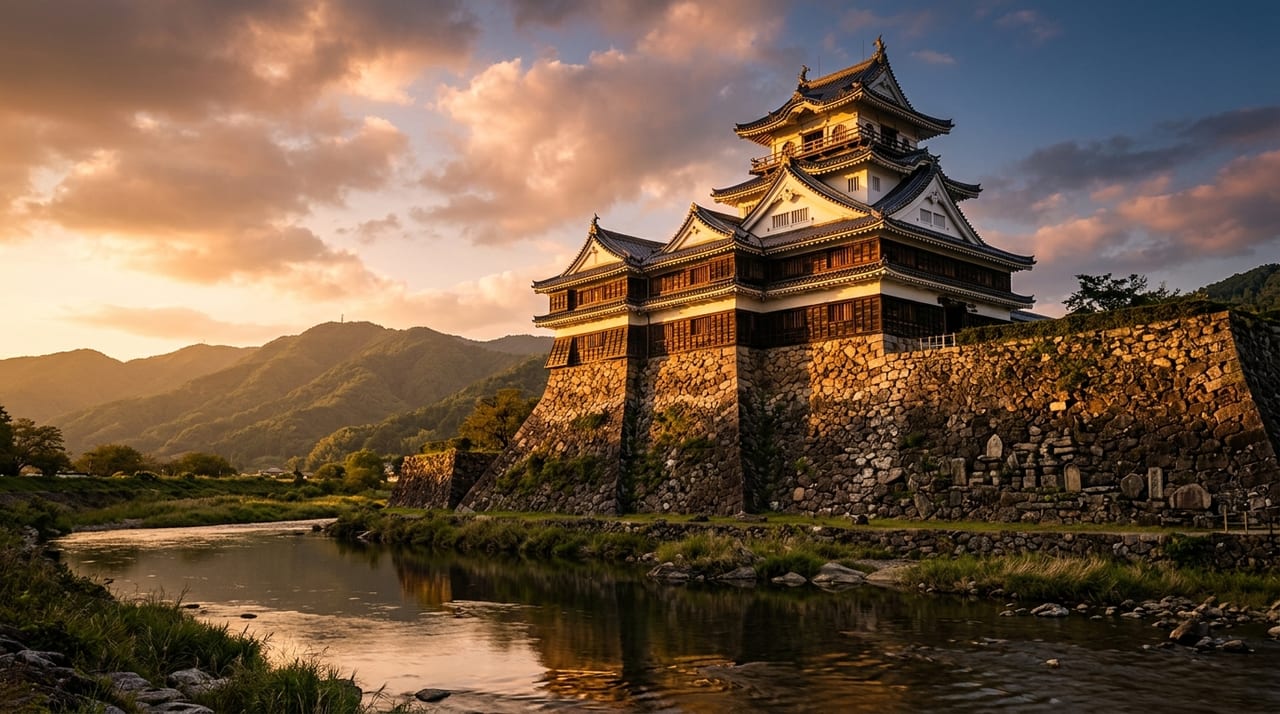
 * Image is for illustrative purposes only.
Fukuchiyama Castle
福知山城
Fukuchiyama Castle is a historic castle in the Kansai region (Built ca. 1579 (Tenshō 7)). Its lord was Akechi Mitsuhide.
Overview
About the Castle
Fukuchiyama Castle was built around Tenshō 7 (1579) by Akechi Mitsuhide, who had pacified Tanba Province. Acting on the orders of Oda Nobunaga, Mitsuhide spent several years pacifying the rugged mountain terrain of Tanba, and by Tenshō 7 he had brought all of Tanba under his control. As a reward for this service, Mitsuhide was entrusted with ruling Tanba as a single province. He attacked Yokoyama Castle, held by the local lord Shiomi, built a new castle on that site, and developed a castle town there as the base for ruling Tanba. This castle is the predecessor of Fukuchiyama Castle. Mitsuhide installed a three-story, four-level main tower here and developed it into an early modern castle. He also improved the low-lying wetlands along the Yura River below the castle and carried out flood control works, which greatly improved living conditions in the castle town.
Akechi Mitsuhide's Governance
Mitsuhide's rule of Fukuchiyama is said to have earned him high praise as a benevolent lord. Policies that emphasized civil administration, such as flood control works, are said to have been welcomed by the local people. Locally, Mitsuhide is still deeply revered as a benefactor of Fukuchiyama, and it is said that the lyrics of the Fukuchiyama Ondo, a dance held every summer, express gratitude toward Mitsuhide. This image of Mitsuhide as a civil administrator beloved by the people differs greatly from the one-sided image of him as the rebel who killed Nobunaga in the Honnōji Incident (1582), and it shows the many-sided true character of Mitsuhide as a warrior.
The Honnōji Incident and the Mystery of Mitsuhide
On the 2nd day of the 6th month of Tenshō 10 (1582), Mitsuhide made a surprise attack on Honnōji, where Nobunaga was staying on his way to attack Takamatsu Castle in Bitchū, and drove Nobunaga to take his own life. Mitsuhide turned his troops around under the command "The enemy is at Honnōji." Scholars have proposed several theories about his true intentions, including the theory of accumulated resentment, the theory of reviving the Ashikaga shogunate, the theory of ambition for supreme power, and the theory of conflict over policy toward Shikoku. The question remains one of the greatest mysteries of Japanese history, and researchers continue to debate it. Mitsuhide was defeated by Hashiba Hideyoshi at the Battle of Yamazaki, and while fleeing he is said to have been caught by ambushers and lost his life. However, the Mitsuhide = Tenkai theory, which holds that he actually survived and became the monk Tenkai Sōjō (Nankōbō Tenkai), also remains persistent.
Architecture and Structure
The stone walls of Fukuchiyama Castle are famous for their extensive use of repurposed stone (tenyōseki). Stone objects such as gorintō (five-ring pagodas) and hōkyōintō (treasure pagodas) were built into the castle walls without being reworked. This technique is not unusual in castles rapidly constructed in the Sengoku period. However, the repurposed stones at Fukuchiyama Castle are especially well known for their number and variety, and new ones are discovered each time an archaeological excavation is conducted. These repurposed stones are a valuable record of the actual state of castle wall construction at the time, and they also provide clues for exploring how stone was obtained and the religious beliefs of medieval society. The current main tower is a reconstructed tower rebuilt in Shōwa 61 (1986), and its interior is open to the public as a local history museum.
Sightseeing and Experiences
With the broadcast of the 2020 taiga drama "Kirin ga Kuru" (with Akechi Mitsuhide as the protagonist), many Mitsuhide fans visited the castle. To coincide with the broadcast, the "Fukuchiyama Mitsuhide Museum" was opened for a limited period of about one year within Fukuchiyama Castle Park, starting in January 2020.
Connection to Swords
The relationship between Akechi Mitsuhide and the sword is a particularly interesting subject of study among Oda Nobunaga's retainers. The army Mitsuhide commanded at the Honnōji Incident is said to have totaled as many as 13,000 men. After Mitsuhide's death, Fukuchiyama Castle changed hands among several castellans: Hashiba Hidekatsu, Sugihara Ietsugu, Onogi Shigekatsu, and Arima Toyouji. After the Battle of Sekigahara, Arima Toyouji established the domain, and it was then governed in succession by Okabe Nagamori, the Inaba family, and the Matsudaira (Fukōzu) family. From Kanbun 9 (1669) onward, the Kutsuki family governed Fukuchiyama Domain until the end of the Edo period. Machiya (townhouse) districts such as Kajimachi (Smiths' Quarter) were established in the castle town. The history of Mitsuhide and the Fukuchiyama domain is presented at the Fukuchiyama City Local History Museum inside the reconstructed tower. For sword enthusiasts, Fukuchiyama Castle provides an important context for discussing the history of the Japanese sword, as a castle ruled by Mitsuhide, who had the dual nature of both a rebel general and a benevolent lord.
Highlights
- Reconstructed castle tower (local history museum) — exhibits on Akechi Mitsuhide and the history of the Fukuchiyama domain, with detailed explanations of repurposed stones
- Repurposed stones in the main tower's stone walls — living proof of Sengoku-era castle construction, with gorintō and hōkyōintō built into the walls
- Yura River and castle-town scenery — the river where Mitsuhide carried out flood control works, and the historic townscape of the castle town
- Goryō Shrine — a shrine enshrining Mitsuhide, who is beloved by local residents
- Amanohashidate (about 40 minutes by car) — one of Japan's Three Scenic Views, an ideal combination with a castle visit for a day trip
* Opening hours and admission fees are subject to change. Please check the official website before visiting.